Scottish Airspace Modernisation: What it will mean for flight paths around Edinburgh and Glasgow airports?

6 min read

As part of a wider scheme to bring the UK airspace up to the standard required by modern aviation, two Scottish airports are undertaking a review of flight paths for arriving and departing traffic.
The project aims to reduce flight times, alleviate congestion, and mitigate harmful carbon dioxide emissions from aircraft, both in the vicinity of the two airports and across a wider area of Scotland.
Scottish Airspace Modernisation – the strategy
Scottish Airspace Modernisation is part of a nationwide upgrade to UK airspace – a process being driven by the UK Government’s Airspace Modernisation Strategy (AMS). Across the country, eighteen airports are developing Airspace Change Proposals to meet the objectives outlined by the Strategy.
Specifically in Scotland, airspace modernisation is being led by Edinburgh Airport, Glasgow Airport and NATS (National Air Traffic Services), the UK’s main provider of air traffic services.
Under the scheme, Edinburgh Airport (EDI) and Glasgow Airport (GLA) are responsible for redesigning the airspace up to 7,000ft (2,134m), including the modernisation of their departure and arrival routes.
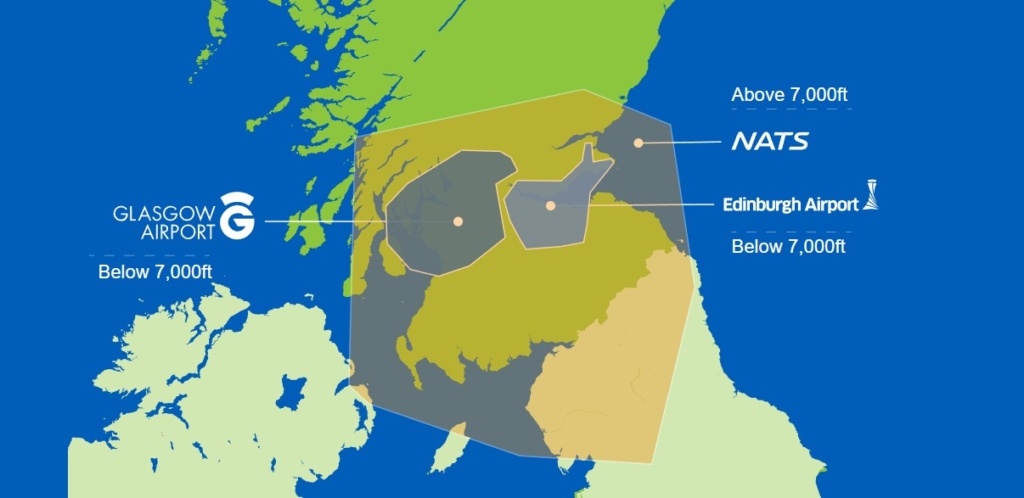
NATS, meanwhile, is responsible for connecting these routes into the wider UK airspace network above 7,000ft, known as en route airspace.
NATS says that systemised airspace will enable aircraft to fly more efficient flight profiles and make their routes more predictable.
This, in turn, will reduce the number of tactical interventions air traffic controllers need to make while reducing the times aircraft spend in holding patterns, ultimately reducing airborne delays.
The aims of the fligth path Modernisation plan
According to Scottish Airspace Modernisation documentation, Edinburgh Airport is proposing to change its arrival and departure routes to introduce Performance Based Navigation Technology (PBN).
Additionally, the airport plans to change the Controlled Airspace area for the airport to allow better use of the airspace over the River Forth, which would avoid aircraft flying over built-up communities around the city itself.
PBN is an aviation framework defining aircraft navigation requirements (accuracy, integrity, availability) for routes, rather than relying on ground-based aids, enabling more flexible, efficient, and precise flight paths using GPS or satellite technology and onboard systems such as RNAV/RNP.
PBN has been shown to improve safety, reduce fuel use, lower emissions, increase airspace capacity, and allow tailored procedures for noise abatement, replacing traditional, fixed routes with dynamic, performance-driven paths.
Edinburgh Airport handled 15.8 million passengers in 2024 (up 10% over 2023) and saw 120,000 movements during the year. 37 airlines serve 155 destinations from the airport, which has a single runway for arrivals and departures.
Meanwhile, Glasgow Airport is proposing to make changes to its own arrival and departure routes and introduce PBN technology. According to the airport, “This could provide an overall reduction in the total adverse effects on health and quality of life from noise, whilst also minimising delays and producing carbon savings.”
Like Edinburgh Airport, Glasgow Airport is also proposing to make changes to the Controlled Airspace (CAS) within the vicinity of the airport, and to reduce the number of flights flying over heavily populated areas, both during the day and at night.
The airport handled nine million passengers in 2024 (up 9.6% over 2023) and saw 78,000 movements during the year. 20 airlines serve over 100 destinations from the airport, which, like Edinburgh Airport, has a single runway for arrivals and departures.
Away from the two airports at the centre of the project, NATS is proposing to systemise the use of higher-level Scottish Airspace.
This will mean creating a structured route network where aircraft follow defined routes between their departing airport and a point of exit from UK airspace, or from the point of entry into UK airspace to their arrival airport. Again, these routes are being designed to smooth airspace flows while reducing congestion and emissions.
The benefits of Scottish Airspace Modernisation
According to NATS, there are various environmental and economic benefits available from the Scottish Airspace Modernisation project-
- 8,000 tonnes of carbon dioxide could be saved every year, the equivalent of the emissions from the power used by over 5,000 UK homes.
- More direct routes save 30 minutes of flying time per day- the equivalent of flying around the world 3.5 times each year.
- 6% fewer aircraft needing to hold at Edinburgh and Glasgow Airports, equating to over 7,000 flights a year. Optimised arrival routes will also reduce average holding times by more than 7% annually.
- Smarter airspace design reduces workload for pilots and air traffic controllers, supporting safe, efficient operations.
- Over 600NM3 of controlled airspace below 7,000ft will be released, improving airspace access for recreational flying and drone activity.
- Changes to where aircraft fly and potential improvements to climb and descent profiles help reduce the overall noise impact on surrounding communities.
Public consultation on flight paths closing soon
Full details on each of the Scottish airports’ proposals for airspace modernisation have been published by NATS and have also been sent to libraries and other public spaces throughout Scotland for public consultation.
This public consultation forms ‘Stage 3: Consult/Engage’, as set out in the Civil Aviation Authority’s 7-stage airspace change process (see below).
The official consultation period has been open since 20 October 2025 and will run to 25 January 2026 at 23:59 hrs. During these 14 weeks, the Scottish public has the chance to engage both online and in person with all three Scottish proposals – those from Edinburgh, Glasgow and NATS.
The need for airspace modernisation in the UK
According to NATS, the UK airspace network is one of the busiest and most complex in Europe, handling around a quarter of the continent’s air traffic despite having only 11% of its airspace. Today, more than 2.4 million aircraft fly through UK skies every year, carrying over 300 million passengers.
Yet, NATS says that the current system is outdated, and UK airspace requires critical updates to keep air traffic moving efficiently. Through modern technology and aircraft, and by creating a more efficient airspace design, NATS says it can reduce delays, improve safety and “deliver quicker, quieter and environmentally cleaner flights.”
To redesign the entire UK airspace network is an especially complex task, given that many airports share their airspace with neighbouring airports. A proposed change at one airport might have an impact on another nearby, and these effects need to be assessed and balanced.
To coordinate this, the Airspace Change Organisation Group (ACOG) has developed a masterplan, which is a coordinated implementation plan for airspace changes across the UK.
The ACOG was formed in 2019 under the direction of the UK Government Department for Transport (DfT) and Civil Aviation Authority (CAA), who co-sponsor and regulate airspace modernisation.
The Masterplan divides the programme into four clusters based on location: Scotland, Manchester and Northern England, Southwest England and Southeast England.
The Masterplan is organised into clusters so that the simpler changes can be deployed sooner, releasing benefits earlier. The timelines for making airspace changes are generally shorter for the simpler clusters, like the one for Scotland, where there are fewer large airports and less complex interdependencies.
Feature image: Yulia / stock.adobe.com