NASA’s X-59 breaks the sound barrier in quiet supersonic flight milestone

6 min read
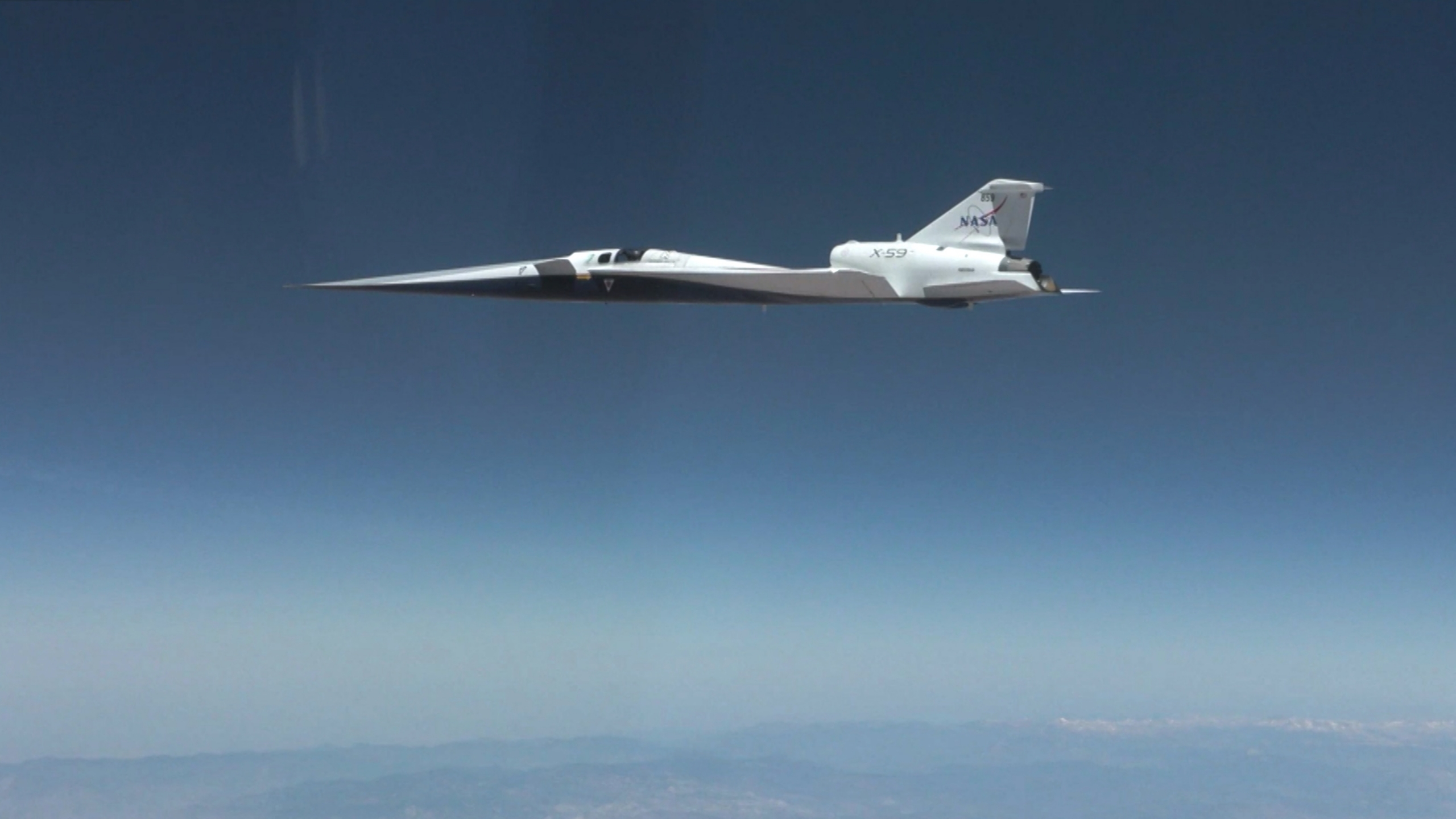
NASA’s X-59 experimental aircraft has flown faster than the speed of sound for the first time, reaching a milestone that could eventually reshape the future of commercial aviation.
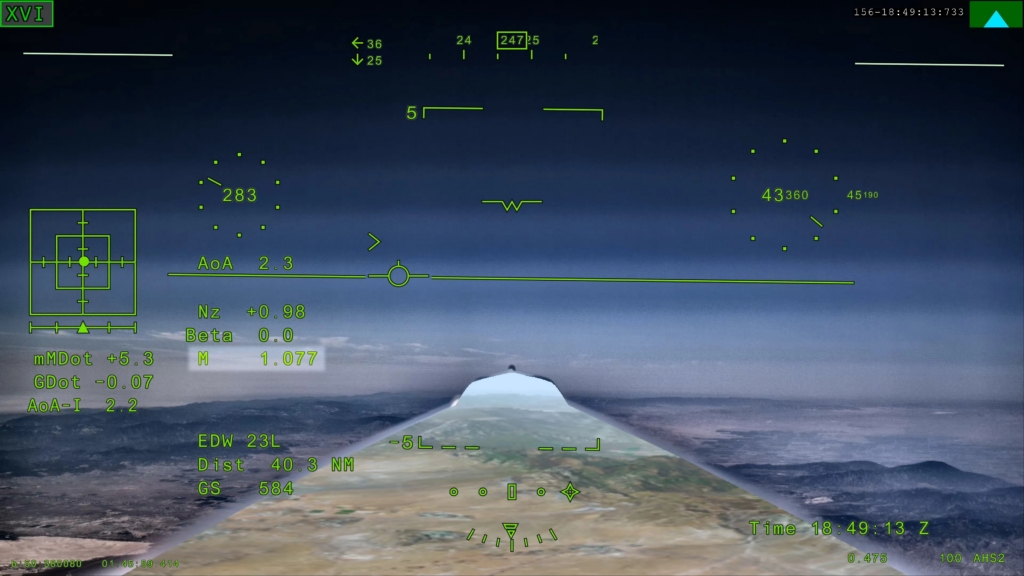
The aircraft exceeded Mach 1 during a test flight from Edwards Air Force Base in California on 5 June, marking the first time the X-59 entered the supersonic flight regime.
NASA test pilot Jim “Clue” Less took the aircraft to approximately Mach 1.1 and 43,400ft during an 81-minute sortie, advancing the agency’s long-running effort to prove that supersonic flight over land can be achieved without the disruptive sonic booms that ended the first generation of supersonic passenger travel.
The achievement is significant in its own right. Yet for NASA and Lockheed Martin’s Skunk Works team, it is only a stepping stone towards the mission that matters most: proving that an aircraft can travel faster than sound while producing little more than a muted thump on the ground.
That objective lies at the heart of NASA’s Quesst mission and the X-59 programme.
Why the sonic boom became the biggest obstacle to supersonic travel
For decades, the dream of routine supersonic passenger travel has been constrained by a problem that engineers could never fully solve.
When an aircraft travels faster than sound, it generates shock waves that merge into a sonic boom. On the ground, the effect can sound like an explosion or thunderclap.
Public complaints about sonic booms became widespread during supersonic testing programmes in the 1960s, ultimately leading regulators to prohibit commercial supersonic flight over land in many countries.
That restriction severely limited the economics of aircraft such as Concorde.

Although Concorde demonstrated that passengers were willing to pay for speed, the aircraft was largely confined to oceanic routes because of noise regulations.
The inability to fly supersonically over populated land masses removed many of the routes that could have made large-scale supersonic travel commercially viable.
More than two decades after Concorde’s retirement, that challenge remains one of aviation’s biggest unsolved problems. The X-59 was created specifically to address it.
How NASA’s X-59 turns sonic booms into a quiet thump
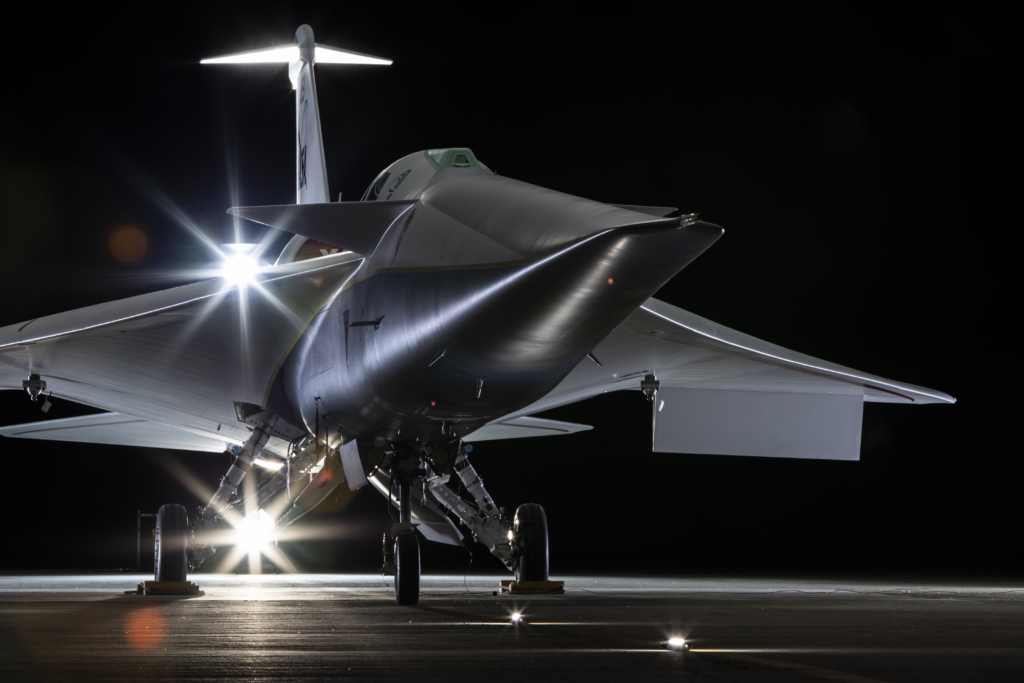
At nearly 100ft long but only 29.5ft wide, the X-59 looks unlike any other aircraft currently flying. Its most striking feature is an extremely elongated nose that stretches almost a third of the aircraft’s overall length.
The shape is deliberate.
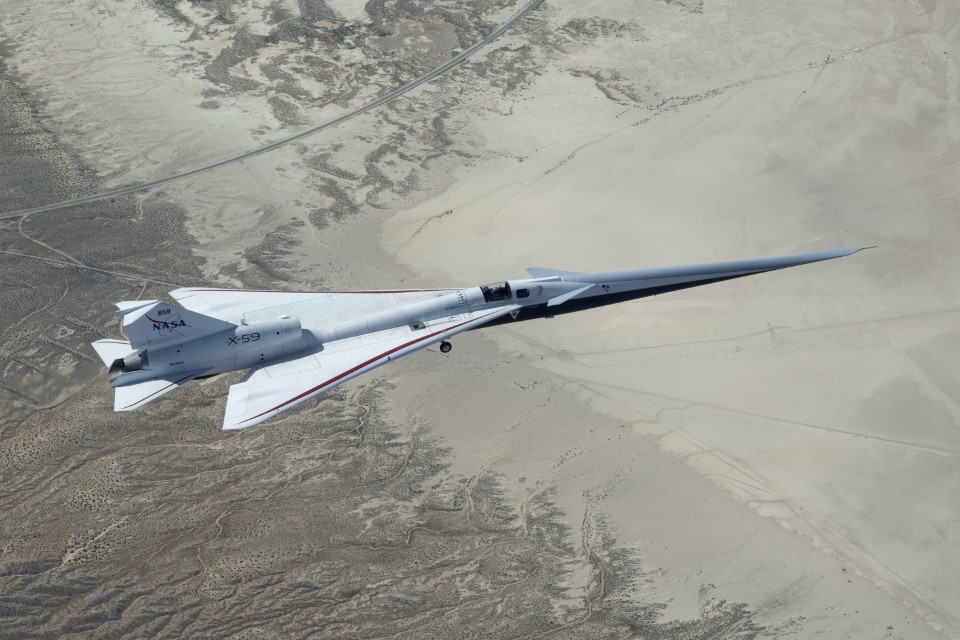
Rather than allowing shock waves to combine into a conventional sonic boom, engineers designed the aircraft to spread and reshape those shock waves before they reach the ground.
The result is what NASA describes as a “quiet thump” rather than the traditional N-wave boom associated with supersonic flight.
According to Lockheed Martin, the aircraft is designed to generate a sound level below 75 perceived decibels, roughly comparable to the sound of a car door closing rather than the sharp crack normally associated with supersonic flight.
The aircraft is powered by a single F414-GE-100 engine and is designed to cruise at Mach 1.4, approximately 925mph, at an altitude of 55,000ft.
Unlike commercial aircraft programmes, however, the X-59 is not intended to carry passengers. Its mission is to collect data.
X-59 community overflights could shape supersonic noise rules
The real purpose of the X-59 extends beyond aerodynamics.
NASA intends to fly the aircraft over communities across the United States and collect public response data. Researchers want to understand how people perceive the aircraft’s reduced noise signature and whether the sound is considered acceptable for routine operations.
That information will then be shared with US and international regulators as they consider future noise standards for supersonic aircraft.

“The X-59 will be used to collect community response data on the acceptability of a quiet sonic boom generated by the unique design of the aircraft,” Lockheed Martin said. The data, it added, will help establish “an acceptable commercial supersonic noise standard to lift the ban on commercial supersonic travel over land.”
If regulators are convinced, the implications could be substantial.
Flights that currently take six or seven hours could potentially be cut in half, opening new possibilities for airlines and aircraft manufacturers.
“This breakthrough would open the door to an entirely new global market for aircraft manufacturers, enabling passengers to travel anywhere in the world in half the time it takes today,” Lockheed Martin said.
NASA X-59 targets Mach 1.4 after first supersonic flight
NASA’s latest flight marks the beginning of a more ambitious phase of testing.
The aircraft has already completed a series of envelope-expansion flights designed to evaluate handling characteristics, systems performance and overall airworthiness.
Since returning to flight testing in March, the X-59 has steadily expanded its operating envelope, reaching altitudes above 43,000ft and speeds approaching Mach 1 before crossing the supersonic threshold.
NASA Administrator Jared Isaacman described the milestone as an important step towards the programme’s next objectives.
“Since the aircraft’s first flight on Oct. 28, 2025, the team has made tremendous progress, flying 16 times in the last 90 days and getting into a steady test rhythm. In the coming days, we expect to take the next step and push to Mach 1.4,” Isaacman said.
A forthcoming “mission conditions” flight will see the aircraft attempt to reach its target cruise condition of Mach 1.4 at approximately 55,000ft. Those parameters are considered critical because they replicate the conditions the aircraft will use during future community overflight campaigns.
Ultimately, the aircraft is expected to reach a maximum speed of Mach 1.6 and an altitude of 60,000ft during the test programme.
The aircraft that could influence the next generation of supersonic airliners
The X-59 arrives at a time when interest in supersonic travel is returning.
Several companies are pursuing new high-speed aircraft concepts, convinced that advances in materials, propulsion and aerodynamics can succeed where earlier programmes struggled. Yet all face the same challenge that limited Concorde: the sonic boom.
That is why the X-59 matters beyond NASA’s research agenda.
The aircraft is effectively a flying experiment designed to answer a question that has frustrated engineers and regulators for more than half a century. Can supersonic aircraft operate over land without disturbing the people below?
The first supersonic flight does not answer that question. But it moves NASA one step closer.
If the aircraft performs as expected in the months ahead, the data gathered by the X-59 could help shape future regulations and provide manufacturers with the confidence to pursue a new generation of quiet supersonic airliners.
“The X-59’s first supersonic flight is a testament to America’s enduring leadership in science, engineering, and aerospace innovation,” said Michael Kratsios, Assistant to the President for Science and Technology and Director of the Office of Science and Technology Policy.
For now, the aircraft’s greatest achievement may simply be proving that the next chapter in supersonic aviation is no longer confined to the drawing board. It is already flying.
Featured image: NASA