World’s largest electric aircraft cleared for first flight as Heart Aerospace secures FAA approval

4 min read

Heart Aerospace is preparing to take the world’s largest electric aircraft into the air after the US regulator authorised flight testing of the X1 demonstrator, moving the programme from ground testing to its most critical phase yet.
The US Federal Aviation Administration (FAA) has issued a Special Airworthiness Certificate in the Experimental Category (SAC-EC) for the X1 demonstrator, allowing the aircraft to begin flight testing from Plattsburgh International Airport in upstate New York following more than a year of regulatory engagement and an extensive ground-test campaign.
The certificate follows an FAA inspection of the aircraft, its supporting technical documentation and Heart’s proposed flight-test programme.
Before receiving approval, the X1 completed structural, propulsion and systems testing, together with low- and high-speed taxi trials that demonstrated its readiness for piloted flight.
The approval moves the programme from ground validation to airborne testing, where engineers will begin gathering flight data needed to support development of the ES-30, the company’s planned 30-seat hybrid-electric regional aircraft.
The X1 demonstrator will validate technologies for Heart Aerospace’s hybrid-electric ES-30 regional aircraft
With a wingspan of 106 ft, a fuselage measuring 76 ft and a maximum take-off weight of more than 25,000 lb, the X1 is expected to become the largest electric aircraft ever flown.
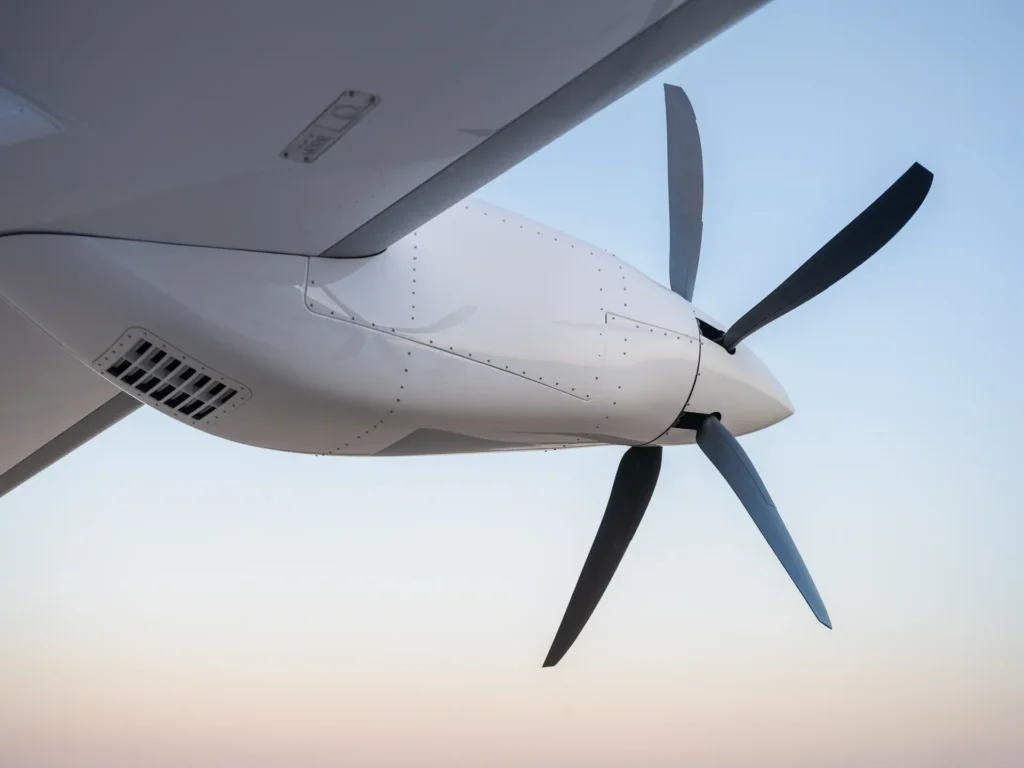
The aircraft was developed as a full-scale flying demonstrator rather than a prototype intended for commercial service. Its role is to validate flight characteristics, evaluate key aircraft systems and generate operational data before those technologies are incorporated into the ES-30 production aircraft.
Unlike the X1, which relies entirely on electric propulsion, the ES-30 has been designed as a hybrid-electric regional airliner capable of operating on battery power for shorter routes while using an independent parallel hybrid-electric propulsion system to extend its range.
Current plans call for the aircraft to fly up to 125 miles on battery power alone and up to 500 miles using hybrid propulsion, allowing operators to serve regional networks while reducing fuel burn and emissions on shorter sectors.
Anders Forslund, founder and chief executive of Heart Aerospace, said the regulatory approval represented the programme’s most important milestone to date.
“Earning FAA flight authorisation brings the X1 programme to the threshold of first flight. This achievement reflects the rigour of the work completed by Heart’s engineering and flight-test teams, as well as the close working relationship we have built with the FAA.”
He added: “With our certificate now in hand, our full focus is on flight. We are ready to get X1 in the air.”
Flight testing shifts the programme from engineering development to gathering operational data
The X1 was first unveiled in Sweden in 2024 before Heart Aerospace relocated its headquarters from Gothenburg to Los Angeles, transferring flight-test activities to the United States as the programme entered its next development phase.

The upcoming flight-test campaign will provide engineers with real-world performance data covering aircraft handling, propulsion, flight controls and systems integration. Those results will be used to refine the ES-30 design and support future certification activities.
Cole Randle, Head of Corporate Affairs at Heart Aerospace, said continued cooperation with the FAA would remain central to the programme.
“The agency’s forward-looking approach to next-generation aircraft is accelerating commercial aviation’s entry into the electric era of flight while supporting Heart’s mission to lower the cost of air travel,” Randle said.
He added that the company looked forward to continuing work with the regulator as development of the ES-30 progresses towards certification.
Regional aviation remains a key focus for electric aircraft developers
Heart Aerospace is among several manufacturers pursuing electric and hybrid-electric aircraft for regional aviation, where shorter sectors and lower passenger capacities are considered more suitable for alternative propulsion technologies than larger long-haul aircraft.

Rather than targeting narrowbody replacement programmes, companies such as Heart are focusing on regional routes where lower operating costs and reduced emissions could improve the economics of connecting smaller communities.
The ES-30 is intended to carry 30 passengers and has attracted commitments from several airlines and leasing companies. Heart says its order pipeline now exceeds US$9 billion, including agreements involving carriers such as United Airlines and Air Canada.
When is the commercial certification of the ES-30 expected?
Commercial certification of the ES-30 is currently targeted for 2031, making the X1 flight-test programme an important step towards demonstrating the technologies needed for the production aircraft.
Heart’s progress also comes as larger aerospace manufacturers continue investing in hybrid-electric technologies for future regional aircraft.
At the Farnborough International Airshow, Airbus outlined progress on its Large Scale Integration Demonstrator of Hybrid Electrical Architecture (LEIA) programme, which brings together 25 industry and research partners under the Clean Aviation Joint Undertaking to develop the electrical systems, batteries, power electronics and energy management technologies needed for future hybrid-electric aircraft.
Rather than focusing on a single aircraft, the programme is aimed at integrating these technologies at aircraft level and validating how they work together in preparation for future commercial applications.
Against that backdrop, Heart Aerospace’s X1 programme represents another important stage in the industry’s broader shift from laboratory development to flight testing.
While certification of hybrid-electric regional aircraft remains several years away, the FAA’s approval allows Heart to begin collecting the flight data needed to mature both the aircraft and the technologies that could underpin a new generation of lower-emission regional aviation.
Sign up for our newsletter and get our latest content in your inbox.


More from


October 17, 20264 min read