


Emirates invests in AI to predict and avoid turbulence

5 min read
Emirates is employing a data-driven strategy to reduce unexpected severe turbulence across its network, integrating artificial intelligence, machine learning, and real-time global data feeds to make flights smoother and safer.
The airline’s multi-layered approach combines several complementary systems — including SkyPath, Lufthansa Systems’ Lido mPilot, and IATA’s Turbulence Aware — to give pilots real-time turbulence information directly in the cockpit. Emirates claims the initiative, launched last year, has already led to a significant reduction in severe turbulence incidents.
Captain Hassan Alhammadi, Divisional Senior Vice President, Flight Operations at Emirates, said the airline aims to reduce the likelihood of unexpected turbulence.
“We’re committed to doing everything possible to minimise unexpected severe turbulence encounters through working with partners who share our vision of using advanced technologies and adopting AI to enhance operations,” he said. “While we cannot promise turbulence-free flights, these initiatives have contributed to a significant reduction in unexpected severe turbulence incidents over the past year.”
How Emirates’ turbulence avoidance system works
Emirates’ turbulence-mitigation strategy integrates three distinct but complementary platforms designed to predict, detect, and share turbulence data globally.
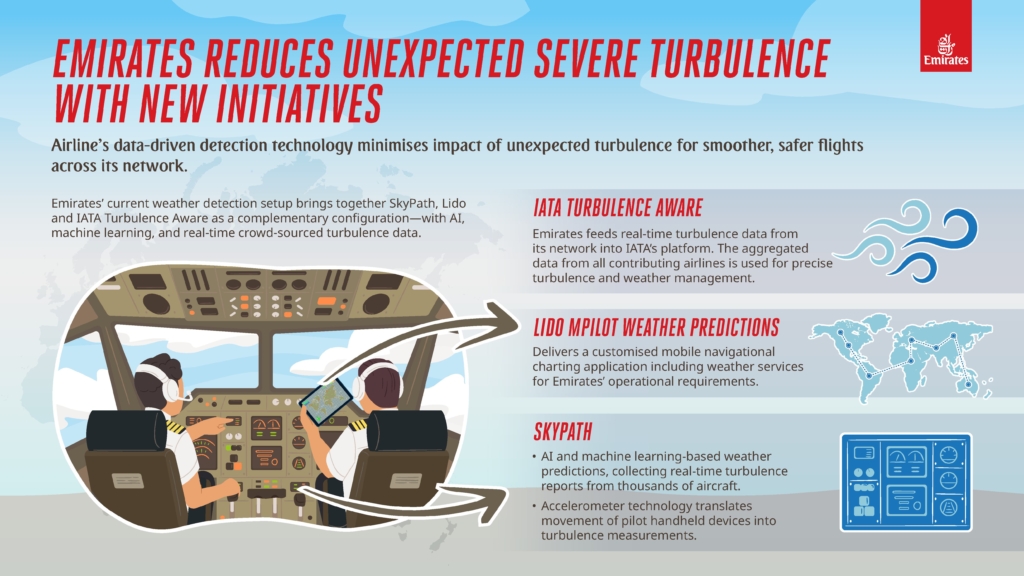
SkyPath, an AI and machine-learning platform, analyses live data from thousands of aircraft to detect turbulence invisible to traditional weather radar, including clear-air turbulence. It processes Eddy Dissipation Rate (EDR) measurements — a universal metric for turbulence intensity — alongside Automatic Dependent Surveillance–Broadcast (ADS-B) data and accelerometer readings from iPads used by flight crews.
Lido mPilot, developed by Lufthansa Systems, provides high-resolution weather and turbulence forecasts through a mobile app used by Emirates pilots. The app incorporates live data from the German Weather Service and includes cloud, convection, icing, and turbulence overlays for flight planning and real-time updates. Lufthansa Systems’ latest version of Lido mPilot now includes 12-hour turbulence and icing forecasts to improve flight safety.
IATA Turbulence Aware is the International Air Transport Association’s data-sharing platform, which aggregates real-time turbulence reports from airlines worldwide. Emirates joined the programme in 2024, contributing data from its flights across the Middle East, Africa, Asia, and Australia. That data feeds into a global turbulence map accessible to all participating carriers, improving situational awareness across the industry.
By integrating these systems into its electronic flight bag (EFB), Emirates provides pilots with live turbulence visualisations, enabling dynamic route and altitude adjustments that improve comfort, safety, and fuel efficiency.
Turbulence is an industry-wide challenge
Turbulence remains one of aviation’s most persistent operational challenges. Although usually harmless to aircraft structure, severe and unexpected turbulence is a leading cause of in-flight injuries among passengers and crew.
The challenge has grown more complex as the frequency and intensity of turbulence increase — particularly “clear-air turbulence,” which occurs without visible weather cues and cannot be detected by radar. Scientists link this phenomenon to changing jet streams and atmospheric instability associated with climate change.

According to IATA, real-time data sharing between airlines is improving predictive accuracy, but forecasting remains imperfect. Each additional aircraft reporting EDR data enhances the network’s coverage and resolution, helping to close long-standing gaps in regions such as Africa and the South Pacific.
Global data collaboration helps airlines anticipate turbulence
IATA Turbulence Aware now has dozens of major carriers contributing live flight data. As this growing dataset becomes available, pilots and dispatchers will be able to make better and more informed decisions, potentially saving fuel and reducing emissions.
“By leveraging real-time turbulence data, airlines can avoid unnecessary altitude changes, helping optimise flight levels and cut fuel burn,” IATA said in a recent statement.
Other participants in the programme include Delta Air Lines, United Airlines, Qantas, and EVA Air, which joined earlier this year. The programme now receives data from 28 airlines across 2,800 aircraft, feeding live reports. “In the first six months of 2025, airlines participating in Turbulence Aware generated 24.8 million turbulence reports, a significant 23% increase over the same period in 2024,” IATA stated.
Emirates’ data-layered approach to turbulence monitoring
Emirates’ approach is unique in that it uses predictive and real-time systems simultaneously, utilising AI-driven modelling and fleet-sourced sensor data. Using SkyPath’s predictive algorithms, Lido’s forecast maps, and IATA’s global EDR database, the airline can predict turbulence in areas previously beyond radar or satellite.

The SkyPath platform’s unique use of iPad accelerometers enables aircraft to act as moving sensors, transmitting turbulence-intensity data even in low-traffic regions. This capability provides near-global coverage and contributes directly to the IATA Turbulence Aware network.
Benefits beyond passenger comfort
While the most visible effect of Emirates’ strategy is a smoother ride for passengers, the airline says the benefits extend deeper into operations. By avoiding unexpected turbulence, crews can better protect service staff, reduce wear and tear on aircraft interiors, and avoid costly diversions or maintenance inspections triggered by turbulence events.
There are also sustainability gains. Avoiding sudden altitude changes or speed adjustments saves fuel, and fewer turbulence-induced delays or route changes mean more efficient scheduling. IATA estimates that real-time turbulence data sharing can improve fuel efficiency by up to 2%, translating to meaningful carbon savings across a global fleet.
The limits of turbulence prediction
Even with advanced AI systems, turbulence forecasting remains a complex science. Factors such as vertical wind shear, atmospheric instability, and micro-scale jet-stream variations can shift within minutes.
The advanced tools airlines are adopting will reduce exposure to turbulence. However, as Emirates notes in its announcement, “turbulence remains an ongoing challenge that cannot be completely eliminated.”
Next-Gen turbulence management
The next generation of turbulence-avoidance technology may go beyond data-sharing. Researchers have been flight-testing forward-looking sensors—including UV Rayleigh lidar systems—that can detect air-density fluctuations ahead of the aircraft. Demonstrated detection ranges of 5–10 km translate to roughly 20–40 seconds of warning at cruise, while other forward-sensing experiments report ~60–80 seconds of warning time under test conditions. Those few seconds of early warning would help pilots alert the cabin crew of the danger ahead.
Emirates’ approach represents one of the most advanced operational deployments of turbulence technology. With machine learning, global data collaboration, and pilot-focused tools, the airline may not eliminate turbulence, but it is significantly reducing unpleasant surprises and improving flight safety.
Featured Image: Emirates


