Cleared for take-off in India: Embraer E-Jets certified by DGCA

3 min read

India’s Directorate General of Civil Aviation (DGCA) has certified Embraer’s E-Jet family for commercial operations.
The DGCA’s certification covers multiple aircraft from Embraer’s E-Jets family, including the E190, E195 and the E195-E2.
India’s certification follows the certification of Embraer’s E-Jets family by the Federal Aviation Administration (FAA) in the US, the European Union Aviation Safety Agency (EASA), and Brazil’s National Civil Aviation Agency (ANAC), which granted type certification in 2018 and 2019, respectively.
The Brazilian manufacturer’s E175 is already type certified for operations in India.
Why DGCA certification of Embraer’s E-Jet matters
Welcoming the DGCA’s type certification, Raul Billaron, Senior Vice President Sales & Marketing, Head of Region Asia Pacific, Commercial Aviation, said: “With remarkable performance, economics and passenger comfort, Embraer’s E-Jets are set to reshape regional aviation in India and support the Indian government’s UDAN vision.”

Ude Desh ka Aam Nagrik (UDAN) is the regional connectivity scheme launched by India’s Ministry of Civil Aviation in 2016. It aims to make air travel affordable and accessible to those in smaller towns and cities, not just major hubs. UDAN routes are typically shorter and serve small regional airports, so smaller regional jets and turboprops (like Embraer’s E-Jets) are best suited to these routes rather than large narrowbody types.
“The E-Jets offer enhanced range of up to seven hours and performance capabilities to operate from challenging airports with short runways or low pavement strength,” said Adity Shekhar, Regional Vice President, Sales, Embraer.
He also noted the certification will enable the Brazilian manufacturer to “support airlines expanding their networks and opening unique routes by tapping into ‘blue ocean’ opportunities that are too small for a large narrowbody or too far for a turboprop.”
One of the most successful aircraft programmes in commercial aviation
With more than 1,900 deliveries and more than 80 airlines in 50 countries globally operating aircraft from the E-Jets family, it has been a hugely successful programme in commercial aviation. In particular, the E195-E2 has low operating costs and is the most fuel-efficient aircraft in the skies today. It features a modern, comfortable cabin with 2×2 seating, no middle seats, and large overhead bins.
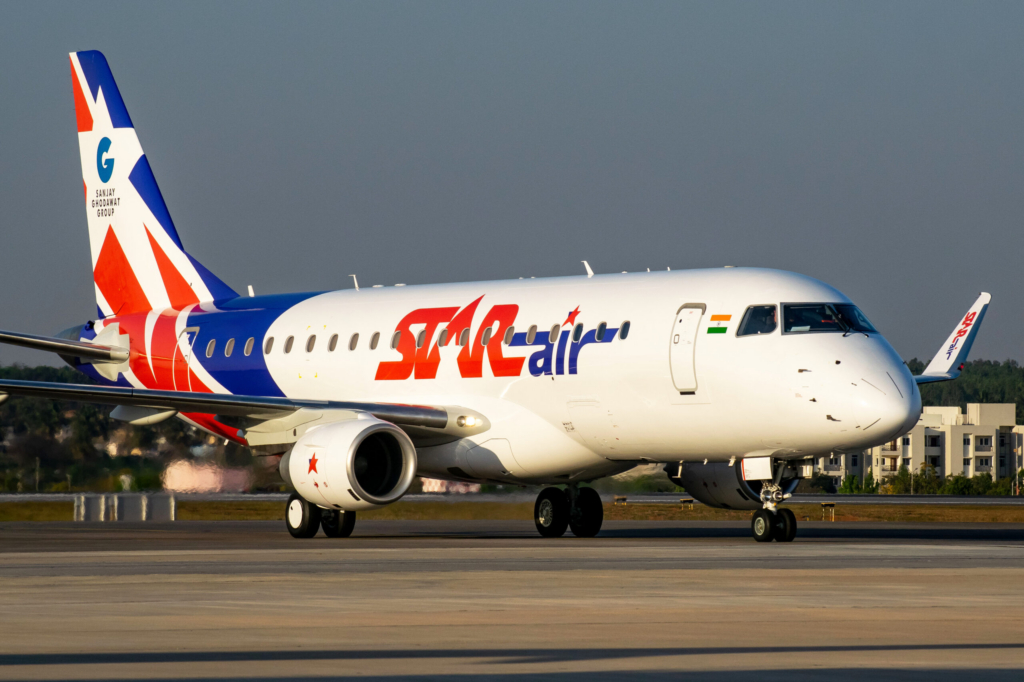
Embraer’s E175 is already type-certified for India and is operated by Star Air. Based in Bengaluru, Star Air is a regional carrier operating under India’s UDAN scheme with a fleet of around 11 E175 and ERJ145 regional jets. It is focused on serving smaller Tier 2 and Tier 3 cities that lack service from larger carriers.

In February of this year, the aerospace and defence arm of Adani Group, one of India’s largest business conglomerates, confirmed an agreement with Embraer aimed at establishing a Final Assembly Line (FAL) for the E175 regional jet. The agreement is aligned with India’s Regional Transport Aircraft (RTA) programme, which aims to boost domestic manufacturing of regional aircraft rather than relying solely on imports.
Embraer eyes growth in India
With nearly 50 aircraft across 11 models distributed across India, Embraer has its sights set on expanding its footprint in the country across the commercial, business and defence sectors.
Despite recent volatility in the aerospace sector, India remains recognised as one of the fastest-growing markets globally. IATA data from late 2025 suggests that domestic traffic soared by 7.7% year-on-year, with capacity up 8.7% and load factors at around 88.5%. Growth in international air traffic has slowed in the first few months of 2026 due to airspace disruptions in the Middle East and fuel-cost pressure. However, May saw a rebound in passenger traffic with 15.3 million passengers transported (a 9.49% yoy increase).