Embraer expands European C-390 training network with new simulators for Sweden and Austria

4 min read

Embraer is expanding the support infrastructure behind its growing European C-390 Millennium fleet after announcing a new package of advanced training systems for the air forces of Sweden and Austria, strengthening a common training ecosystem as more NATO nations introduce the tactical transport aircraft into service.
Announced on the opening day of the Farnborough International Airshow, the agreement will see Sweden receive a comprehensive training package comprising a Level D Full Flight Simulator (FFS), a Cargo Handling Station Trainer (CHST) developed with Rheinmetall, and a Computer-Based Training (CBT) solution produced with ETI. Austria will receive a Computer-Based Training system to support aircrew and maintenance training.
The training devices are intended for pilots, loadmasters, aircrew and maintenance personnel, providing realistic digital environments designed to improve operational readiness while reducing dependence on aircraft for routine instruction.
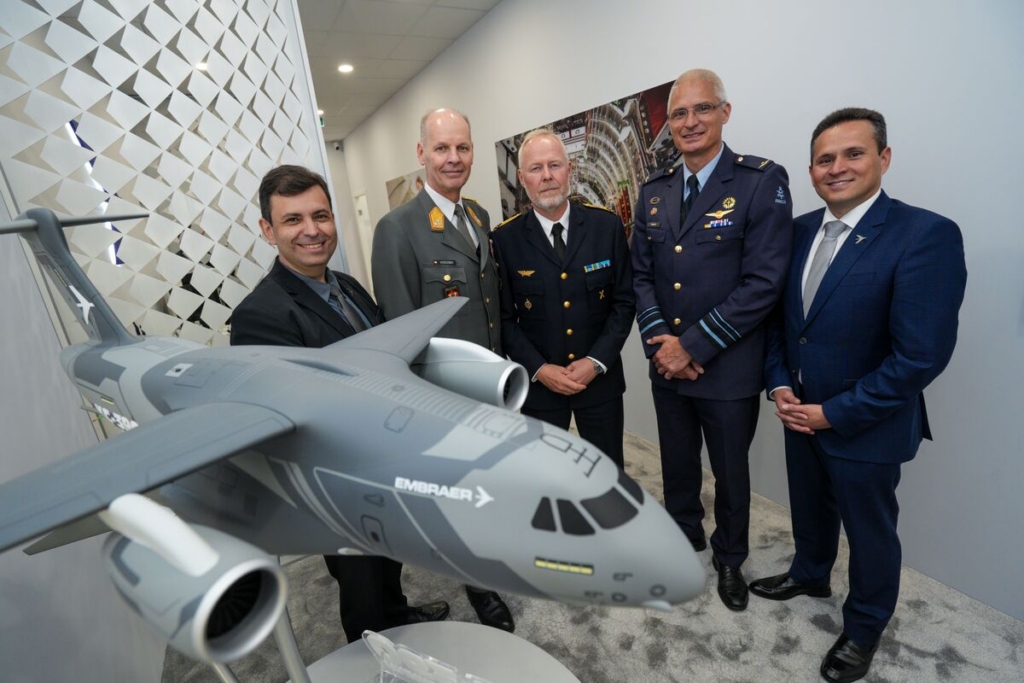
Carlos Naufel, President and CEO of Embraer Services & Support, said the package reflected the company’s long-term commitment to operators of the C-390 in Europe.
“Delivering advanced training capabilities to our European C-390 Millennium operators reinforces Embraer’s commitment to mission readiness and operational excellence over the long term. Together with our partners, we are building a comprehensive training ecosystem that enables Sweden and Austria to maximise the C-390 Millennium’s capabilities, while strengthening their interoperability and commonality.”
Training capability grows alongside Europe’s expanding C-390 fleet
The announcement marks another step in Embraer’s strategy of developing not only the aircraft but also the training and sustainment infrastructure required to support a growing number of European operators.
Sweden selected the C-390 Millennium to replace its ageing C-130 Hercules fleet and is procuring four aircraft through a joint acquisition with the Netherlands and Austria, allowing faster deliveries under an existing contract.
The Swedish government said the collaborative procurement would reduce costs while accelerating the replacement of aircraft that have served for more than six decades.

Earlier this year, Sweden formally signed for the aircraft, with the first C-390 expected to enter service by the end of 2027. Swedish defence officials have said the new transport aircraft will provide the country’s long-term tactical airlift capability while improving its ability to deploy personnel and equipment nationally and internationally.
Austria is acquiring the aircraft through the same multinational procurement programme, creating opportunities for shared training, logistics and long-term support between operators.
Simulators are designed to replicate operational missions and emergency scenarios
The centrepiece of the Swedish package is a Full Flight Simulator designed to achieve Level D qualification, the highest certification standard for civil and military flight simulators.
According to Embraer, the simulator will enable crews to train in normal, abnormal and emergency situations while also supporting military mission profiles. The system incorporates more than 350 simulated malfunctions, allowing pilots to rehearse failures and emergency procedures without affecting aircraft availability.
The Cargo Handling Station Trainer is intended for loadmaster instruction and cargo operations. Developed with Rheinmetall, it uses advanced visualisation technology to recreate both the aircraft’s cargo compartment and the external operating environment, enabling crews to practise loading procedures and mission preparation in a virtual setting.

The Computer-Based Training package provides theoretical instruction for pilots, loadmasters, additional crew members and maintenance personnel through a SCORM-compatible learning management system that supports flexible classroom and remote training.
European operators continue to strengthen common C-390 capability
The latest training announcement comes as the C-390 continues to gain momentum across Europe.
Last week, Embraer delivered the first C-390 Millennium to the Czech Air Force, only 20 months after the acquisition contract was signed, adding another European operator to the programme. The aircraft is intended to support tactical airlift, humanitarian assistance and NATO operations.
The growing European fleet now includes Portugal, Hungary, the Netherlands, Austria, the Czech Republic, Sweden, Slovakia and Lithuania, alongside operators outside Europe including Brazil, South Korea and the United Arab Emirates.
Embraer has previously said Sweden’s selection was significant because it brought another NATO member into the programme while strengthening opportunities for common training, logistics and support among European operators.
The company also noted that the aircraft has accumulated more than 15,000 flight hours with the Brazilian Air Force since entering service in 2019, recording mission capability rates of 93% and mission completion rates exceeding 99%.
A multi-mission aircraft designed for a wide range of operations
The C-390 Millennium is designed as a medium tactical transport aircraft capable of carrying payloads of up to 26 tonnes. It can perform cargo and troop transport, medical evacuation, search and rescue, humanitarian relief, firefighting and aerial refuelling missions, while operating from temporary or unprepared runways.
As European air forces continue replacing ageing transport fleets, Embraer’s focus is increasingly extending beyond aircraft deliveries to the wider training, logistics and sustainment network needed to support multinational operations and improve interoperability across the expanding C-390 user community.
Sign up for our newsletter and get our latest content in your inbox.


More from


October 13, 202612 min read