Future Chinese fighter jets could feed off enemy radar energy rather than hide from it

5 min read
For decades, radar has been something aircraft feared: invisible beams sweeping the sky, searching for reflections that reveal position and intent.
Now, Chinese researchers are exploring a very different idea. What if those same radar waves could be absorbed, redirected and even reused as a source of energy?
That question sits at the heart of a new academic study examining how advanced “smart surfaces” could allow aircraft and other platforms to harvest electromagnetic energy from radar and communications signals already filling the air.
The research does not describe a weapon or a deployed system. Instead, it outlines a theoretical and experimental framework that could reshape how future stealth and communications technologies interact with hostile sensors.
How smart surfaces could absorb and control radar energy
At the centre of the work is a technology known as a Reconfigurable Intelligent Surface (RIS), a flat, engineered structure made up of hundreds or thousands of tiny programmable elements capable of manipulating radio waves in precise ways.
Traditional stealth relies on shaping and coatings to scatter radar energy away from its source. The RIS concept explored in the study goes further.
According to the researchers, an intelligent surface can be electronically controlled to absorb, redirect, focus or transform incoming electromagnetic waves, rather than simply reflecting them.
Each element on the surface can be adjusted independently. By altering its electromagnetic response, the surface can influence how a radar beam behaves, whether it is weakened, redirected, or partially converted into a usable signal.
Crucially, the study examines how some of that absorbed energy could be converted into electrical power, rather than dissipated as heat.
Turning radar exposure into usable electrical power
The researchers introduce a concept they describe as RIS-assisted simultaneous information and power transfer. In simple terms, this means the same electromagnetic signal can be used for both communication and energy harvesting.
Radar signals, satellite links and communications transmissions already saturate military and civilian airspace. Rather than treating this electromagnetic environment purely as interference, the study argues it could be treated as a resource.

In the proposed model, an intelligent surface captures incoming signals and routes part of the energy to an internal harvesting circuit, while the remaining signal is manipulated for communication or signal control.
The paper stresses that this process is passive in nature. The surface itself does not emit detectable signals, an important consideration for low-observable platforms.
How 6G communications enable radar energy harvesting
The research is framed around sixth-generation (6G) communications, which are expected to operate at higher frequencies and in much denser signal environments than today’s networks.
According to the authors, future 6G systems are likely to rely heavily on intelligent surfaces to manage signal propagation, overcome obstacles and improve efficiency. Those same characteristics make RIS technology attractive for energy harvesting.
Higher-frequency signals carry more concentrated energy, while denser signal coverage increases opportunities to harvest it. In such an environment, aircraft fitted with intelligent surfaces could continuously collect small but meaningful amounts of power from ambient transmissions.
How enemy radar could unintentionally benefit stealth aircraft
One of the study’s more striking implications is that radar illumination itself becomes counterproductive.
When a platform covered with an intelligent surface is illuminated by radar, part of the incoming energy can be absorbed and reused. In theory, the stronger the radar signal, the greater the energy available to harvest.

The researchers are careful not to overstate the effect. The concept does not make an aircraft invisible, nor does it defeat radar outright. Instead, radar emissions intended to detect a target could end up partially benefiting it.
This is presented as a conceptual shift rather than a near-term operational reality.
Inside the research: how intelligent surfaces manage energy and signals
The paper develops mathematical models describing how energy and information flow through an RIS-based system. It examines trade-offs between:
- Signal redirection and absorption
- Communication performance and harvested power
- Surface size, element density and overall efficiency
Simulation results suggest that intelligent surfaces can improve both energy harvesting and communication reliability compared with conventional antenna systems, at least under controlled conditions.
The authors also explore optimisation strategies, using software-driven methods to determine how each surface element behaves in real time.
Technical and practical challenges of radar energy harvesting
The researchers are explicit about the limitations. The study does not present a deployable aircraft system, nor does it claim operational readiness.
Significant challenges remain in materials, durability, control electronics and the complexity of real-world electromagnetic environments. Harvested power levels are modest, and integrating such systems onto fast-moving platforms would require further breakthroughs.

Even so, the paper argues that intelligent surfaces offer a new way of thinking about stealth, survivability and energy management as airspace becomes increasingly crowded with sensors and signals.
What could energy harvesting mean for future Chinese fighter jets?
Rather than simply hiding from radar, the research imagines systems that interact intelligently with it, reshaping electromagnetic encounters to their own advantage.
If realised over time, the concept points towards a future in which aircraft are no longer passive participants in the sensor battlespace, but adaptive platforms able to redirect, absorb and reuse the very signals meant to expose them.
For now, it remains an academic vision. But as the study suggests, even radar beams, long symbols of vulnerability, may one day become a source of power instead.
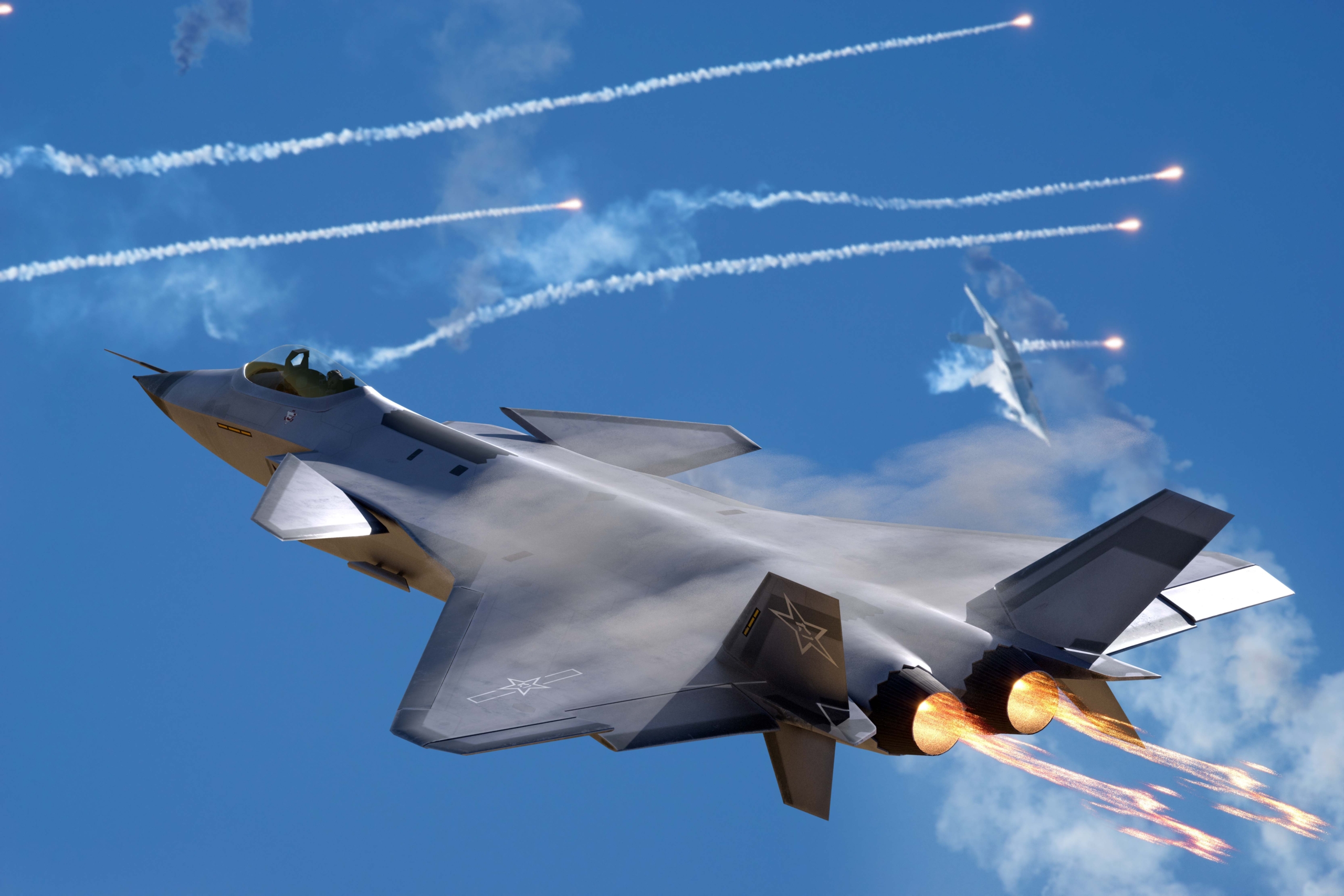
Featured image: Mike Mareen / stock.adobe.com
Sign up for our newsletter and get our latest content in your inbox.


More from


October 17, 20264 min read