Black Hawk crash report reveals failures behind American Airlines collision that killed 67

4 min read
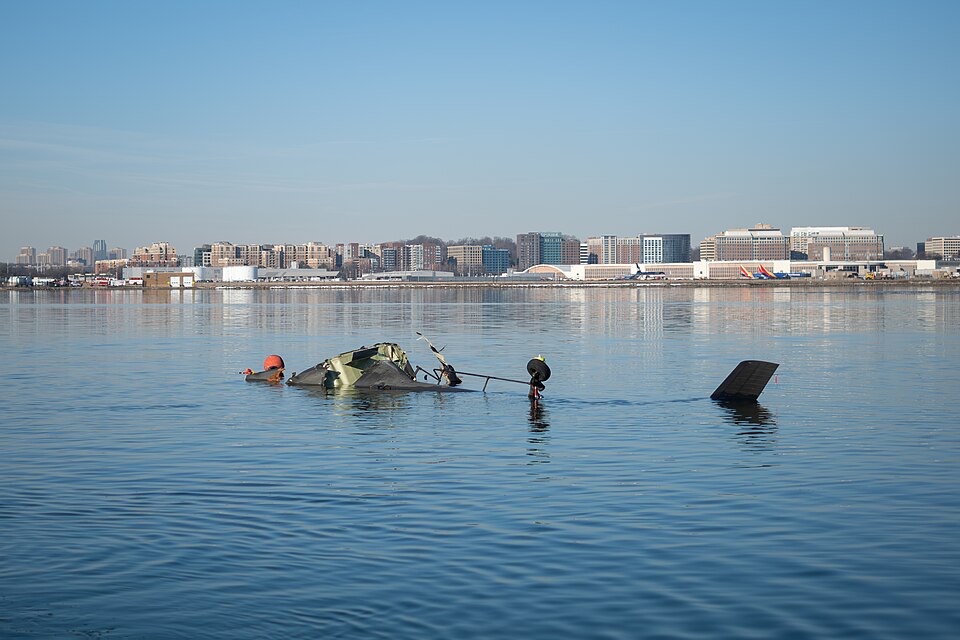
A US Army report into the fatal midair collision between an American Airlines jet and a Black Hawk helicopter has been made public.
The collision between Flight 5342 and the US Army helicopter near Ronald Reagan National Airport on 29 January 2025 was one of the worst US aviation disasters in recent history.
The 50-page investigation, completed in May but made public yesterday (8 October) details problems with radio communications, helicopter equipment, pilot training and the military’s approach to aviation safety.
The collision happened as American Airlines Flight 5342, a Bombardier CRJ700 operated by PSA Airlines, was approaching Ronald Reagan Washington National Airport after flying from Wichita, Kansas.
All 60 passengers and four crew members aboard the jet died, along with three soldiers travelling in the US Army UH-60L Black Hawk helicopter.
Two broken radio transmissions contributed to Black Hawk collision
The Army’s investigation identifies two interrupted radio transmissions as a contributing factor in the crash.
Around two minutes before the collision, an air traffic controller warned the helicopter crew about a CRJ700 circling to land on runway 33. However, interference meant the pilots did not hear that the aircraft was circling.
A second message, instructing the helicopter to pass behind the passenger jet, was partially blocked by a transmission from within the helicopter.
The Black Hawk crew had reported seeing an aircraft and requested permission to maintain visual separation, which was granted.
Investigators also identified difficulties caused by the crew’s night-vision goggles, surrounding city lights and gusty winds, which affected their ability to identify and avoid the approaching jet.
Faulty altitude readings and missing safety technology
The investigation highlights further problems with the Black Hawk’s equipment and the Army’s handling of known safety risks.
According to investigators, the helicopter was flying at approximately 278ft above sea level when the collision occurred, despite a maximum permitted altitude of 200ft along its designated route.
Investigators found that inaccuracies in the helicopter’s altitude instruments may have contributed to the aircraft operating higher than the crew believed.
The Army’s report also identified problems with the helicopter’s Automatic Dependent Surveillance-Broadcast (ADS-B Out) system, which broadcasts an aircraft’s position to other aircraft and ground-based receivers.
The Black Hawk was not transmitting the required position information because of maintenance-related failures.
The investigation found that numerous helicopters in the same Army battalion lacked Traffic Alert and Collision Avoidance Systems (TCAS).
The report also pointed to helicopter crews failing to meet minimum flying-hour requirements and inadequate coordination between the Army and the Federal Aviation Administration (FAA).
A joint working group had also failed to discuss airspace violations, near misses and pilot deviations that could have helped identify emerging risks.

US Army inspects 3,585 helicopters following Washington crash
The Army says it has introduced changes to address the problems identified by investigators.
According to an official fact sheet released alongside the report, all 3,585 affected Army rotary-wing aircraft were inspected by 31 July 2025 to check their ADS-B configurations.
The military also introduced mandatory ADS-B inspections every 90 days in January 2026.
Additional measures include improved training for helicopter crews operating around Washington, testing for potential altitude errors and changes to safety reporting procedures.
The Army is also developing more regular flight-data monitoring and pursuing an agreement with the FAA to improve the sharing of information about potential collision risks.
Families demand accountability over Black Hawk collision
Although the Army’s report identifies widespread failures, it does not detail disciplinary action against individual military leaders.
That has led to renewed criticism from some relatives of those killed. Tim Lilley, whose son Sam was the first officer aboard American Airlines Flight 5342, said, “Recommendations for change are important, but they are not a substitute for accountability.”
Families have also renewed calls for legislation requiring improved aircraft collision-avoidance technology.
The Army’s findings follow the National Transportation Safety Board’s (NTSB) earlier investigation, which concluded that failures in airspace design, safety oversight and risk management by both the FAA and the Army contributed to the disaster.
The NTSB issued 50 safety recommendations following its investigation, including changes to helicopter routes, air traffic control procedures and collision-avoidance technology.
While the safety board has acknowledged progress by the Army in addressing its recommendations, it has stressed that further improvements are still needed.