


Leonardo rolls out first M-346 for Italian Air Force’s Frecce Tricolori aerobatic team

6 min read
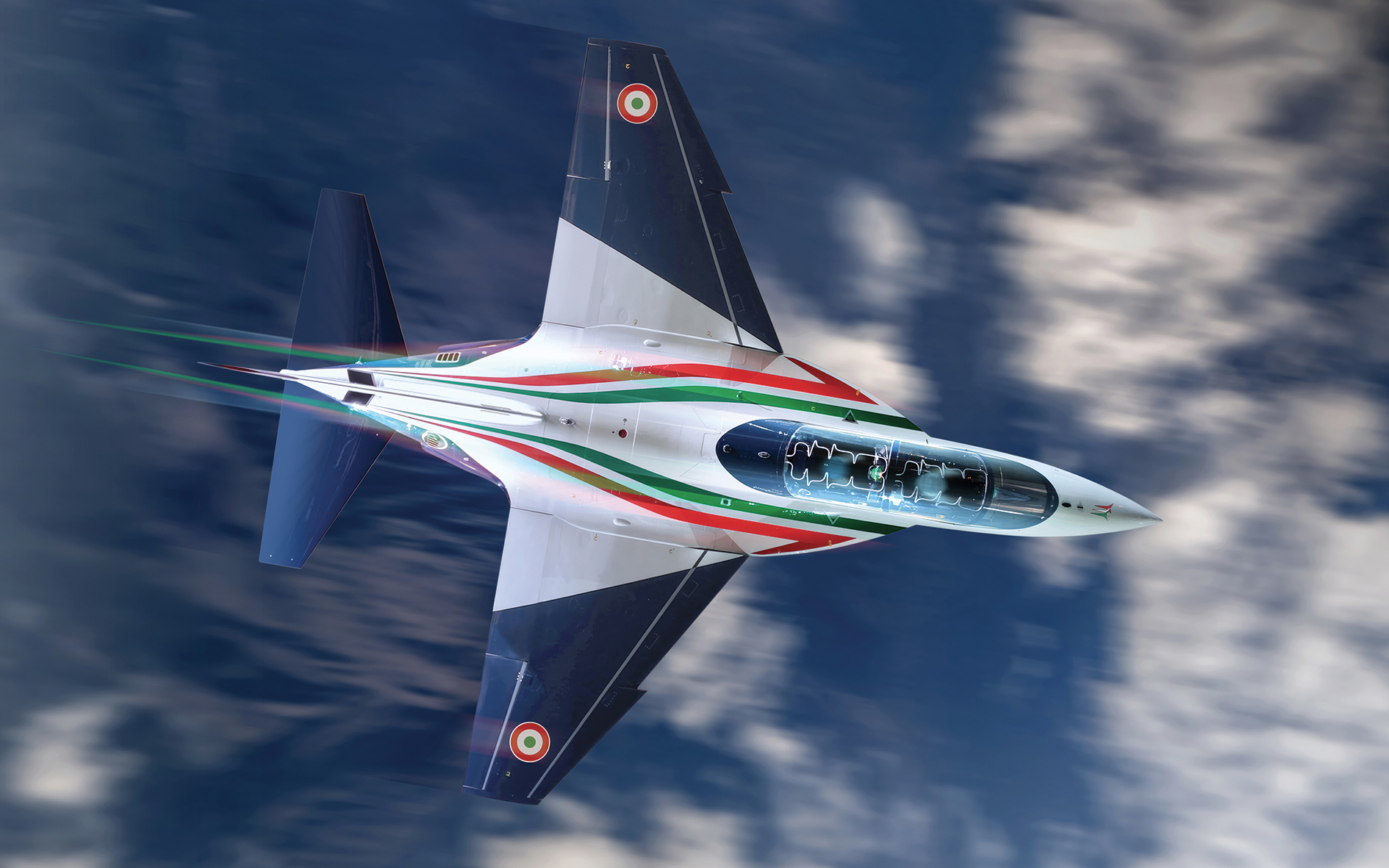

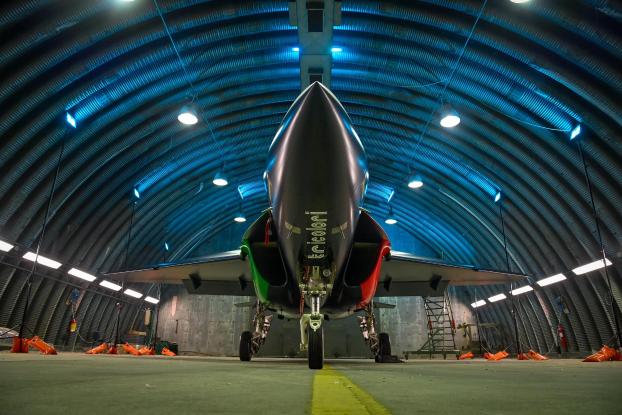
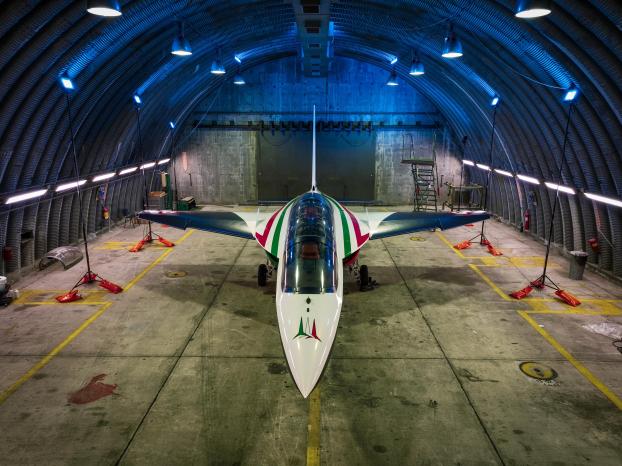
Leonardo has rolled out the first of 15 specially configured M-346 aircraft for the Italian Air Force’s Frecce Tricolori aerobatic team, marking the beginning of flight testing ahead of deliveries between 2027 and 2028.
The twin-engine aircraft will replace the Aermacchi MB-339 PAN, which has carried the Italian national aerobatic team through more than four decades of displays at home and abroad.
Announcing the milestone on 26 November, Leonardo said the programme was progressing on schedule, with pilot and technician training underway alongside the development of a new aerobatic display routine tailored to the capabilities of the M-346.
Designated M-346 PAN by the Italian Air Force, the aircraft will be manufactured at Leonardo’s production facility in Venegono Superiore, in the northern Italian province of Varese.
The programme also includes technical and logistical support, flight simulators, maintenance training systems and infrastructure upgrades at Rivolto Air Base in Udine, home to the Italian Air Force’s 313th Aerobatic Training Squadron.
“This programme represents a major success for Leonardo and for Italy,” said Lorenzo Mariani, chief executive and general manager of Leonardo.
“Our close collaboration with the Italian Air Force and the Italian Ministry of Defence has enabled us to achieve this important milestone, laying the foundations for further achievements.”
Frecce Tricolori prepares to bid farewell to the MB-339
The selection of the M-346 as the future aircraft of the Frecce Tricolori was unveiled on 12 September 2024 at Istrana Air Base near Treviso, during a ceremony marking the team’s return from its North American tour.
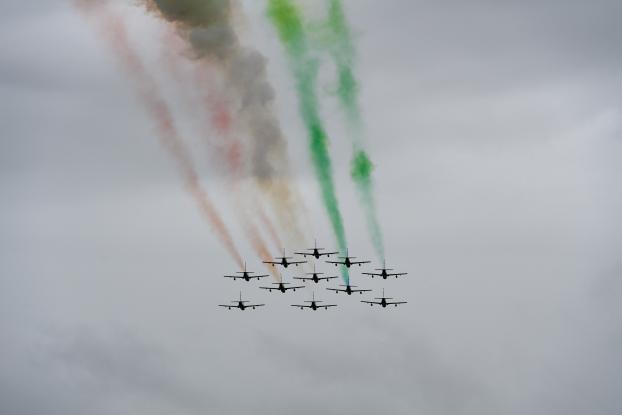
The transition represents a significant technological leap for the Italian aerobatic team, which will move from a single-engine jet trainer of an earlier generation to a twin-engine aircraft equipped with digital avionics and electronic flight controls.
The M-346 also offers different performance and manoeuvrability characteristics, giving the team scope to develop new formations and aerobatic sequences.
“It is a truly moving experience to see this remarkable achievement of Italian technology take to the skies,” said Lieutenant General Antonio Conserva, Chief of Staff of the Italian Air Force.
“The transition from the illustrious MB-339 to the M-346 marks another step forward, embracing the challenges of the future while remaining true to the values that have always defined the Frecce Tricolori,” he said.
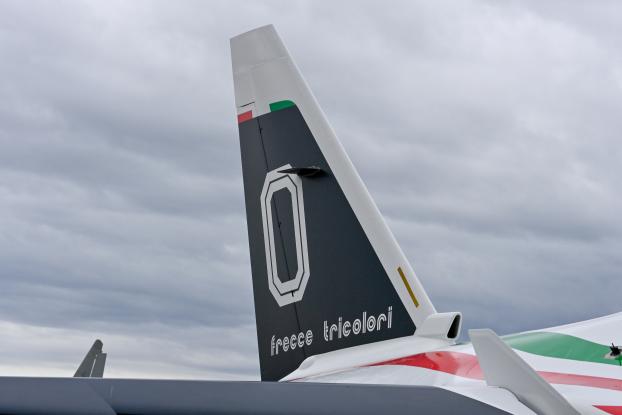
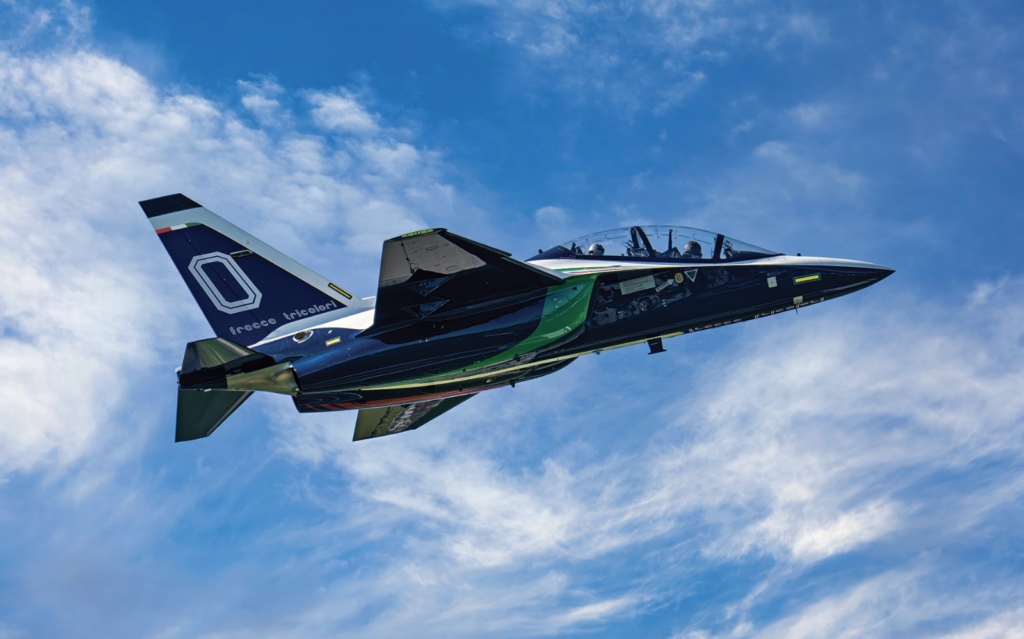
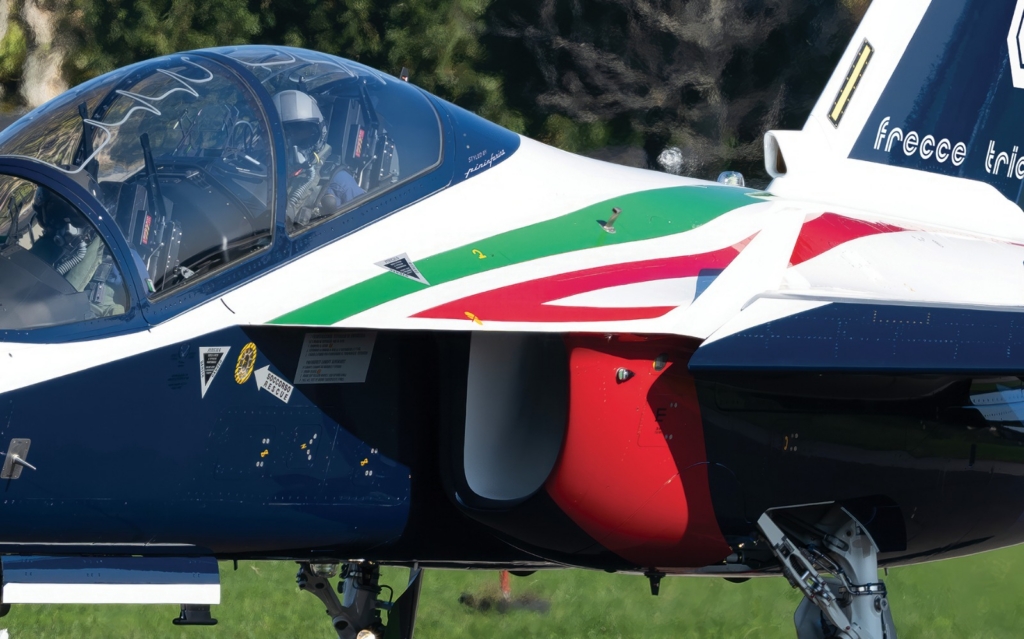
The new aircraft features a livery styled by Italian design house Pininfarina. The design combines a predominantly dark blue finish with sweeping green, white and red stripes representing the Italian flag.
“The Italian flag that we will continue to fly in skies around the world symbolises our national unity, the professionalism of the men and women of the Italian Air Force and the wider defence community, as well as our country’s ingenuity, creativity, and technological and industrial excellence,”Lt. Gen. Conserva added.
How the M-346 has been adapted for aerobatic displays
Although the M-346 PAN retains the avionics, digital flight controls and performance characteristics of the advanced jet trainer, Leonardo has introduced several modifications specifically for the aerobatic team.
These include a smoke generation system, which will allow the Frecce Tricolori to continue painting the skies with its distinctive green, white and red smoke trails.
The aircraft also incorporates video streaming equipment, modifications to the cockpit and flight control systems, and auxiliary fuel tanks to support flights between display venues.
An onboard access ladder will allow pilots to enter and leave the cockpit without relying on external boarding equipment, a useful addition when operating from different airfields during international tours.
One of the most significant differences between the M-346 and its predecessor is its quadruple-redundant fly-by-wire flight control system.
Instead of relying on conventional mechanical connections between the cockpit controls and the aircraft’s control surfaces, the system uses electronic signals and flight control computers to interpret the pilot’s commands.
Multiple independent channels provide redundancy in the event of a system failure.
The introduction of the aircraft will require the team’s pilots to familiarise themselves with its handling characteristics before developing and rehearsing a new display programme.
From advanced fighter training to formation aerobatics
The M-346 was developed to prepare military pilots for the transition to modern frontline fighter aircraft.
The twin-seat jet combines a digital cockpit with a high degree of manoeuvrability, allowing trainee pilots to experience many of the flight characteristics and cockpit demands associated with contemporary combat aircraft.
Much of the M-346’s appeal as a military trainer lies in its ability to combine actual flying with computer-generated combat scenarios.
Its Embedded Tactical Training System (ETTS) allows pilots to train against simulated threats and practise tactical missions without requiring additional aircraft to represent adversaries.
The aircraft forms the backbone of the International Flight Training School (IFTS) at Decimomannu in Sardinia, established through a partnership between Leonardo and the Italian Air Force.
The school combines airborne instruction with ground-based flight simulators, mission planning systems and computer-generated scenarios.
Known as Live, Virtual and Constructive (LVC) training, the technology allows pilots flying actual aircraft to participate in exercises alongside pilots operating ground-based simulators and entirely computer-generated forces.
While the requirements of an aerobatic team differ considerably from those of a fighter training school, the Frecce Tricolori will benefit from the aircraft’s established training and simulation infrastructure.
Leonardo also sees the selection of the M-346 by the Italian aerobatic team as an opportunity to broaden the aircraft’s international market beyond advanced military training and light combat operations.
“The M-346 is now well positioned to pursue major new commercial and industrial cooperation opportunities worldwide, both as a trainer and multirole aircraft and as a platform for aerobatic teams,” said Stefano Bortoli, managing director of Leonardo’s Aircraft Division.
A new aircraft carrying an Italian tradition
The Frecce Tricolori’s international appearances have long provided a showcase for Italian aircraft manufacturing as well as the flying skills of the country’s military pilots.
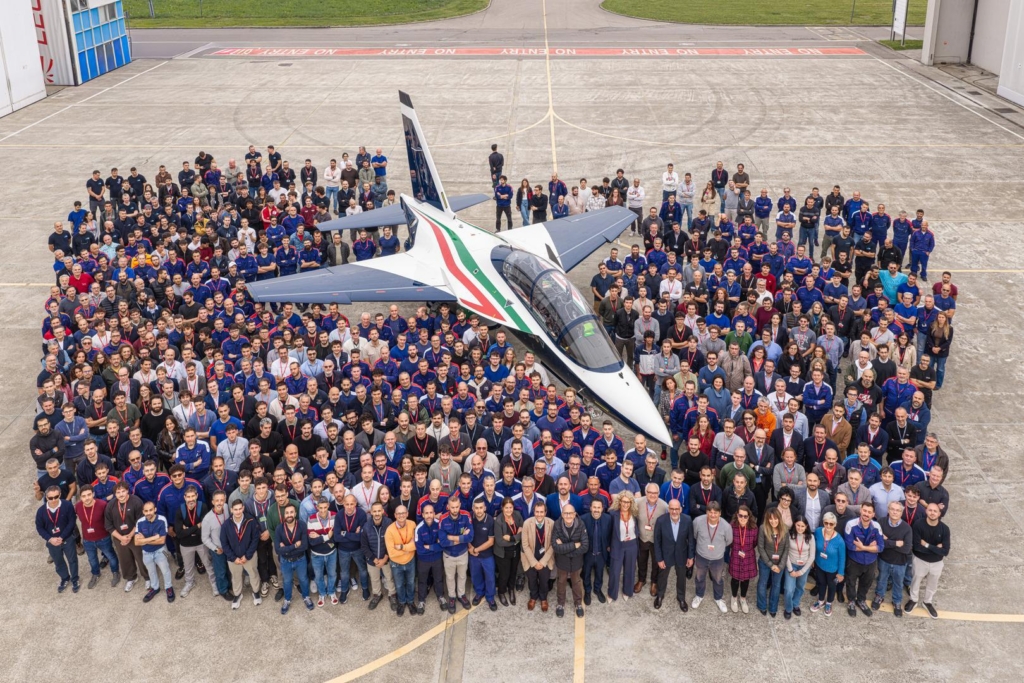
Mariani acknowledged the contribution of the workforce involved in developing the team’s new aircraft.
“Behind every aircraft are designers, engineers, technicians, skilled workers and entire industrial supply chains,” he said. “Behind it are investments in research and development, expertise and a culture of industrial excellence and dedication that is passed down through generations and continually renewed.”
Conserva also highlighted the relationship between the Italian Air Force and the country’s aerospace industry.
“Behind every new chapter in the history of the Frecce Tricolori lies an extraordinary wealth of expertise, passion and professionalism shared by Italian Air Force personnel and the skilled workforce of our national industry,” he said. “This heritage is built on education, training and the ability to work together as a team.”
Although production and deliveries are scheduled between 2027 and 2028, Leonardo has not specified when the Frecce Tricolori will perform its first full public display with the M-346 or when the last MB-339 PAN will be retired.
Sign up for our newsletter and get our latest content in your inbox.