


Watch: COMAC CE-25A electric aircraft completes first crewed flight in China

3 min read
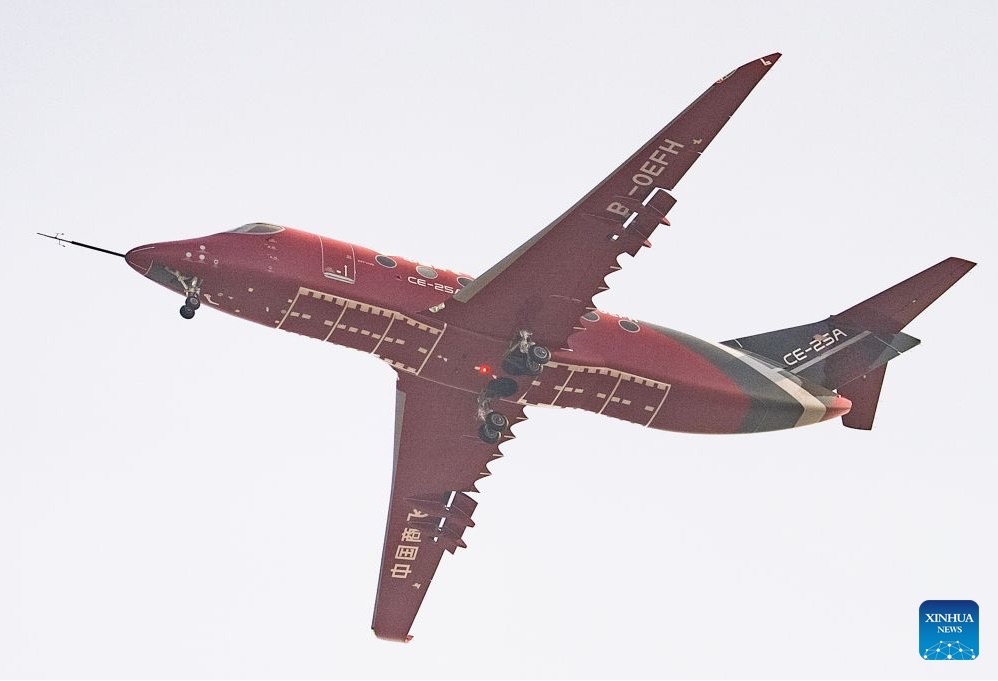
COMAC‘s CE-25A all-electric commuter aircraft has completed its first crewed flight, advancing the development of a 19-seat regional aircraft design powered by ten electric ducted fans.
The aircraft flew at Binzhou in Shandong province on 14 November with two pilots and a flight-test engineer aboard. COMAC said the aircraft operated normally and its performance met expectations, according to a report published by China’s Civil Aviation Administration (CAAC).
The CE-25A spent 16 minutes and 38 seconds airborne, covering 60.4km. The complete test, including ground operations, lasted 57 minutes and 46 seconds.
The first crewed flight follows photos of a full-sized CE-25A demonstrator which first appeared in October, as Aerospace Global News reported.
The CAAC’s latest announcement says the aircraft has been flying uncrewed for months.
COMAC reveals 19 earlier uncrewed flights
COMAC says the CE-25A made its first autonomous, uncrewed flight on 2 February 2026 and completed 19 uncrewed flight validations before Saturday’s flight with people aboard.
Photographs of the full-sized aircraft first circulated widely in late October 2026.
COMAC first unveiled the CE-25A concept at the China International Import Expo in Shanghai in November 2023.
According to news reports crediting COMAC, the “C” in the name stands for China and COMAC; “E” represents electric power, “25” represents compliance with the CCAR-25 airworthiness regulations for transport category aircraft; and “A” indicates it is the first product of its kind developed in China.
How the CE-25A’s ten electric fans work
The aircraft relies on a distributed electric propulsion system. Five electrically driven ducted fans sit above each wing, replacing the turboprop engines used on conventional commuter aircraft.
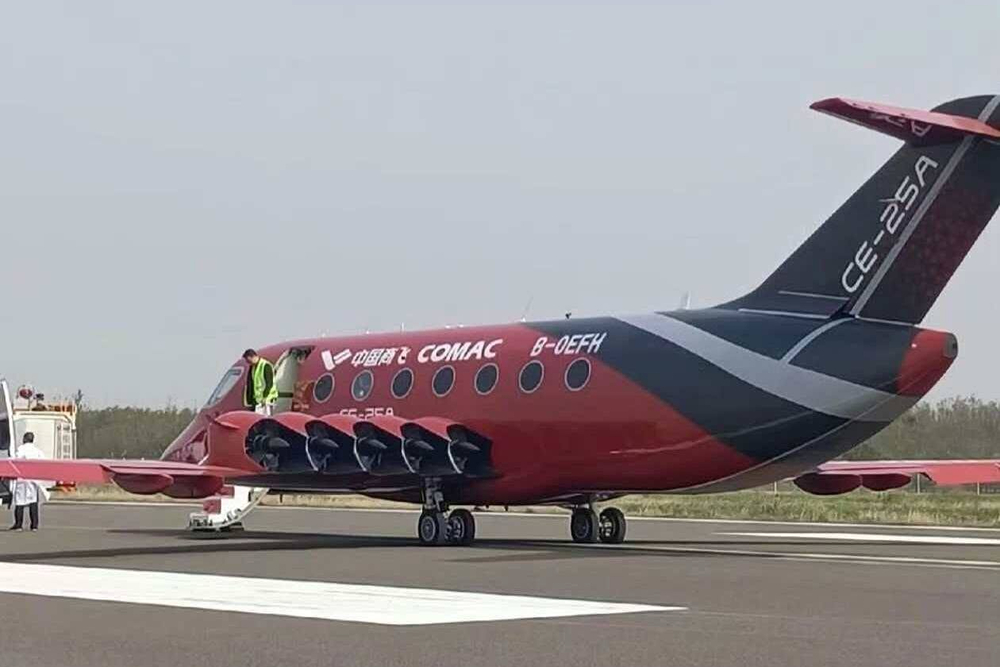
COMAC lists the aircraft’s maximum take-off weight of 10 tonnes. It has a capacity of 19 passengers, with a cruising speed of 300km/h and a cruising altitude of 2,400m. The aircraft’s range is approximately 400km, which would suit short intercity routes.
The programme involves COMAC, Chinese battery manufacturer CATL, Shanghai Jiao Tong University and other partners. CATL has previously publicised high-energy-density battery technology for aviation, but the cells which power the CE-25A have not been confirmed.
Certification and commercial service remain ahead
The CAAC confirmed it has accepted COMAC’s application for a CE-25A type certificate.
The aircraft was developed to meet China’s CCAR-25 transport-aircraft airworthiness framework. The manufacturer must now prove the design’s safety, battery performance and reliability in various operating conditions before the CE-25A can enter commercial service.
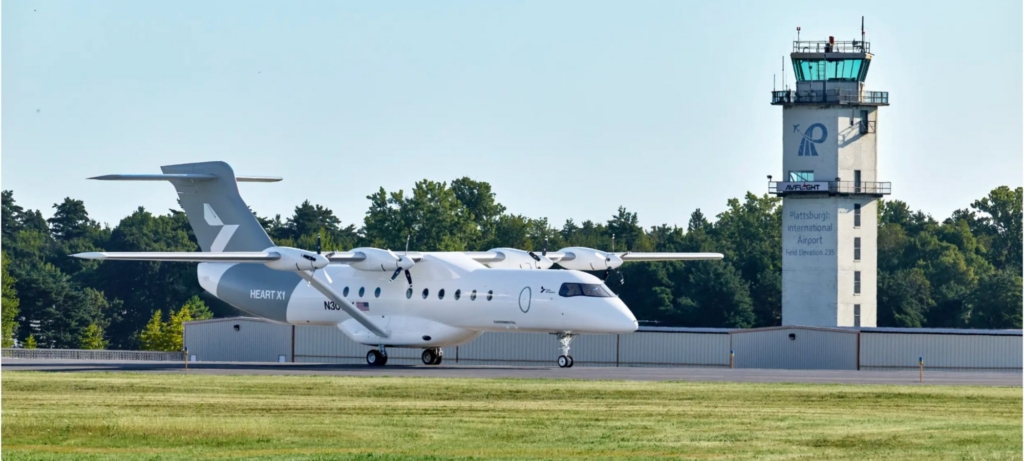
The CE-25A joins a small group of larger electric aircraft demonstrators. Heart Aerospace‘s X1 made its first flight in the United States in August 2026. The company is developing a hybrid-electric regional airliner and unveiled its ES-36 in September, which will carry up to 36 passengers. It would use battery power for shorter routes, with two megawatt-class turbogenerators powered by a compact gas turbine enabling longer routes. JSX has converted its previous letter of intent into an order for 50 ES-36 aircraft, with options for 50 more.
No timeline has yet been established for the CE-25A’s final certification, and no details have been disclosed about possible airline operations. COMAC has not announced a confirmed entry-into-service date.


