


Watch: Real-life Iron Man flies jet-powered suit at NASA’s Kennedy Space Centre

3 min read
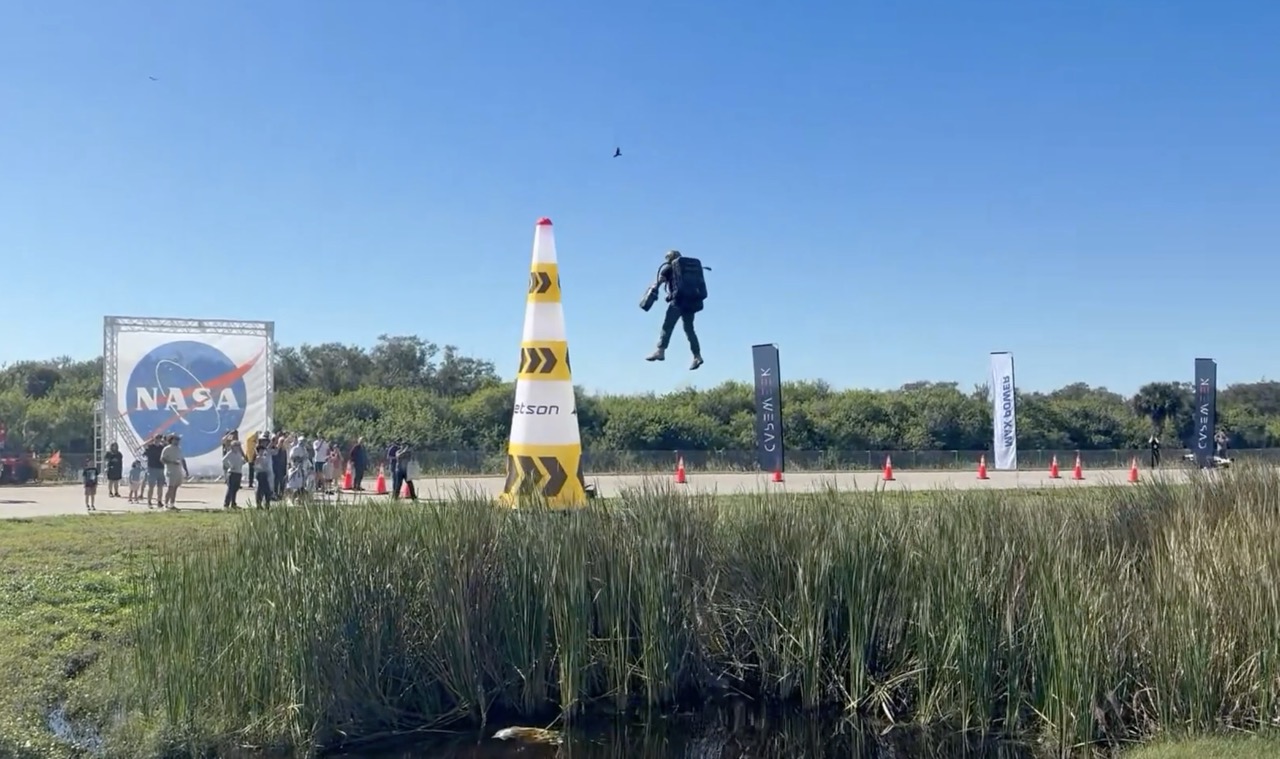
A turbine-powered jet suit developed by UK company Gravity Industries was demonstrated at NASA’s MAX POWER aerospace expo in Florida on 7 November. The NASA event showcased aircraft, spacecraft and new transport systems.
Footage from the demonstrations shows Gravity Industries founder and chief executive Richard Browning lifting off the ground at Kennedy Space Centre in the company’s latest jet suit.
Pretty cool things at @NASA today! @takeonGravity @capeweek_us https://t.co/pns6AGy1VV
— Collin Craig (@CollinCraigAI) November 7, 2026
The display gave visitors a close-up look at one of the world’s most advanced examples of personal flight technology, a concept Gravity has been developing for almost a decade.
How does Gravity’s jet suit fly?
Gravity’s system uses small gas turbines to generate thrust, with engines carried on the arms and back. It allows a pilot to leave the ground without the wings or rotor system of a conventional aircraft.
Jetpack Dude from @takeonGravity going ham at Up.Summit today. @UPSummitVC https://t.co/sG1Lez9uCv
— GoatGains (@TheGoatGains) November 8, 2026
The company’s current technology description says its latest Mk4 suits combine arm-mounted microjet engines with three additional turbines on the back.
Gravity says it uses polymer, aluminium and titanium 3D-printing processes to manufacture its latest suits.
Reporting on Gravity’s work with manufacturing specialist EOS in 2018 described printed cable guides, electronics and battery housings, arm brackets and thrust-control components. The collaboration reduced the number of parts in an assembly from eight to three, simplifying assembly.
Gravity dates its first prototypes to March 2016 and Browning’s first off-ground flight to November that year. The company launched publicly in April 2017.
Who is Richard Browning?
Richard Browning is the founder and chief executive of UK-based Gravity Industries, a company known for developing turbine-powered personal flight systems.
Browning first achieved sustained jet suit flight in 2016 and publicly launched Gravity Industries in 2017. His demonstrations have attracted global attention and earned comparisons with the fictional Iron Man suit.
How fast can the Gravity jet suit fly?
Gravity Industries has previously reported speeds in excess of 80mph during testing. The wearable aviation technology combines multiple micro gas turbines to provide lift and directional control, with movement controlled largely through the pilot’s arm position and body balance.
From public displays to rescue trials
The potential applications extend beyond eye-catching demonstrations at events. Gravity markets its technology for medical response, maritime operations and access to difficult terrain, aiming to move an individual quickly past obstacles.
The Great North Air Ambulance Service explored jet suit paramedic response in the Lake District. In 2022, it announced work with Gravity and offshore wind developer Ørsted to trial jet suit paramedics for the wind industry.

The Royal Navy also documented a 2021 trial involving HMS Tamar and Royal Marines from 42 and 47 Commando. Gravity personnel operated the equipment throughout the exercises.
At the time, trial sponsor Lieutenant Colonel Will Clarke said: “Whilst the technology may not be ready for military adoption just now, it shows significant promise”.
Aerospace technology on show at Kennedy
NASA’s MAX POWER event brought together air shows, technology displays and space exhibits at Kennedy Space Centre on 7–8 November.
The programme included NASA and external partners, with aircraft, rovers and autonomous vehicles among the technologies displayed. AGN also reported on NASA’s X-70 Fractal announcement at UP.Summit at Kennedy that week.
For Gravity, which also markets its jet suit for various brand-building and corporate events, the expo provided another venue to demonstrate personal turbine-powered flight.


