



General Atomics rolls out next-generation Do228 NXT utility turboprop

5 min read


Germany’s General Atomics AeroTec Systems GmbH has marked a significant milestone in its history. On 8 June, the company celebrated the official roll-out of its Do228 NXT aircraft, the next-generation version of the Dornier 228 utility turboprop that was originally produced in the country between 1981 and 1998.
General Atomics has updated the aircraft with new engines, avionics, and other improvements that it hopes will make it more appealing in today’s regional aviation market as well as other niche sectors.
General Atomics rolls out first DO228 NXT turboprop
In a high-profile ceremony held at the company’s hangar in Oberpfaffenhofen in Germany, the modernised Do228 NXT turboprop was rolled out in front of representatives of the company as well as hundreds of specially invited guests.
The event marked the first time in many years that a new series of aircraft manufactured in Germany had been unveiled.
The Do228 NXT is a new, versatile aircraft (albeit based largely on the design of the 19-seat Dornier 228-200) that has been designed to serve regional passenger markets as well as operate in a range of special missions and military roles.
The aircraft is being targeted at customers in the civilian, military and government aviation spaces.
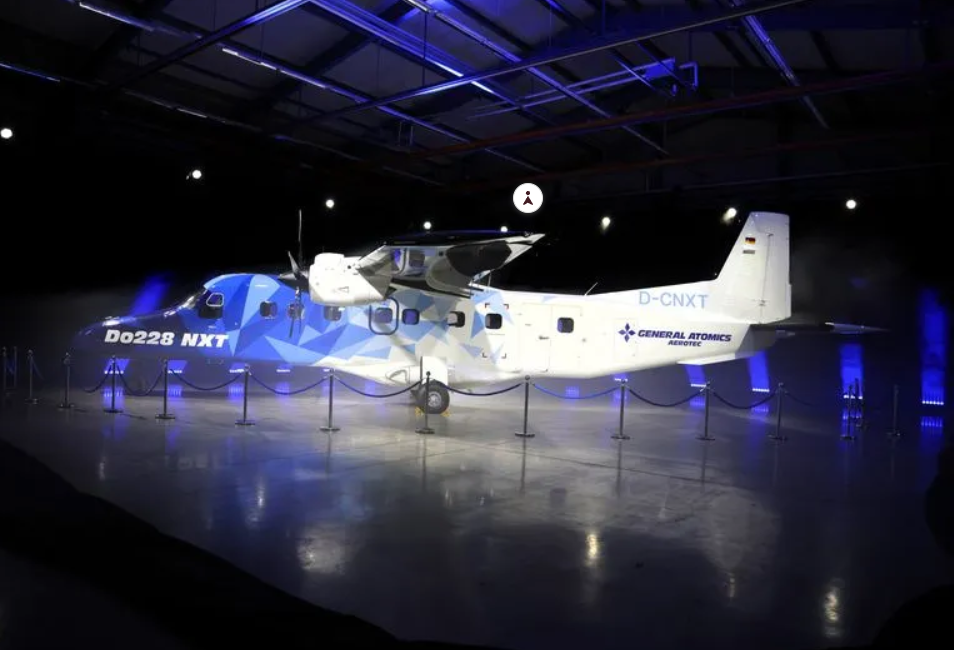
The roll-out event brought together stakeholders from across the aviation landscape as well as many Do229 NXT programme partners. Among the approximately 500 attendees were representatives from politics and government, the defence sector, customers and suppliers, service partners and media members. The entire General Atomics team was also in attendance.
According to the company, a “particularly meaningful” element of the roll-out ceremony was the participation of the Dornier family as guests of honour.
In their speech, Claudio and Camillo Dornier emphasised that the Do228 NXT would carry on the region’s long tradition of aircraft manufacturing with pride, and that they saw great potential for the Do228 NXT and the company in the future.
General Atomics updates the venerable Dornier 228
The Do228 NXT has used the platform of the original Dorner 228-200 to bring an upgraded turboprop in the 19-seat capacity range to the market. However, key improvements have been incorporated to improve the aircraft’s performance over its predecessor.
Visually, the biggest giveaway is the five-blade propellers, which have replaced the previous four-blade versions. These provide for improved economics, reduced fuel burn and a lower noise footprint. The Do228 NXT also features a glass cockpit and updated interior cabin design.

Elsewhere, the distinctive high-wing layout of the Dornier 228 is retained, featuring that aircraft’s iconic TNT (“new technology”) wing design.
The new version also retains the Dornier 228’s excellent short-take-off and landing (STOL) capabilities and the ability to carry up to 19 passengers or cargo while operating from short, rough, or unpaved runways.
According to General Atomics, the Do228 NXT “flies like a Dornier 228, but with technology and supportability expected from a current-production aircraft.”
Versatility is the key with the Do228 NXT
According to a General Atomics statement, the Do228 NXT builds on the Dornier 228’s legacy as “one of the most versatile and reliable aircraft in its class.”
Having served in locations around the world across missions ranging from passenger and cargo transport to maritime surveillance, MedEvac operations and disaster response missions, the Do228 NXT will continue in this tradition, serving niche markets in hard-to-reach areas.
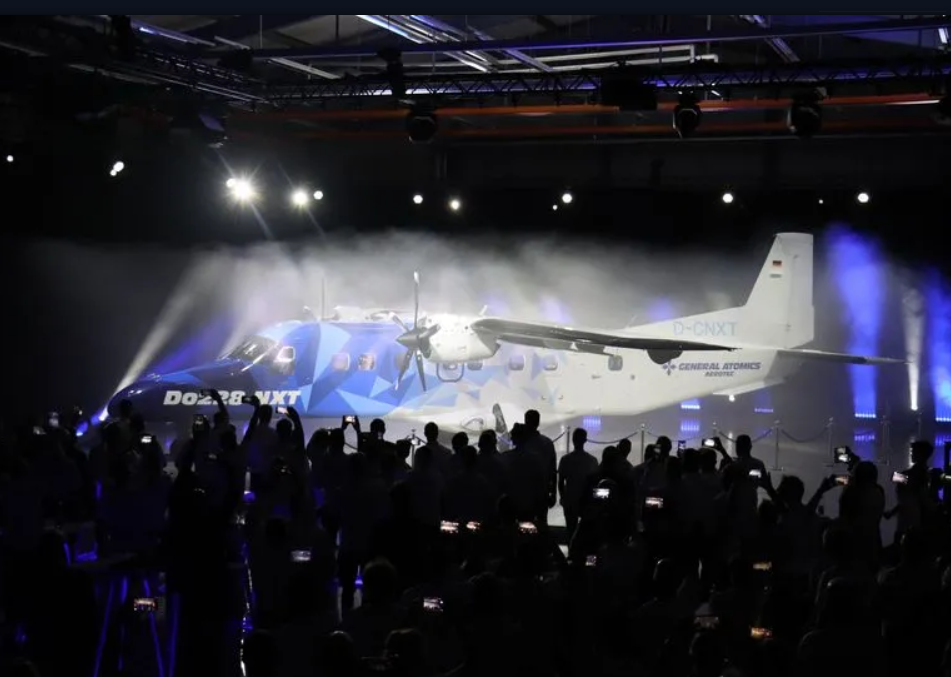
The roll-out ceremony of the Do228 NXT also saw the aircraft feature a newly designed, eye-catching livery. According to the company, the modern livery design featuring blue triangles “symbolises the seamless interplay of the aircraft’s individual features and characteristics, which complement each other perfectly.”
In addition, the design of the spreading triangles was described as representing the aircraft’s aerodynamics, with the various shades of blue also being inspired by camouflage design, as the Do228 NXT is envisaged to satisfy a growing need in the security and law enforcement sectors.
“The Do228 NXT is a true effort by the entire General Atomics Group,” said Harald Robl, CEO, General Atomics Europe. “It fills me with great pride to see aircraft being built in Germany again. I am convinced that the Do228 NXT will be an extraordinary aircraft for our customers, ” he added.
The Do228 NXT – built to serve a range of missions
The Do228 NXT is aimed at a fairly specialised part of the aviation market – operators that need a rugged, relatively inexpensive aircraft capable of flying into places that larger regional airliners cannot reach. Rather than competing directly with aircraft like the ATR42 or DHC Dash 8 on mainstream airline routes, it will target remote transport, government missions, and specialised surveillance roles.
The Do228 NXT’s STOL capability allows operators to serve airports that many competing aircraft cannot use, opening routes that would otherwise require helicopters or much longer ground transport.
The aircraft is expected to be popular among operators that offer island-hopping services, serve remote communities, and operate to mountain airfields, while serving low-demand regional routes where larger aircraft would be uneconomical.
In cargo configuration, in regions that need regular freight services but lack major airport infrastructure, the Do228 NXT is designed to carry more than two tonnes of cargo into small airports and rough strips.
Typical customers could include cargo airlines, humanitarian organisations, mining and energy companies, as well as government supply services. General Atomics points out that the Do228 NXT’s ability to switch between passenger and cargo layouts also improves aircraft utilisation.
General Atomics is betting that there is still demand for a modern, missionised utility turboprop that can go where larger regional aircraft cannot and perform surveillance, transport, and emergency-response tasks from the same basic platform.
Featured image: General Atomics
Sign up for our newsletter and get our latest content in your inbox.


More from

September 26, 20263 min read

September 25, 20264 min read


September 25, 20264 min read

September 24, 20262 min read


