


Electra sees demand for up to 16,000 aircraft in untapped US ‘direct aviation’ market

5 min read

Hybrid-electric aircraft developer Electra says the United States could support a fleet of up to 16,000 regional electric aircraft over the next decade, providing millions of travellers with alternatives to congested roads and inconvenient hub-and-spoke airline journeys.
In its inaugural Direct Aviation Market Outlook, the Virginia-based company argues that a new category of regional air mobility — which it calls “Direct Aviation” — could improve short-haul travel by connecting travellers directly from local access points nearer to home and to their destinations.
“Aviation is entering a new era, where capabilities that weren’t possible before are now fundamentally changing how we move,” said Marc Allen, CEO of Electra, in the report’s announcement. “Direct Aviation is how that shift shows up in the real world, giving people the ability to go from where they are to where they want to go without the time, friction, and constraints that define travel today. It will slash travel times by hours, changing how people live, work, and play.”
More than 6,000 untapped US regional routes
Electra’s report identifies a significant market for regional journeys of 50 to 265 miles, where most travellers currently drive by car because air service is unavailable or impractical.
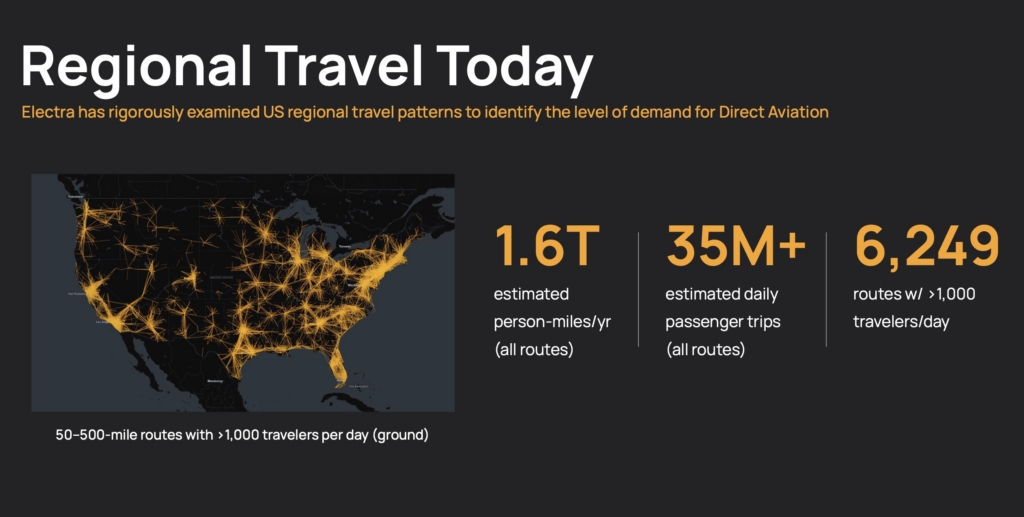
According to Electra’s analysis, Americans make more than 35 million daily passenger trips across routes between 50 and 500 miles, accounting for roughly 1.6 trillion passenger-miles annually.
Electra sees strong passenger demand for a direct air travel option with over 6,000 US regional routes already carrying over 1,000 travellers per day. Around 85% of the most promising short-haul routes Electra identified lack practical air service within 40 miles of either the origin or destination.
The case for “direct aviation”
Electra’s concept centres on using ultra-short takeoff and landing hybrid-electric aircraft capable of operating from compact access points much closer to travellers’ origins and destinations.
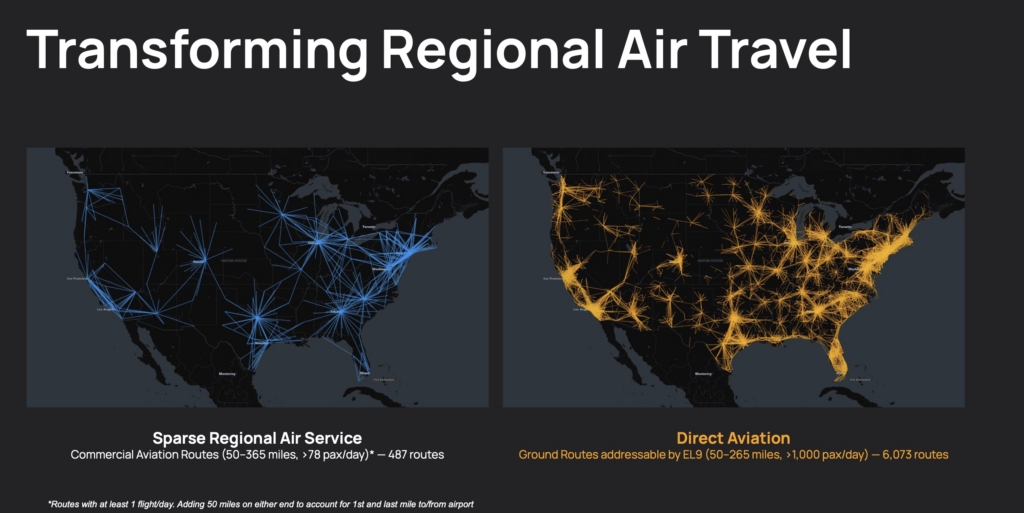
Rather than relying exclusively on traditional airports, the company envisions aircraft operating from repurposed municipal airports, rooftop landing areas, parking lots, piers and barges, fields, and other distributed access points.

The goal would be to create dense point-to-point regional networks that bypass highway congestion and airport chokepoints.
Americans would spend less time driving or flying
The report emphasises that the strongest growth opportunity lies in trips currently made by car. Electra’s analysis found that only about 1% of journeys between 50 and 265 miles are currently flown, despite the scale of travel demand in that distance range.
Electra argues that significant door-to-door time savings could persuade travellers to switch modes. Its analysis identifies:
- 1,851 routes where travellers could save more than one hour
- 540 routes with more than two hours of potential savings
- 227 routes with more than three hours of time savings
Electra breaks down potential routes into three categories: intercity connections, leisure launchpads, and airport feeder routes.
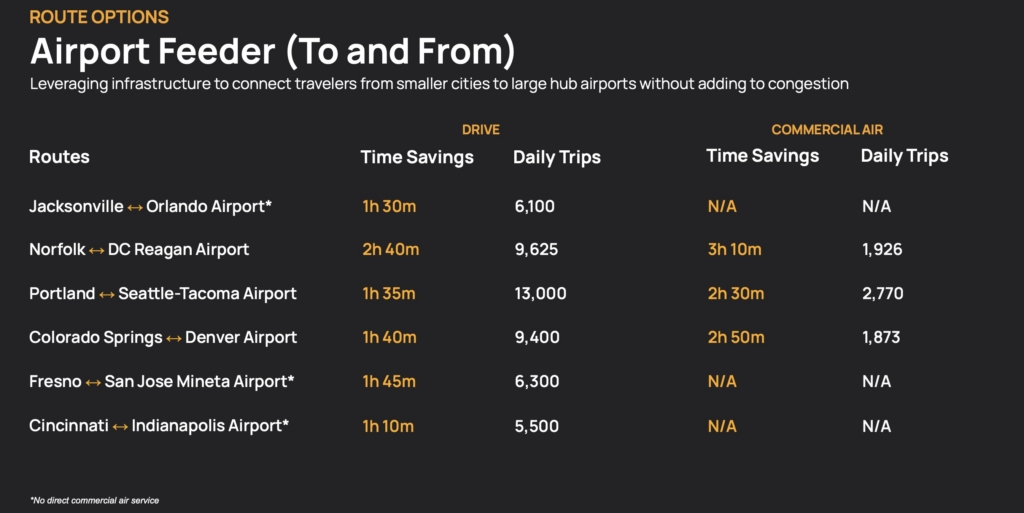
For example, the report cites travel between Washington, DC and New York, where Electra claims its proposed EL9 aircraft could reduce door-to-door travel time to 1 hour and 45 minutes, compared with roughly 4 hours for either driving or a commercial airline service.
Other intercity connections that could benefit from direct air service include Austin-Dallas, Orlando-Miami, Boston-New York, and Los Angeles-San Diego.
A 12,000–16,000 aircraft opportunity
Electra estimates that scaling this new regional mobility ecosystem would require between 12,000 and 16,000 aircraft between 2030 and 2040. The company’s projections rely on assumptions about route density and passenger demand for high-frequency regional shuttle operations.
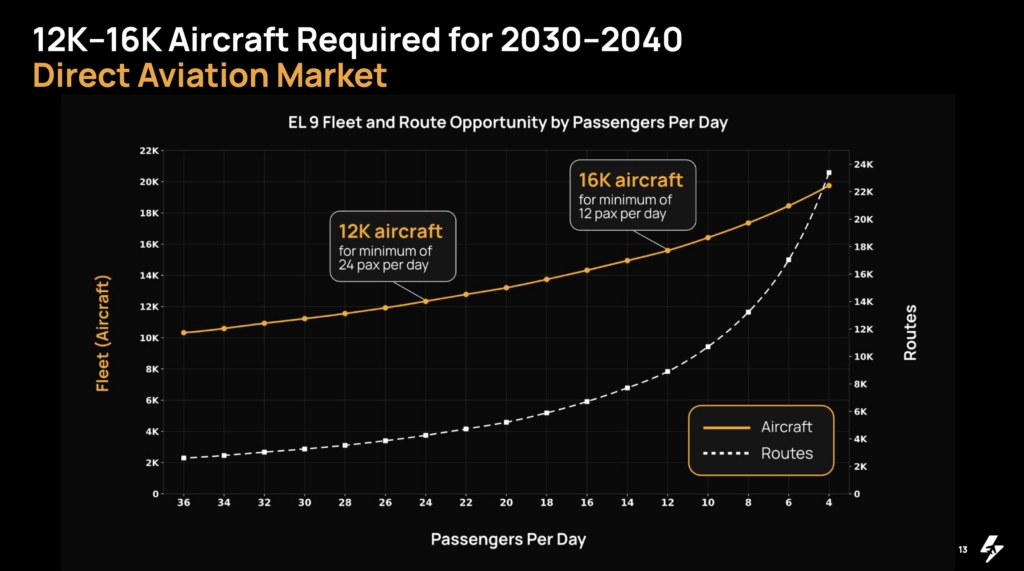
The 12,000 aircraft would cover routes with demand of up to 24 passengers daily, and the 16,000 aircraft would add routes with demand of up to 12 passengers daily.
While such low passenger numbers would not make these routes viable for most commercial operations, Electra argues that passengers would pay the equivalent of business-class airfare to shave significant time from their journey. While that might be the case for some intercity and leisure routes that appeal to more affluent travellers, it’s harder to make a similar case for other underserved regions that Electra identified.
Electra EL9 enabling a new direct aviation network
The aircraft at the centre of the strategy is Electra’s EL9 hybrid-electric “Ultra Short” aircraft, which can carry nine passengers and a pilot. The aircraft combines blown-lift aerodynamics with hybrid-electric propulsion to enable short takeoff and landing distances of roughly 150 feet and lower noise levels compared to conventional aircraft.

The EL9 will have a maximum range of 1,100 nautical miles and cruise at up to 175 knots, while generating less than 75 dBA of noise during takeoff at 300 feet.
The company sees the aircraft as a viable alternative to short regional airline services, as well as to helicopters and electric vertical takeoff and landing (eVTOL) aircraft. Electra claims its hybrid-electric approach offers longer range, greater payload capability, lower certification risk, and significantly lower operating costs than many eVTOL concepts.
Building a new regional mobility ecosystem
Electra’s report argues that aircraft alone will not be enough to create this market. The success of a direct aviation transport model would depend on a regional mobility ecosystem that includes distributed access infrastructure, new air service operating models, favourable Advanced Air Mobility regulations, and a supply chain capable of supporting large-scale production and operations.
While many Advanced Air Mobility proposals focus on urban air taxi services, Electra’s analysis points instead to regional mobility as the more scalable near-term market opportunity.
The company’s report suggests that large geographic clusters — including the Northeast Corridor, Southern California, Florida, Texas, and the Midwest — could support dense regional air shuttle networks linking communities that are poorly served by traditional airline schedules today.
Whether regulators, infrastructure developers, operators, and travellers embrace that model remains uncertain. But Electra’s report suggests an opportunity to bolster access to regional aviation through shorter, more flexible point-to-point operations rather than conventional airport-centric airline networks.
Featured Image: Electra
Sign up for our newsletter and get our latest content in your inbox.


More from

September 18, 20263 min read

September 18, 20264 min read


September 17, 20265 min read

September 17, 20263 min read


September 18, 20263 min read


