


SkyClinic eVTOL flying hospital aims to deliver surgery to disaster-hit regions

6 min read

When an earthquake hits or floodwaters rise, the damage is immediate and visible. Buildings collapse, roads vanish, and power fails. But for many, the most critical loss comes quietly: access to medical care.
Hospitals become unreachable or unusable just when they are needed most. It is this gap between survival and treatment that LYTE Aviation is trying to close with what it calls the world’s first purpose-built flying hospital.
At the centre of that effort is SkyClinic, a hybrid hydrogen-electric vertical take-off and landing aircraft designed to bring surgical care directly to disaster zones, conflict regions and remote communities.
Unlike conventional air ambulances, which still depend on functioning infrastructure, SkyClinic is intended to operate almost independently of it, landing in as little as a 50-metre stretch of ground and delivering advanced medical treatment on site.
The idea is as simple as it is ambitious: if patients cannot reach hospitals, the hospital should reach them.
Flying hospital concept targets growing gap in disaster response and healthcare access
The concept has emerged at a time when extreme weather events and humanitarian crises are becoming more frequent and more complex.
Across much of the world, particularly in developing regions, medical infrastructure is unevenly distributed even in normal conditions. In the aftermath of disasters, that imbalance becomes acute.
Roads are blocked, airports are damaged, and already limited healthcare capacity is quickly overwhelmed. SkyClinic is designed to work in exactly those conditions.
Inside the aircraft is a fully equipped operating theatre, capable of supporting surgeons and nurses in carrying out complex procedures.
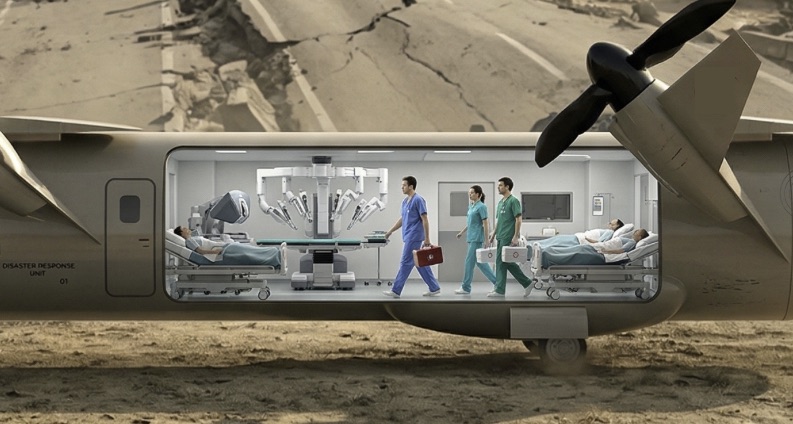
The platform can accommodate up to six patients and is also designed to integrate remote robotic surgery systems, allowing specialists to assist from afar using AI-supported platforms.
That hybrid approach of combining onboard medical teams with remote expertise reflects a broader shift in how healthcare is being delivered in difficult environments.
Rather than relying solely on physical infrastructure, the model leans on connectivity and mobility, bringing together transport, medicine and digital systems into a single deployable unit.
SkyClinic eVTOL is part of a wider push to transform regional aviation and emergency logistics
SkyClinic is not a standalone project but part of a broader family of aircraft being developed by LYTE.
The company, founded in 2023, first drew attention with its LA-44 platform, a 40-seat hybrid hydrogen-electric VTOL aircraft designed for regional passenger transport.

From that base, it expanded into cargo with the SkyTruck and into emergency medical services with SkyClinic, all built around a shared architecture. This common platform approach is central to the company’s strategy.
By using the same underlying aircraft design across passenger, cargo and medical roles, LYTE is aiming to spread development costs while addressing multiple markets at once, from regional mobility to humanitarian logistics.
The SkyTruck, for instance, is designed to carry payloads of up to 4.5 tonnes, supporting supply chains in areas that are difficult to reach by conventional aircraft.

That same capability underpins the SkyClinic’s ability to transport medical equipment and sustain operations in remote locations.
The broader LA-44 platform is designed for ranges of around 1,000km, with the company indicating that future iterations could extend significantly beyond that, particularly for humanitarian missions where reach is critical.
Hybrid hydrogen-electric propulsion powers SkyClinic flying hospital design
One of the more significant technical developments behind the programme lies in its propulsion architecture.
LYTE says it has reduced the number of engines on the aircraft from eight to four through the development of what it calls its PowerBridge system, a hybrid arrangement combining combustion engines, electric propulsion and hydrogen fuel cells.
The aim is to simplify the aircraft while improving efficiency and reliability.

Electric aviation has long been constrained by limits on motor power and energy storage. By combining different propulsion elements, LYTE is attempting to work around those constraints, while also positioning the aircraft as part of a longer-term transition towards zero-carbon flight.
For operators, fewer engines also mean reduced maintenance complexity and potentially lower operating costs, factors that are particularly important for aircraft intended to operate in austere environments.
India emerges as early launch market for SkyClinic flying hospital
While the idea of a flying hospital has global appeal, its first large-scale application may take shape in India.
Mumbai-based Vman Aviation has placed a conditional order for 10 SkyClinic aircraft, in a deal valued at €500 million ($590 million).
The agreement, which includes milestone-linked deposits, positions Vman as one of the earliest backers of the concept.
“We are creating the aircraft for the next 100 years,” says Freshta Farzam, CEO & Founder of LYTE Aviation. “Working alongside one of the greatest Indian visionaries and leading aviation businesses enables alignment between aircraft development and operational realities in India, especially for medical emergencies that we intend to cover with our SkyClinic.”
The choice of India reflects both scale and need.

With a large and geographically diverse population, the country faces significant challenges in providing specialised healthcare beyond major urban centres.
Building fully equipped hospitals in every region is neither practical nor economically viable, particularly in remote or underserved areas.
Vman plans to use SkyClinic to bridge the gap in deploying airborne medical units capable of delivering specialist care directly to locations where it would otherwise be unavailable.
The aircraft’s reliance on high-speed connectivity, including future 5G and 6G networks, is expected to play a key role in enabling remote diagnostics and surgical support, extending the reach of urban medical expertise into rural areas.
“This transformative platform will democratise access to high-quality healthcare at a fraction of the cost of traditional infrastructure, reduce patient migration to major cities, optimise the deployment of specialised medical expertise, and support India’s journey toward inclusive, future-ready healthcare for all,” noted CEO of VMAN Aviation, Vishok Mansingh.
SkyClinic flying hospital faces certification and deployment challenges
Despite the momentum, the SkyClinic remains at an early stage.
The $590 million order is conditional, and like much of the advanced air mobility sector, the programme still faces a complex certification pathway. LYTE has indicated that a full-scale prototype could take several years to complete, followed by additional time for regulatory approval, suggesting entry into service in the early 2030s.
That timeline reflects the broader reality facing new aircraft programmes, particularly those introducing new propulsion systems and operational concepts.
There are also questions around infrastructure, training, and integration with existing emergency response systems, all of which will need to be addressed before the aircraft can be deployed at scale. Yet the underlying need is unlikely to diminish.
As climate-related disasters become more frequent and healthcare demand continues to grow, the gap between where care exists and where it is needed is widening.
Traditional solutions of more hospitals, more roads, more infrastructure are not always fast enough or feasible in the most vulnerable regions. SkyClinic is an attempt to approach that problem differently.
Featured image: LYTE Aviation
Sign up for our newsletter and get our latest content in your inbox.


More from


October 4, 20264 min read


