


Video shows US Navy EA-18G Growlers entangled moments before dramatic mid-air crash
Two US Navy Boeing EA-18G Growlers collided mid-air during a demonstration at the Gunfighter Skies Air Show at Mountain…

5 min read
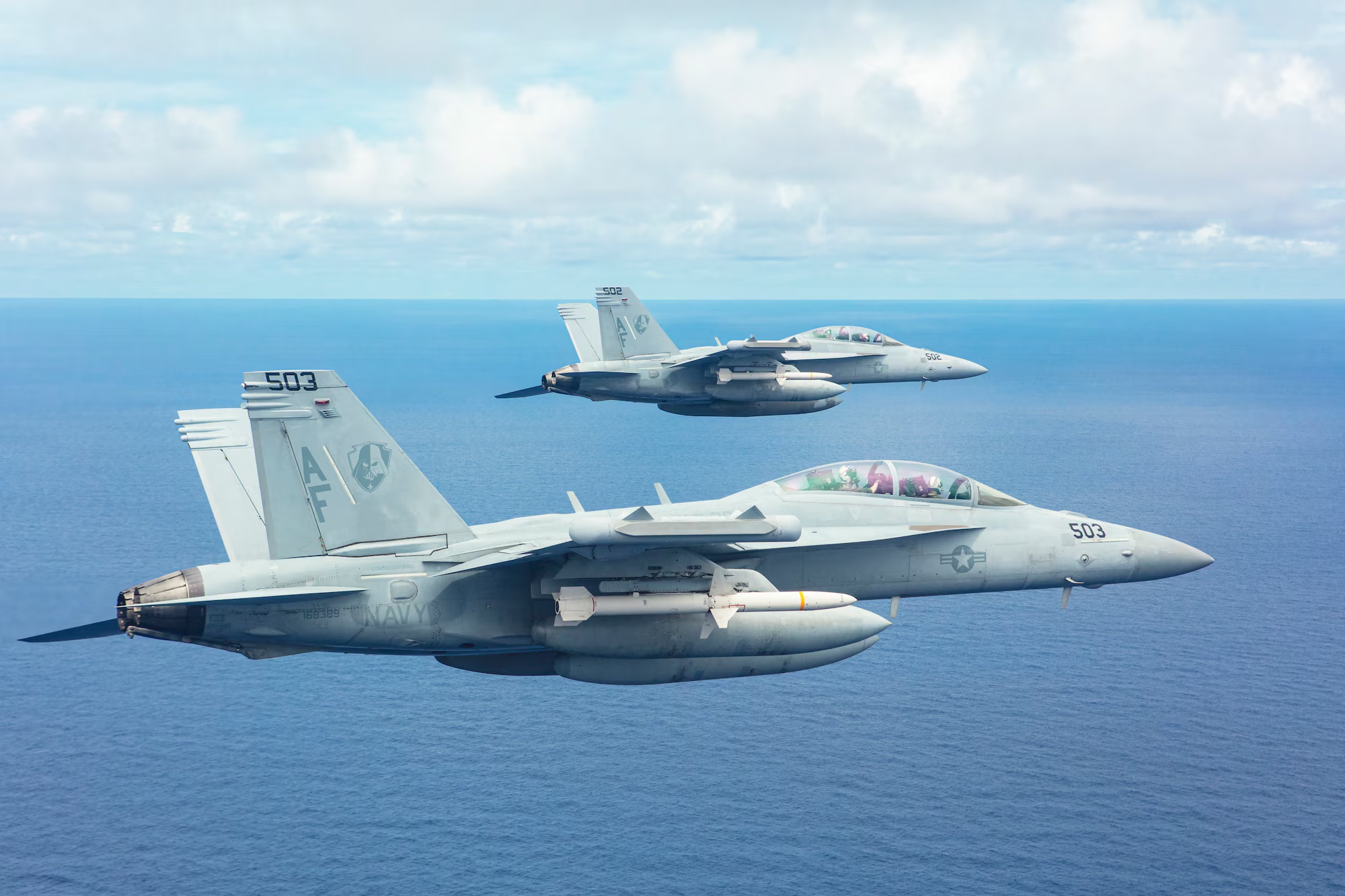
Two US Navy Boeing EA-18G Growlers collided mid-air during a demonstration at the Gunfighter Skies Air Show at Mountain Home Air Force Base in Idaho on 17 May.
The two aircraft were flying in close formation around two miles northwest of the base when the collision occurred. Video shows the two jets locking wings and spiralling out of control, before descending towards the ground.
The four aircrew onboard the aircraft ejected and were confirmed to be recovered alive and in stable conditions. The Growlers impacted open terrain outside the base perimeter near State Highway 167.
EA-18G Growlers mid-air collision: How it happened
The two Navy EA-18G Growlers from the VAQ-129 demonstration team were performing a two-ship aerobatic routine as part of the Gunfighter airshow.
The pair were flying in close formation, with one leading and the other slightly behind. They’d flown away from the air base and appeared to be turning to head back over the show crowd.
At some point, the trailing aircraft appears to close too rapidly on the lead aircraft.
The trailing Growler then struck the rear upper section of the lead aircraft with its nose, impacting the tail area of the other jet.
Footage of the mid air collision between a pair of Navy Super Hornets/Growlers during the Gunfighter Skies Air Show at Mountain Home Air Force Base moments ago. pic.twitter.com/yQqPavmSWk
— OSINTtechnical (@Osinttechnical) May 17, 2026
Unusually, the two aircraft did not bounce apart following the collision, but appeared to have become physically locked together. One aircraft ended up partially on top of the other, with the two jets effectively stacked nose-up together.
This meant what could have been a recoverable accident almost turned into a disaster. The two aircraft became a single, unstable mass, pitching sharply upwards and rapidly losing airspeed.
The subsequent stall left the EA-18G crews with nowhere to go but out. The aircraft were doomed, but the crew managed to eject safely.
How could the two EA-18G aircraft become entangled?
Investigations will follow, but analysts suggest that the nose of the trailing aircraft may have become lodged underneath a structural section of the lead aircraft.
The geometry of the impact appears to be significant. From the footage, we can see the rear aircraft approaches from slightly above and behind, before descending into the lead aircraft’s rear fuselage and tail area.
Better angle of today's midair collision in Idaho.
— Brick Suit (@Brick_Suit) May 18, 2026
The trailing plane (on the right) appears to have descended onto the plane below it, perhaps after losing sight of it in a blind spot.
Miraculous that all four ejected safely. pic.twitter.com/Zwwf2Z83Ef
The nature of the close formation flights means the speed differential was much lower than in a head-on collision, a fact that avoided a catastrophic explosion but also meant the two jets didn’t instantly shear apart.
Whatever caused the rear Growler to become mechanically attached to the lead aircraft, the force was such that the two jets appear to have stayed interconnected all the way to the ground.
This is relatively rare in mid-air collisions. Usually, aircraft separate immediately due to aerodynamic forces and structural breakup.
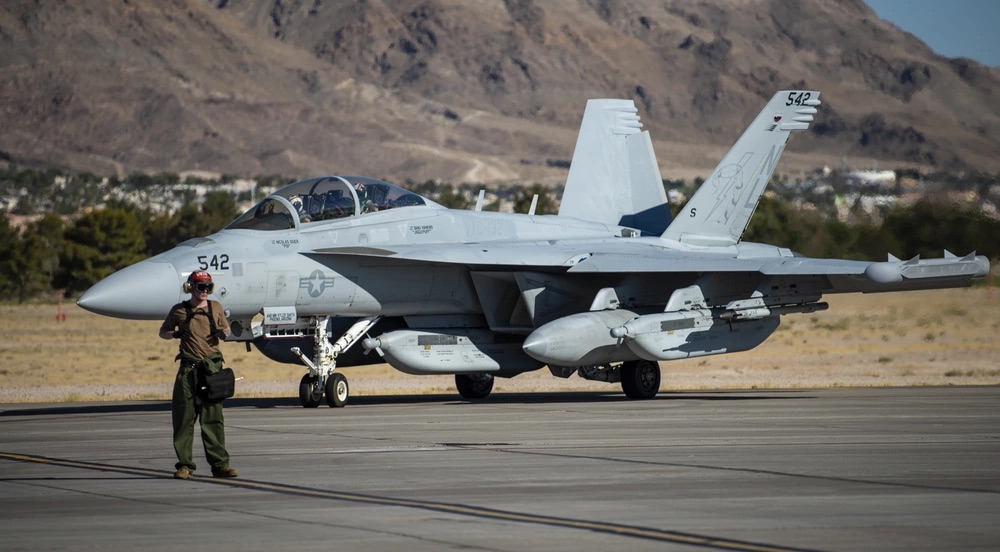
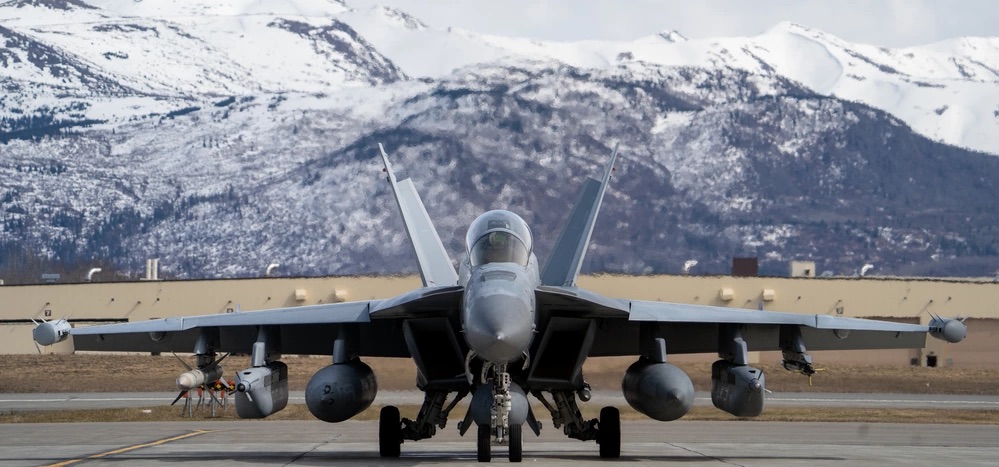
The design of the EA-18G may have contributed to this unusual outcome. Its twin vertical tails, widely spaced engines and large leading edge extensions create multiple structures capable of trapping another aircraft during a low-angle collision.
A lucky escape for the US Navy EA-18G crew
Crowds at the airshow were relieved to see four parachutes open up soon after the collision, but the escape of the aircrew was almost a miracle in itself.
Two fast jets colliding in mid-air and becoming physically entangled could have created an unsurvivable situation. However, several things came together that allowed the crew to eject safely.
Although the Growlers became entangled, they didn’t immediately lose control. The collision forced the aircraft into a sharp nose-up attitude and a momentary climb. Those few seconds were vital for the crew’s escape.
As the aircraft seemed to hang in the air, noses together, the crew saw a window to escape. Had the aircraft been back-to-back, inverted or begun to break up, ejection would have been impossible.
Yesterday, two Boeing E/A-18G Growlers collided mid-air during an airshow demonstration at Mountain Home AFB, Idaho.
— Martin-Baker (@MB_EjectEject) May 18, 2026
All four pilots successfully ejected using the Martin-Baker US14A (NACES) Ejection Seat.#EngineeringForLife pic.twitter.com/MbEqOEyegF
All four crewmembers (one pilot and one electronic warfare officer on each aircraft) ejected almost simultaneously, demonstrating excellent crew discipline and rapid decision-making in the cockpit.
Ironically, the unusual entanglement of the aircraft may ultimately have been what saved the crew.
Investigation begins into the EA-18G mid-air collision
A formal military investigation has been launched following the crash, led by the US Navy with support from Mountain Home AFB.
The US Navy has not yet released the identities of the crew involved, but having direct cockpit testimony from survivors will be significantly beneficial for the investigation.
Nevertheless, the complete investigation is likely to take months.
Following the crash, the rest of the flying display at Gunfighter Skies was cancelled.
The 2026 edition of the show is the first time the airshow has taken place since 2018, after a civilian glider pilot was killed during a performance. In 2003, a USAF F-16 also crashed at the same airshow, although the pilot ejected safely.
That does not necessarily mean the airshow itself is unusually unsafe, because military airshows inherently involve high-performance flying. But it does mean the event now has a notable accident history attached to it.
Featured image: DVIDS


