


Embraer and Saab expand Gripen production in Brazil as partnership evolves into global manufacturing programme

7 min read

Saab and Embraer are expanding their Gripen partnership with an agreement that could see up to 20 additional fighters assembled in Brazil, increasing production capacity for future international customers.
Announced at the Farnborough International Airshow, the Heads of Agreement provides the framework for the potential production of 20 additional Gripen aircraft in Brazil, with the two companies intending to conclude a final agreement this year.
Under the proposed arrangement, Embraer will assemble the aircraft at its Gaviao Peixoto facility, complementing Saab’s existing final assembly line in Linkoping and increasing production capacity to meet future international demand.
Rather than representing a new aircraft order, the agreement expands the industrial partnership between the two companies, allowing Saab to manufacture Gripens simultaneously in Sweden and Brazil should additional export contracts materialise.
Bosco da Costa Junior, President and Chief Executive Officer of Embraer Defense & Security, said the agreement reflected how the partnership had developed over the past decade.
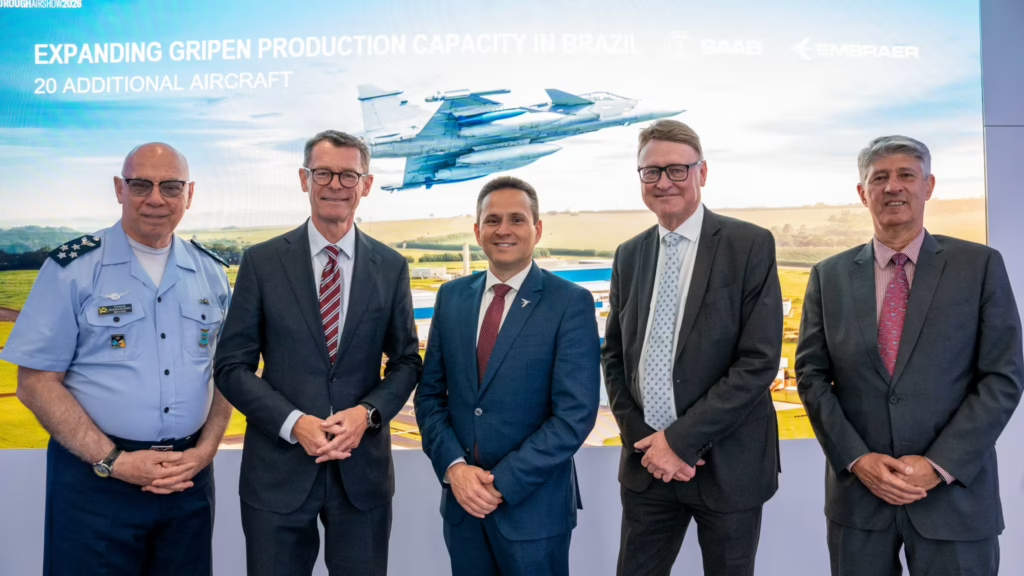
“The expansion of this partnership with Saab reflects the mutual trust built over the past ten years and reinforces Embraer’s strategic role in the Gripen programme. We are well positioned to support increased production capacity, if demand requires it,” he said.
Saab President and Chief Executive Officer Micael Johansson said the expanded industrial arrangement would provide additional manufacturing flexibility while reinforcing the company’s long-term commitment to the region.
“The partnership between Saab and Embraer reinforces our long-term commitment to Latin America. Together, we are strengthening our capabilities, securing additional capacity for future business opportunities, and taking a forward-leaning approach to supporting the evolving needs of our customers across the region.”
Brazil is becoming Saab’s second manufacturing hub for the Gripen fighter
The agreement represents another step in a programme that has steadily transformed Brazil from a Gripen customer into one of Saab’s principal industrial partners.
The relationship began in 2014 when Brazil selected the Gripen E/F under a contract covering the development and production of 36 aircraft including 28 single-seat Gripen E fighters and eight two-seat Gripen F variants.

Unlike many fighter acquisition programmes, the agreement was built around industrial participation, technology transfer and local production from the outset.
Since then, Gaviao Peixoto complex in Sao Paulo State has evolved into the only Gripen final assembly line outside Sweden. Working within an integrated production model that combines Brazilian and international suppliers, the facility now undertakes aircraft assembly, systems integration, testing and production activities for the Brazilian Air Force while supporting Saab’s wider manufacturing network.
The significance of that capability became evident in March this year when Embraer, Saab and the Brazilian Air Force formally unveiled the first supersonic Gripen fighter assembled in Brazil at the Gaviao Peixoto facility. The aircraft marked the beginning of local production under the Brazilian programme and demonstrated that the industrial capabilities transferred from Sweden had matured into a fully operational assembly line.
At the ceremony, Bosco da Costa Junior described the aircraft as the product of a long-term industrial partnership rather than simply another defence procurement programme.
“We take great pride in supporting the Brazilian Air Force in this project and in developing, within Brazil, the capability to produce a high-tech supersonic fighter aircraft fully capable of executing air superiority missions and contributing to the defence of our territorial sovereignty. The unveiling of the first Gripen produced in Brazil represents yet another significant step in the strategic collaboration between Brazil and Sweden,” he said.
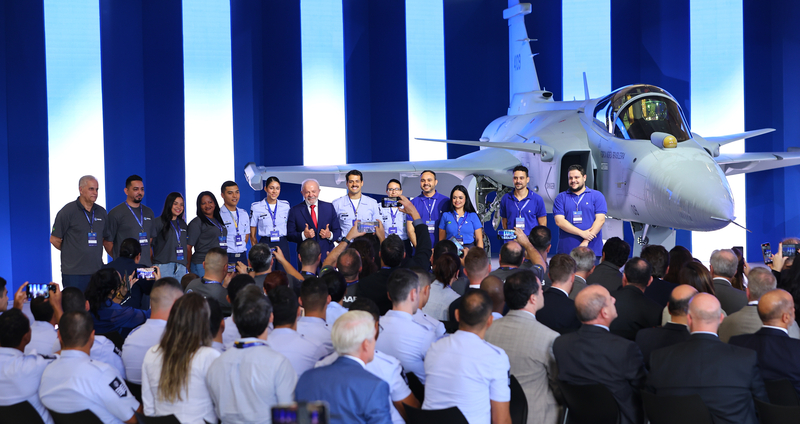
Johansson said the first Brazilian-built Gripen demonstrated how the partnership had evolved beyond aircraft deliveries.
“The delivery of the first Gripen produced in Brazil represents far more than the completion of an aircraft; it symbolises the strength of a partnership built on trust, long-term vision and true cooperation,” he said.
Technology transfer has become one of the programme’s defining achievements
The Brazilian Gripen programme has been built around one of the most extensive technology transfer initiatives undertaken by Saab.
Over the past decade, Brazilian engineers, technicians, test pilots, assembly specialists and maintenance personnel have trained in Sweden before returning to Brazil to work on aircraft design, manufacturing and flight testing. The programme has created a highly skilled workforce while establishing capabilities that extend well beyond final assembly.
That investment in people and industrial capability is now becoming central to Saab’s global manufacturing strategy.
Instead of operating solely as a domestic production facility, Gaviao Peixoto is increasingly positioned to support international programmes, providing Saab with additional capacity while giving Brazil a long-term role in one of Europe’s most advanced fighter aircraft programmes.
The Gripen F gives Brazil a central role in the programme’s future development
The industrial partnership has also extended beyond production into aircraft development.
In June, Saab rolled out the first Gripen F for the Brazilian Air Force during a ceremony at its Linkoping facility.
The aircraft is the two-seat variant of the Gripen E family and has been jointly developed to meet Brazil’s operational and training requirements while expanding the aircraft’s capabilities for future export customers.
Unlike conventional twin-seat fighters that are primarily used for pilot instruction, the Gripen F has been designed as a fully operational combat aircraft. While retaining the sensors, avionics and mission systems of the single-seat Gripen E, it incorporates an independent second cockpit that enables instructor-led operational missions, advanced tactical training and shared workload during complex combat operations.
Saab says the configuration allows air forces to shorten pilot conversion times by providing realistic operational training in the aircraft that crews will ultimately fly, while also increasing mission effectiveness during demanding operational scenarios.
Lars Tossman, Head of Saab’s Aeronautics business area, said the aircraft reflected the depth of cooperation between Sweden and Brazil.
“The rollout of Gripen F represents a shared achievement between Saab, Brazilian industry and the Brazilian Air Force, reflecting the deep trust we have built together over many years. Developing this aircraft together demonstrates the maturity of this collaboration. It represents not only a highly capable fighter for the Brazilian Air Force, but also the tangible outcome of sustained joint development and shared ambition.”
Before entering operational service, the aircraft will undergo a dedicated flight test campaign at Saab’s Flight Test Centre in Sweden.
Brazil’s role now extends beyond aircraft production
Brazil’s participation in the Gripen programme has steadily expanded from customer to development partner and now to manufacturing partner.
Under the original agreement, Brazilian engineers worked alongside Saab during the development of the Gripen F, contributing to design activities while building expertise in advanced fighter technologies. The collaboration has helped establish engineering capability in areas ranging from systems integration and software development to structural design and flight testing.
The Gaviao Peixoto facility is also supported by a wider Brazilian industrial network, including Saab’s aerostructures facility in Sao Bernardo do Campo, which supplies major structural components for the programme. Together, the facilities form an integrated production chain that mirrors Saab’s manufacturing model in Sweden.
The first Brazilian-built Gripen is currently undergoing functional testing and production flight trials before joining the Brazilian Air Force’s First Air Defence Group at Anapolis Air Base, where the aircraft has already begun supporting Quick Reaction Alert missions following earlier deliveries.
Growing export success is increasing pressure on production capacity
The proposed expansion of production comes as the Gripen continues to secure new international customers.
Alongside Brazil, Saab has recently secured orders for the Gripen F from Thailand and Colombia, adding to a growing international operator base and increasing demand for both aircraft production and long-term support.
Deliveries to the Brazilian Air Force began in 2020 and more than a dozen aircraft have now entered service, with the remaining aircraft under the original contract continuing to move through production. Each delivery further expands Brazil’s experience in assembling, testing and supporting one of the world’s most advanced fourth-generation-plus combat aircraft.
Against that backdrop, the agreement announced at Farnborough is less about producing another 20 aircraft than about preparing the industrial capacity needed for future opportunities.
Should the proposed production framework be finalised this year, Saab will be able to draw on two fully integrated final assembly lines operating on separate continents. That additional flexibility could become increasingly important as countries seek faster delivery schedules and greater industrial participation in future fighter acquisitions.
Sign up for our newsletter and get our latest content in your inbox.


More from

October 25, 20266 min read

October 25, 20265 min read


