Iran ceasefire reopens critical airspace but airline restrictions remain

5 min read

A tenuous two-week ceasefire between the United States and Iran has eased some aviation restrictions across the Gulf. However, the lifting of airspace closures is uneven and partial. While Syria, Iraq and Bahrain have reopened their flight information regions (FIRs) and airports, other Gulf routes remain tightly restricted due to persistent security risks.
How long these airspaces will remain open is still uncertain, given the fragile nature of the agreement.
Below is the current operational picture for the Gulf and the nearby Middle East airspace at the time of writing.
Where airspace has reopened after the Iran ceasefire
As reported by Anadolu Ajansı (AA), Syria, Iraq and Bahrain reopened their airspace on Wednesday, with civil aviation authorities permitting flights after the announcement of the US-Iran ceasefire agreement.
Iraq has reopened its airspace, and Baghdad International Airport resumed limited operations following the ceasefire announcement. This restores part of a key Europe–Asia transit corridor that had been closed since early in the conflict.

As AirlineRatings has reported, Iraq allowing overflights again is a significant development. Iraqi airspace lies directly along the shortest Europe-Asia route. If its reopening lasts, it could reduce detours and cut airline fuel costs. However, most airlines will likely wait and watch how the situation unfolds before relying on this routing.
Bahrain has also reopened its airspace and the country’s civil aviation authority has committed to ensuring the smooth flow of air traffic while maintaining high safety and security standards.
Syria also reopened its airspace shortly after the ceasefire announcement, with operations at Damascus International Airport reported to be “returning to normal.”
Still, at the time of writing, Flightradar24 showed no air traffic activity over Syria and limited activity over Iraq and Bahrain.
Air traffic flow through the Middle East region continues to concentrate around open airspace and limited but usable corridors.
Why airlines will remain cautious
Even with the temporary ceasefire, airlines may hesitate to resume normal routes because the truce is conditional and expected to last only two weeks. Iran’s objections to Israel’s ongoing strikes on Lebanon could cut the truce shorter. The risks of missiles and drones in parts of the Gulf remain an ongoing concern.
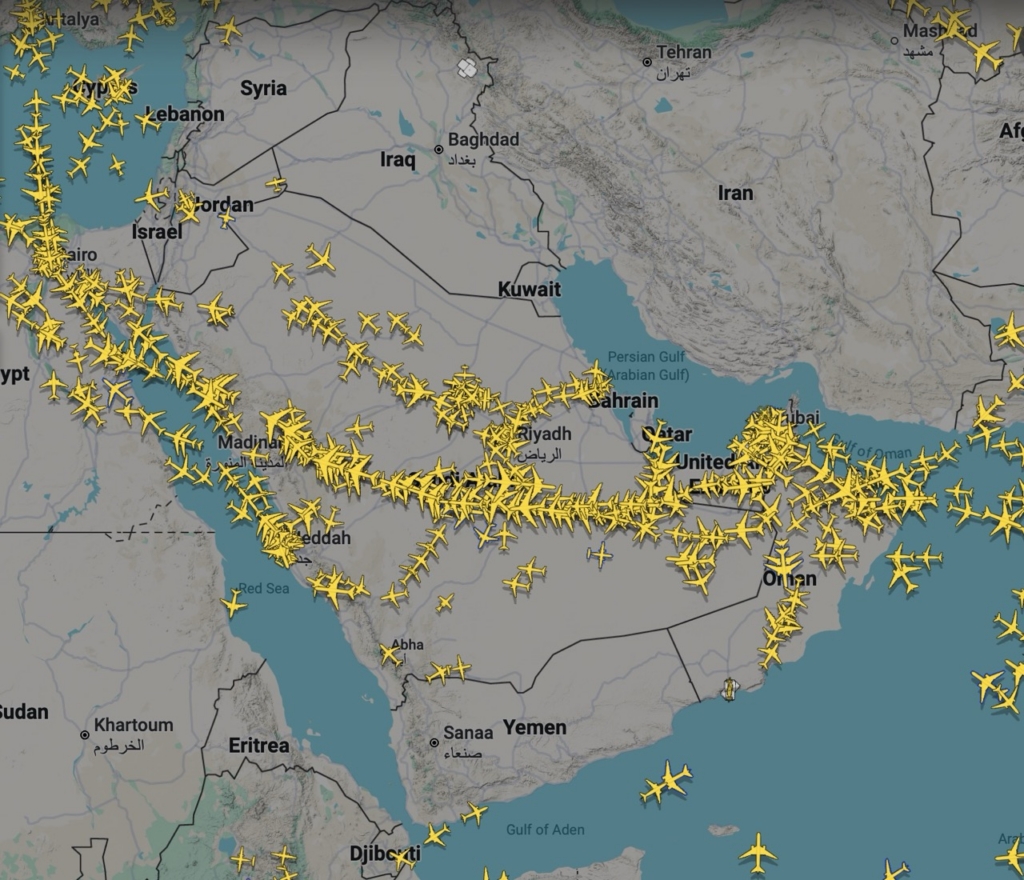
FlightRadar24 activity shows aircraft primarily using approved “safe corridors” with limited activity in the recently reopened airspace. Many long-haul flights between Europe and Asia are still routing north via the Caucasus or south via Egypt and Saudi Arabia, rather than flying directly across the Gulf.
How airlines are routing flights during the Iran conflict
The traditional Middle East flight corridor between Europe and Asia is still only partially usable. As OpsGroup has reported, throughout the conflict, airlines have followed two main routing patterns.
1. The northern “Caucasus corridor”
This route has become the primary alternative during the conflict.
The typical flight path has been:
- Europe
- Türkiye
- Georgia / Azerbaijan
- Caspian Sea
- Kazakhstan or Turkmenistan
- China / Japan / Korea
This corridor handled much of the diverted Europe-Asia traffic after authorities effectively shut the normal Gulf routing.
Airlines have followed this path because it avoids Iranian, Iraqi, and Gulf airspace entirely, with lower risk from missile or drone activity.
The main drawbacks of this routing are that it can add 1–2 hours of flight time and, thus, requires more fuel burn, with jet fuel costs rising.
2. The southern “Arabian Sea corridor”
The southern corridor has been the second major detour around the conflict, especially for flights to India and Southeast Asia.
Typical path:
- Europe
- Egypt
- Red Sea
- Saudi Arabia
- Oman
- Arabian Sea
- India / Southeast Asia
This routing avoids Iranian airspace completely, using lower-risk flight corridors through Saudi Arabia and Oman. However, like the northern Caucasus route, it also adds flight time and fuel burn. Some airlines have selected this route because large portions of Saudi and Omani airspace have remained open during the conflict.
Limited operations at “Gulf safe corridors”
As OpsGroup reported on March 30, “operations in the Gulf are mostly limited to local carriers and approved flights.” Routes overflying Gulf hubs are restricted and tightly controlled, with air traffic flowing through security-managed corridors.
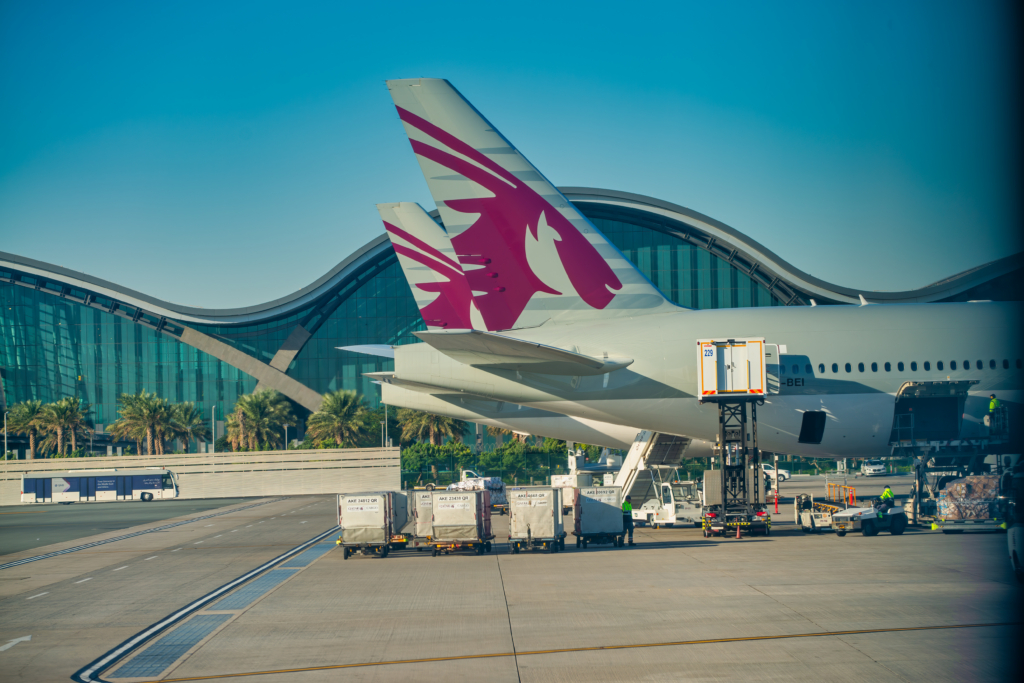
These routes are mainly used by national carriers serving Gulf hubs such as Dubai, Abu Dhabi, and Doha, mainly for repatriation and cargo flights.
UAE airspace is open only through restricted corridors under emergency air traffic control. Qatar is allowing limited operations by Qatar Airways. But most international carriers have suspended service to these hubs.
Why airlines will continue to avoid high-risk airspace
Because the ceasefire is temporary, many international airlines will likely continue to avoid the central Gulf corridor. EASA’s most recent CZIB on Middle East airspace, which is valid through April 10, notifies airlines to avoid airspace of Bahrain, Iran, Iraq, Israel, Jordan, Kuwait, Lebanon, Qatar, UAE, Oman and Saudi Arabia.
However, the CZIB lists an exception in Oman and Saudi Arabia, permitting operations south of a line of four specific compulsory reporting points, only flying at an altitude of FL320 (32,000 ft) or above, and only with a current risk assessment.
National regulators have warned airlines to avoid large areas of Gulf airspace, as missile and drone risks remain across the region, along with the threat of misidentification, where a civilian aircraft may be brought down, inadvertently confused for a hostile aircraft.
The limited ceasefire does not significantly benefit airlines
The conflict is fluid with risk levels shifting quickly, sometimes mid-flight. Airlines will likely continue to avoid flight corridors that could pose a risk to passengers, even if the two-week ceasefire holds.
Airlines currently face multiple challenges, not the least of which is the rising cost of fuel. If the Strait of Hormuz reopens long enough and fuel costs stabilise, the airline industry would benefit. But until the parties reach a lasting agreement, commercial aviation will continue to navigate in turbulent skies.
Featured Image: Bahrain Airport