The Goodyear blimp – marking 101 years from innovative advertising tool to American cultural icon

13 min read
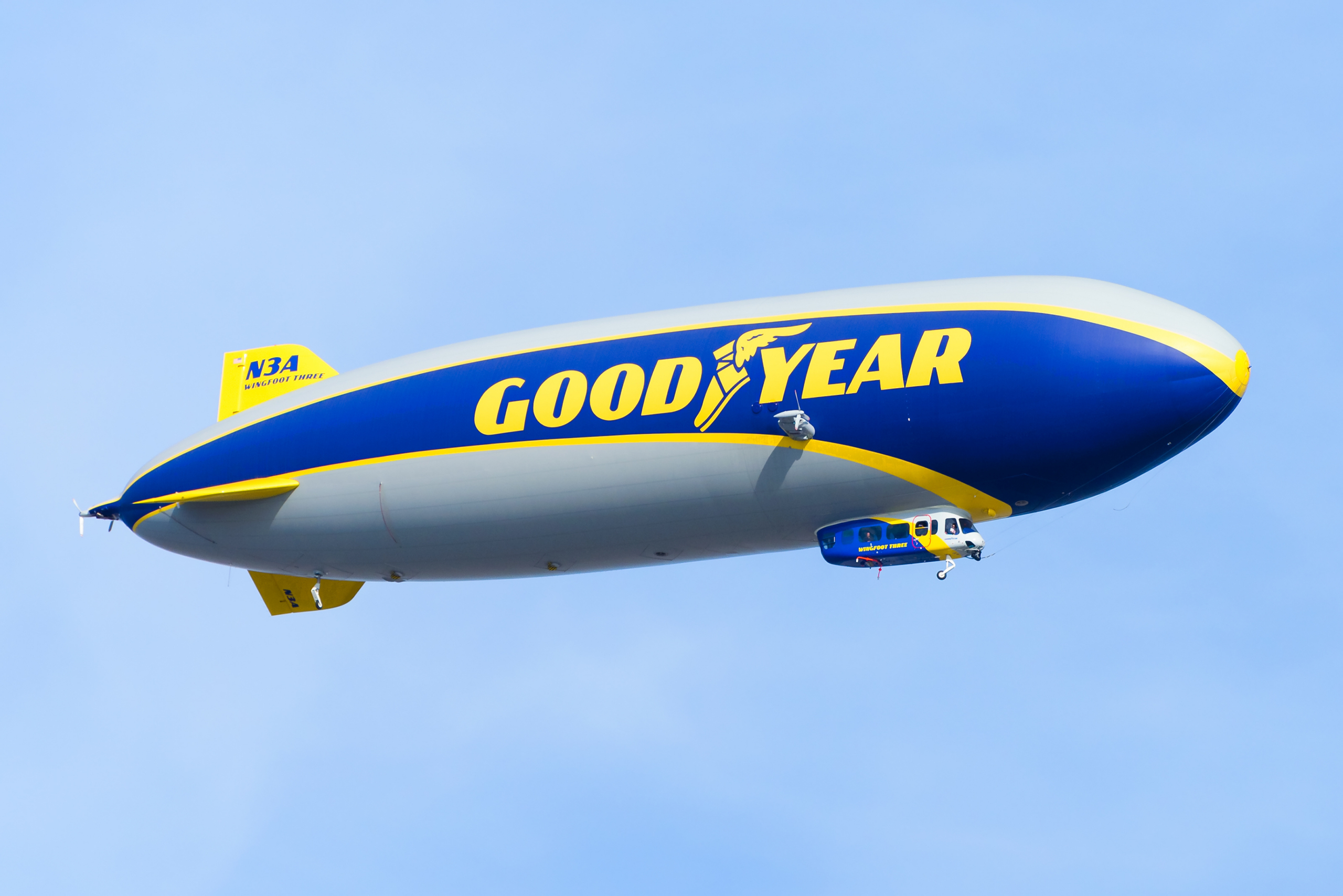
Any mention of the Goodyear blimp conjures up thoughts of soaring lighter-than-air aviation and Americana at its finest. In the 101 years since the first flight of a Goodyear blimp, the aircraft has become synonymous with huge US sporting events, cheering crowds and stunning air-to-ground video footage.
What began as a unique way of advertising and selling motor car tyres has become a cultural icon of modern-day America. The unmistakable sight of the blue and gold airships over major public events across the US has become part of American folklore.
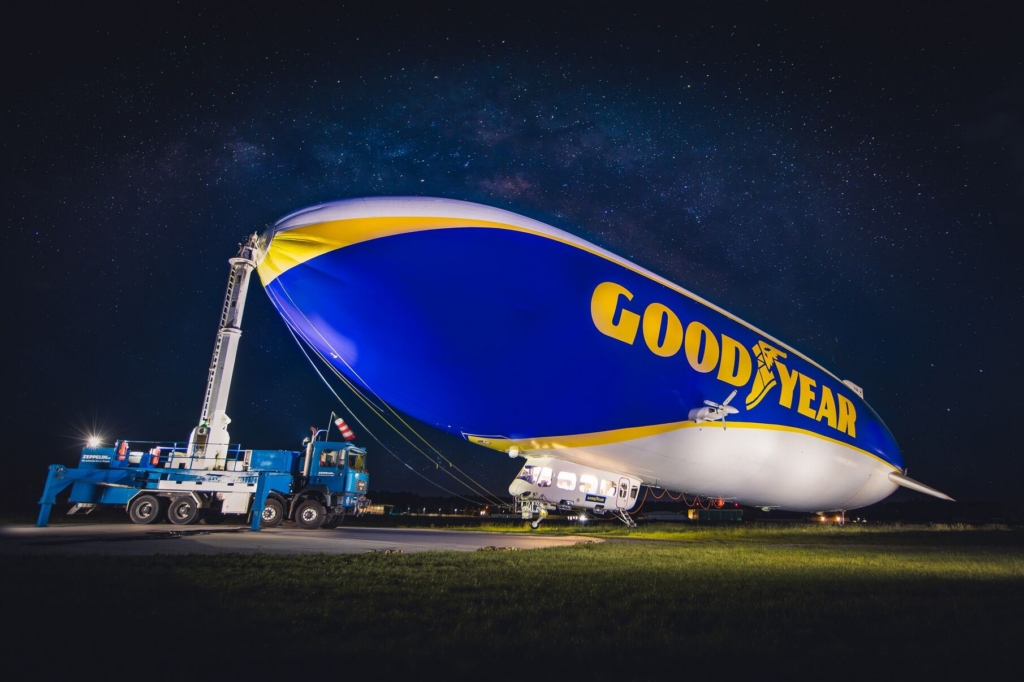
With the FIFA World Cup looming large on the horizon and kicking off on 11 June across the United States and Mexico, the profile of the Goodyear blimp airships is just about to be raised even higher on the world stage.
Pre-1920s: Goodyear’s first foray into aviation
The Goodyear Tire & Rubber Company first entered the fledgling aviation industry when it established its Aeronautics Department in 1910 to market rubber-infused fabrics and coatings for aircraft and lighter-than-air craft. Goodyear built its first balloon in 1912, and the next year began building and flying balloons in national and international competitions.
In 1916, Goodyear bought 720 acres of land southeast of Akron (Ohio) to serve as a flying field and manufacturing site. It included Fritch’s Lake, which provided water power for a grist mill and a water reserve for factories several miles downstream.
The Goodyear Wingfoot Lake Airship Base, located near Akron, is the oldest in the United States. Construction of the Wingfoot Lake hangar started in March 1917. The facility and the lake itself were named after Goodyear’s corporate emblem, the winged foot of the Roman god Mercury.
Goodyear’s first airship production began in March 1917 when the US Navy ordered nine B-type airships. Since the hangar at Wingfoot Lake was still under construction, the initial prototype, the B-1, was erected in a large amusement park building in Chicago.
The B-1 first flew on May 24, 1917. Five days later, it was flown nonstop to within a few miles of Wingfoot Lake. The second airship, the B-2, was also erected in Chicago and soon joined the B-1 as a training ship at Wingfoot Lake. In 1918, the Navy ordered 15 C-type airships from Goodyear, and production of the C-1 began at Wingfoot Lake shortly thereafter.
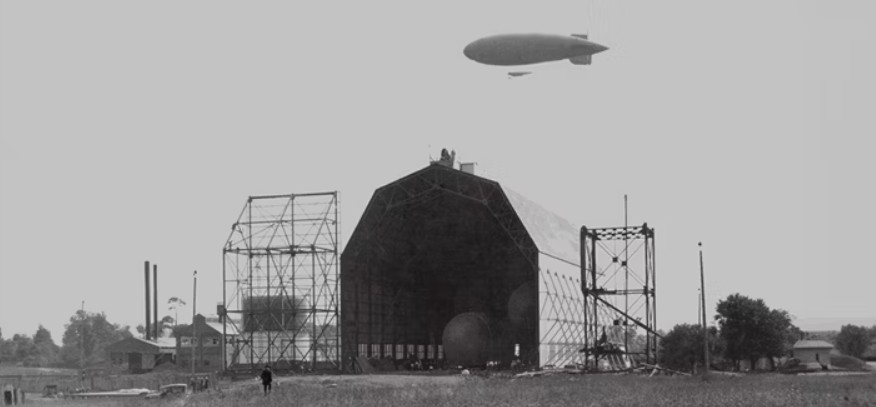
Although most of the B- and C-ships built by Goodyear were shipped to the Navy for final assembly and flight testing, Wingfoot Lake was used as the training site of the first class of Navy airship pilots.
With Goodyear personnel as instructors, some 600 Army and Navy officers and enlisted men were trained to fly and maintain B- and C-type airships, kite (observation) balloons and free balloons.
The Navy took over the Wingfoot Lake facility and operated it as a US Naval Airship Training Station from 1917 through 1921. It served as a construction, test and development base and consisted of 26 buildings by the end of World War I.
The word ‘blimp’ first appeared in print during World War I (1916) and was used as a term for a non-rigid airship – an airship that keeps its shape from the pressure of the gas inside rather than from a rigid internal frame.
The development of blimps in the 1920s
During the “Roaring ’20s”, Goodyear looked for an innovative way to expand its tyre business. At the time, flying circuses were all the rage, with barnstormer shows becoming hugely popular across the US, with daredevil pilots showcasing their aerobatic skills to the delight of spectators.
At the time, alongside roadside billboard advertisements and newspapers, banner-towing planes were the only way to inform people about new products.
Looking to take advantage of the appeal of flying circuses, with their wing walkers and acrobatic stunts, as well as its fledgling airship business, Goodyear decided to build a fleet of airships (or dirigibles) for sightseeing flights to engage the public even further in the early days of aviation.
Goodyear’s first civilian blimp was the ‘Goodyear Type AD’, which the company named Pilgrim.
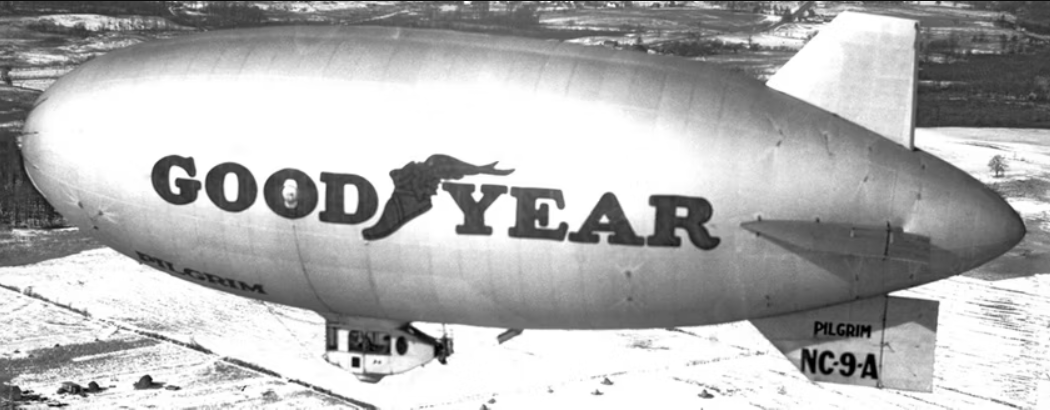
The Type AD made its maiden flight in Akron on 3 June 1925. While the company had initially intended to operate the airships for passenger flights, it soon realised that the airships, with their iconic shape and slow-flight capabilities, would be the perfect advertising tool for major outdoor events.
Using helium gas as a lifting agent, the Type AD offered a conventional design with a gondola large enough for the crew and two passengers. A unique feature of the Type AD was that it carried its own mooring mast, allowing the airship to land anywhere there was enough space.
Goodyear’s Pilgrim was the first commercial non-rigid airship flown using helium. With a landing wheel replacing bumper bags and the first passenger car held flush against its bag by internal cables, the Pilgrim was at the top of lighter-than-air technology.
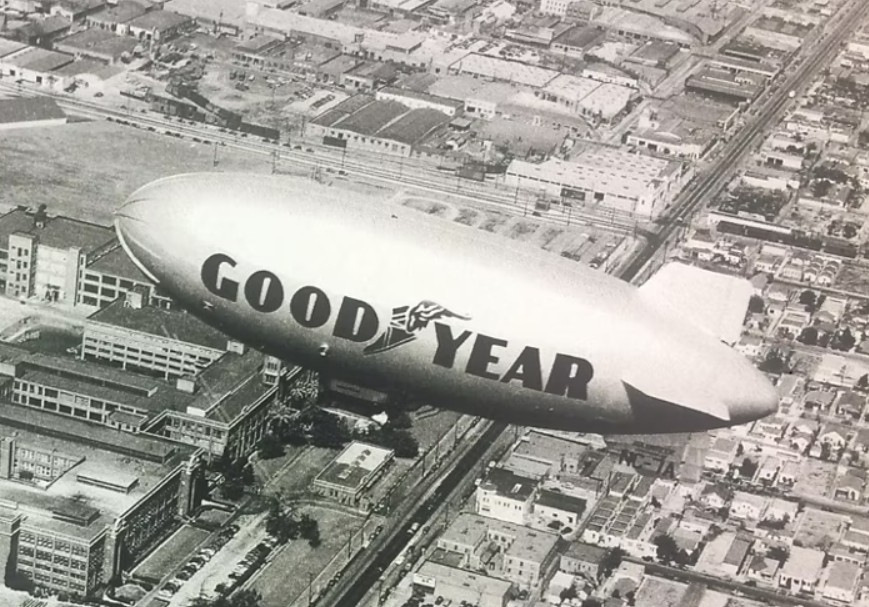
Previously, blimp gondolas were suspended from their envelopes by external cables only. Pilgrim was also the first blimp to be used for public relations.
Goodyear president Paul Litchfield saw the airships as yachts in the sky and decided to name the blimps after winners of the exclusive America’s Cup yacht race. Except for the Spirit of Akron, the tradition of naming the blimps after victorious yachts ended in 2005 with the Christening of Dennis Conner’s Stars and Stripes.
1930s – the Goodyear blimps were fitted with illuminated signs
In 1930, the Goodyear blimp named Defender became the first airship in the world to carry a lighted sign. Developed by H. Webster Crum and named Neon-O-Gram, the sign comprised ten removable aluminium-framed panels, which were attached to the side of the Defender and allowed static text to be displayed using neon light tubes.
Each panel weighed 35 pounds and stood six feet tall and four feet wide. The first sign to be illuminated spelt out the name of the company itself at night.
The Goodyear blimps, Columbia and Resolute, were built with 112,000-cubic-foot envelopes in 1931 and 1932. The other ships in the fleet were gradually fitted with new, larger envelopes. The Enterprise introduced the 123,000-cubic-foot envelope in 1934. Other ships were eventually increased to this size, as were the new ships, such as the Rainbow in 1939.
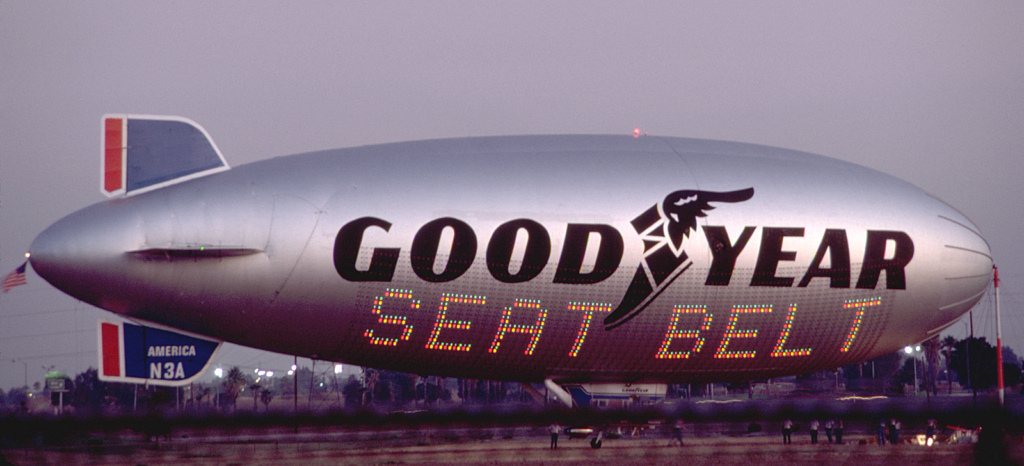
The fleet barnstormed over 42 states, training pilots and crewmen as well as developing operating procedures and techniques. The expeditionary mast and other support equipment were defined and refined. Engineering and manufacturing staff grew in their skills, and an immense knowledge of airship capabilities was gained.
Goodyear expanded its Aeronautical Department and then formed the Goodyear Zeppelin Corporation to build giant rigid airships for the US Navy.
The airships USS Akron and USS Macon were built from 1929 to 1933 in Akron. Several of the Goodyear pilots who were Naval Reserve officers were trained aboard these giant airships.
1940s and wartime – Goodyear halts its blimp programme
By the start of 1940, Goodyear wanted to make its blimps even more appealing, so it equipped each of its blimps with a record player, microphone, and loudspeakers to play recordings and would ‘blimp cast’ recordings and live greetings to the public below.
Two years earlier, during the 1939 New York World’s Fair, RCA’s president, David Sarnoff, unveiled the world’s first commercially available television – an innovation that would transform the potential for the Goodyear blimp.
However, with America’s entry into World War Two following the surprise Japanese attack on Pearl Harbour on 7 December 1941, Goodyear turned its attention to building aerial surveillance and early warning airships and mothballed its burgeoning blimp programme for the time being.
Additionally, during the war, RCA turned its attention to building military radios and components for radar systems, stifling the marketing potential of the blimp.
Post-war era – Goodyear blimps began covering sporting events
Following the war, RCA returned to making televisions, and by 1948, there were two million televisions in American homes.
Companies soon realised the value of sponsoring television shows and sporting events. In the early 1950s, Goodyear realised that its blimps could both advertise the company and its products while also generating additional revenue by providing aerial footage of large public sporting events from the air.
On 1 January 1955, using camera and microwave transmitting equipment provided by NBC, the Enterprise V became the first aerial platform to provide a live television picture of a nationally televised program when it broadcast the Tournament of Roses Parade in Pasadena, California.
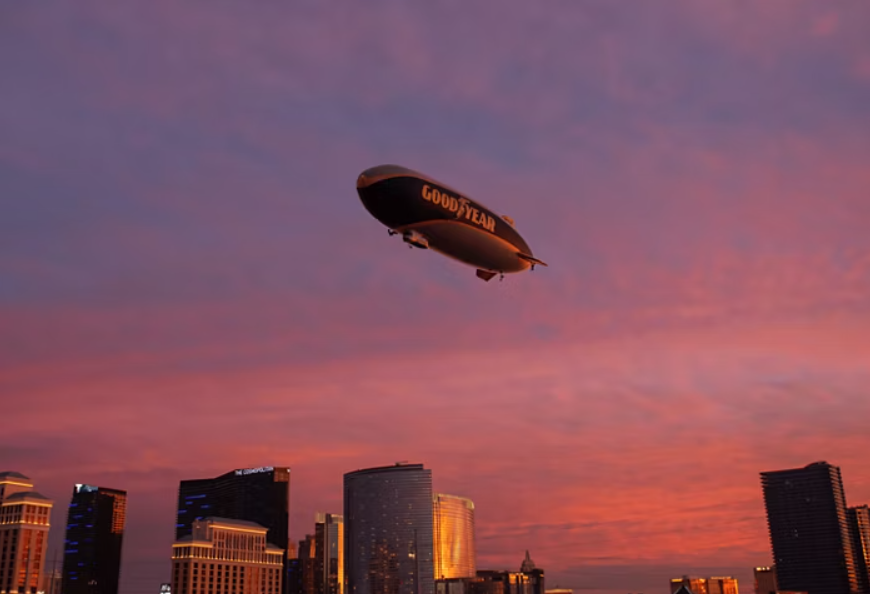
In the early years of the blimps’ aerial television coverage, the equipment was heavy and unstable, but it brought a new angle to the industry and allowed audiences to see things like never before. The television networks embraced aerial views and began employing the Goodyear blimps for an increasing number of events.
Goodyear blimp technology saw another leap forward in 1959 with the GZ-19 Mayflower V, which incorporated major gondola and power plant changes. This Blimp also featured the largest envelope yet at 132,000 cubic feet.
By the end of the decade, Goodyear had made three major advancements that would prove to be hallmarks of the fleet as well as lighter-than-air aviation in general: the new incandescent aerial sign lights, the larger envelopes allowing for more lift and the venture into live television.
With the waning of significant military applications for airships, these new opportunities would prove to be especially important for the company as the blimps soared into the 1960s and beyond.
Entering the 1960s with new technology and new opportunities
By the 1960s, nearly every home in America had a television, as the world was transitioning from black-and-white to colour. Live sporting events were more popular than ever, with Goodyear blimps not only providing aerial views for the fans at home but also a spectacle for the people who were attending the events themselves.
In 1963, the Mayflower VI was enlarged to 147,300 cubic feet, and Goodyear built a new sister ship of the same size, the Columbia II. The size of Goodyear’s blimps would continue to grow, and as they grew, the blimps were able to carry additional television equipment and more modern, easier-to-read electronic signage.
A remarkable advancement to the electronic sign was made with the introduction of Skytacular, a four-colour, animated night sign developed at Wingfoot Lake. It debuted to the public on the Mayflower V at the Indianapolis 500 in 1966.

Skytacular was a colourful leap forward from the 182 white bulbs, which were the standard for the blimps in the 1950s and early 1960s. With 1,540 lights per side in red, green, yellow and blue, the Mayflower V was the first Goodyear blimp sign to display moving figures and text.
Skytacular was so successful that in 1969, when the larger GZ-20 airship was designed and certified with more powerful engines and a larger envelope size of 202,700 cubic feet, the sign was enlarged as well. The new sign, dubbed ‘Super-Skytacular,’ had double the lights at 3,780 per side and was connected by more than 80 miles of wiring.
The Super-Skytacular sign was later installed on two new GZ-20A airships built in 1969, the America I and Columbia V, and on all new GZ-20As made after that.
Booming US sports provide the ideal platform for the blimps
For the Goodyear blimps, the 1960s ended with another expansion of the fleet as a new airship, the America, was built and given a home with a brand-new hangar and base in Spring, Texas, near the growing city of Houston.
Additionally, sports programming was a blossoming industry in the 1960s and produced several firsts, some with the Goodyear blimps in attendance.
The first-ever Super Bowl, featuring the Kansas City Chiefs and Green Bay Packers, was played on 15 January 1967, in Los Angeles, California, and shown live on CBS. The Goodyear blimp Columbia shared in the experience by providing live aerial views for the network and the nation.
The next year, when the Packers met the Oakland Raiders in Miami for Super Bowl II, the Mayflower was there to provide coverage. The Columbia also made a simple flyover appearance at the 1966 World Series in Los Angeles, where the Dodgers were playing the Baltimore Orioles.
In 1967, Goodyear purchased its first complete set of colour television gear, with a microwave transmitter and receiver.
The company would no longer be dependent on network-provided equipment for aerial coverage. Eventually, all three of the company’s blimps would have their own equipment, providing a huge leap forward in flexibility and, more importantly, continuity in operation.
Having become a firm and popular fixture at large American sporting events, Goodyear blimps began making cameo appearances in movies like the Beatles’ movie ‘Help’ and other classic beach party movies of the era.
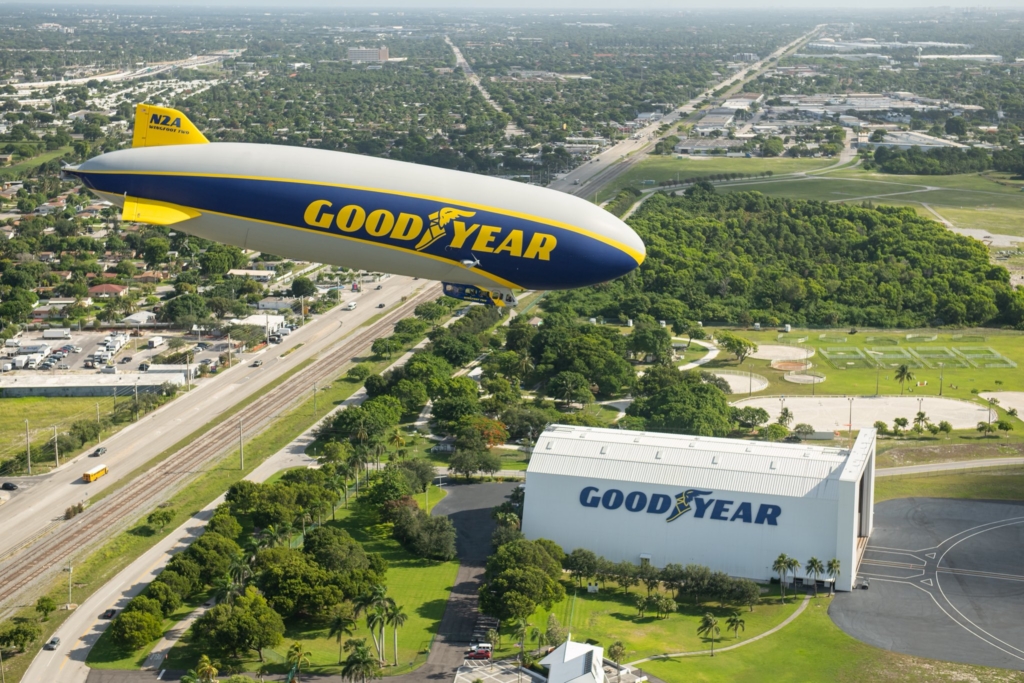
Later, two Goodyear blimps were used to cover the 1980 Baseball World Series between the Philadelphia Phillies and the Kansas City Royals.
Everything went so well with the World Series coverage that Goodyear sent two blimps to California to televise the 1984 Los Angeles Summer Olympic Games and many subsequent baseball World Series.
From 1970 through 1979, Goodyear’s Blimps were active broadcasters at more than 275 televised events across the US. These included the Super Bowl, the Indianapolis 500, the Sugar Bowl, the Cotton Bowl, the US Open Tennis, the PGA Golf, Grand Prix racing, the Kentucky Derby and the Daytona 500, to name just a few.
With sporting events such as Formula One and endurance races like the Le Mans 24-hour road race becoming prevalent in Europe, the American tyre manufacturer teamed with Deutsche Zeppelin-Reederei GmbH, based near Friedrichshafen in Germany, to build a European blimp.
Unlike its American counterparts, when this blimp is not covering European sporting events, it is regularly used for sightseeing trips around Germany.
Today’s Goodyear NT series blimp
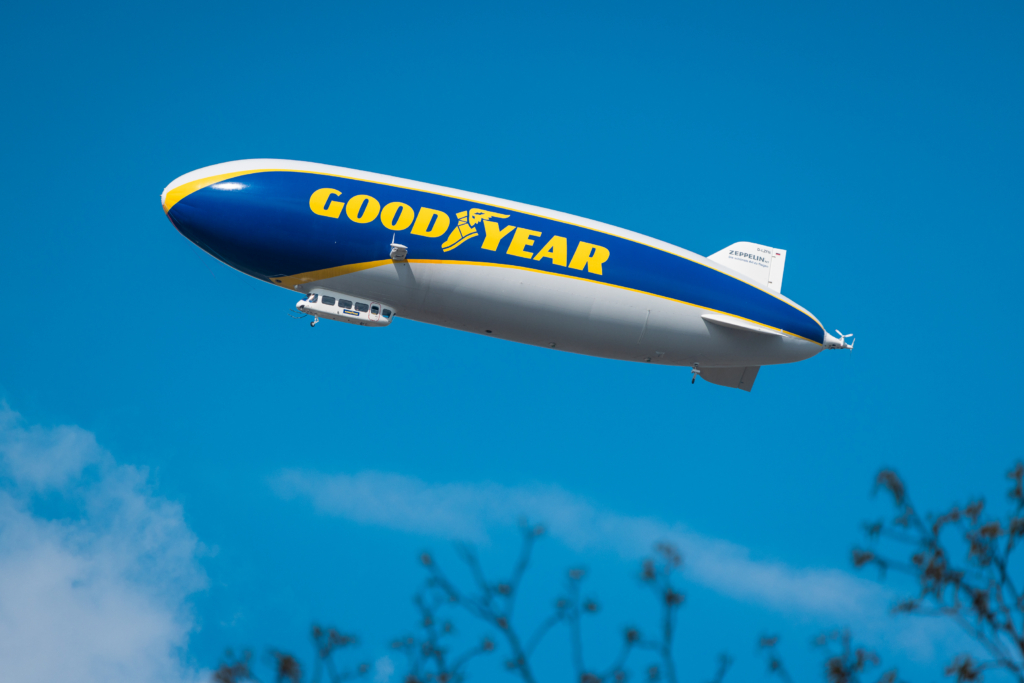
Currently operating a fleet of three Goodyear NT series blimps, the company continues to capture the imagination of the public with its airship activities. Goodyear blimps have become almost a permanent fixture at all major sporting events in both the US and across Europe and are now a familiar sight, resplendent in their blue and gold liveries.
With the FIFA World Cup starting in a matter of days, the Goodyear blimps are expected to have a significant presence over the headline matches, introducing the blimp phenomenon to a whole new generation.
The iconic nature of the blimps and their presence at such events has gained them a place in classic American history, along with Elvis Presley, the Moon landings, and apple pie.
Synonymous as they have become with huge sporting and outdoor events across the US, no such event is complete without the sight of a huge Goodyear blimp soaring gracefully overhead.
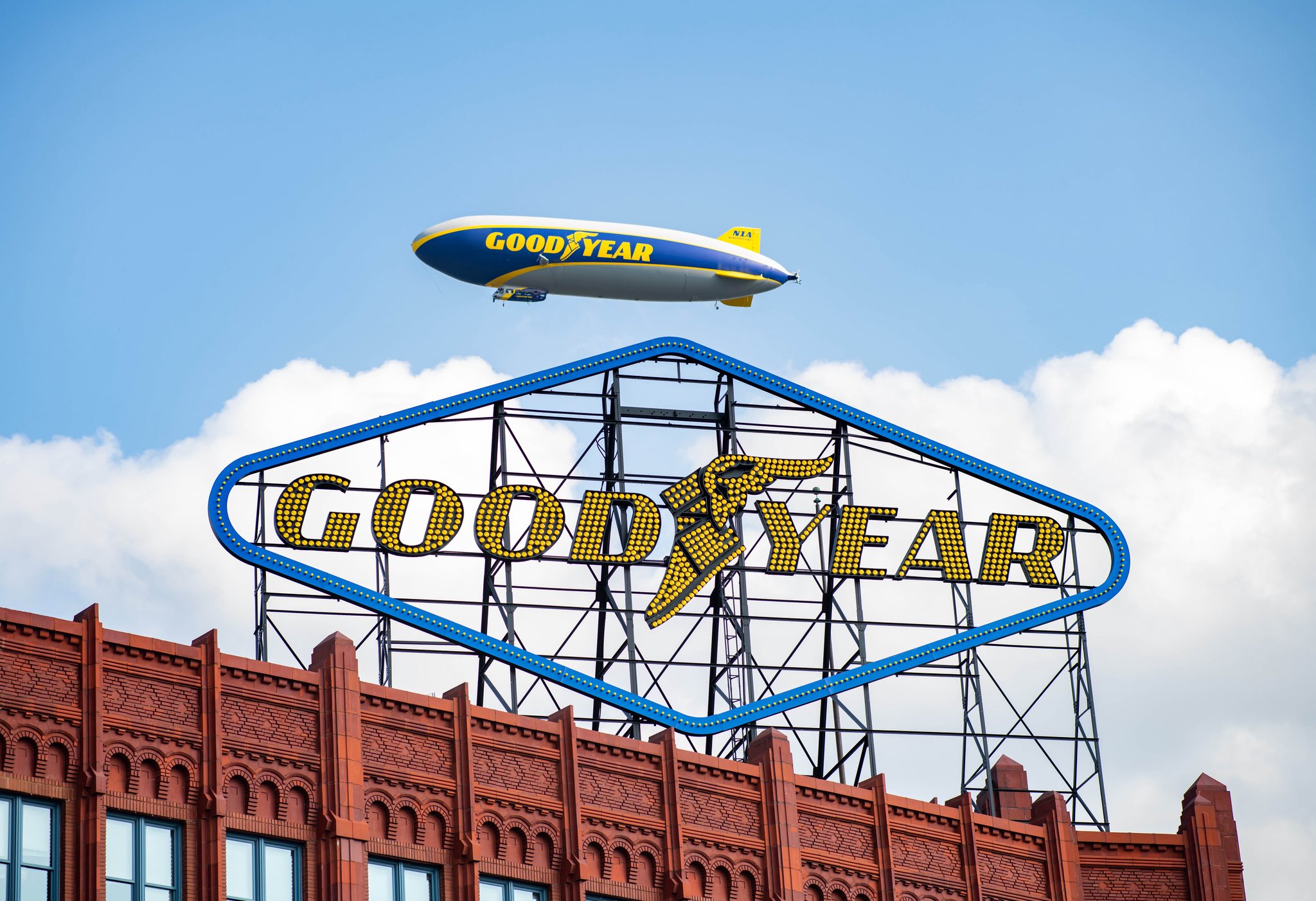
Now based in three locations across the US and with another based in Germany, the Goodyear blimps continue to impress crowds on the ground and add a certain nostalgia element to major outdoor events. The three US blimps are located at:
- Wingfoot Lake (Ohio) – home of Wingfoot One. This is the historic Goodyear airship facility, dating back to 1917.
- Pompano Beach (Florida) – home of Wingfoot Two, serving much of the southeastern United States.
- Carson City (California) – home of Wingfoot Three, serving the western United States.
So long as there are large outdoor events and huge crowds, the age of the Goodyear blimp lives on. With 101 years of unblemished service behind it and holding a special place in American aviation history, the Goodyear blimp continues its legacy as an icon of the skies.
Featured image: Thiago Trevisan / stock.adobe.com
Sign up for our newsletter and get our latest content in your inbox.


More from


October 17, 20265 min read


October 17, 20264 min read