As Air New Zealand brings back berths on planes, here’s what to expect from its new economy Skynest

6 min read
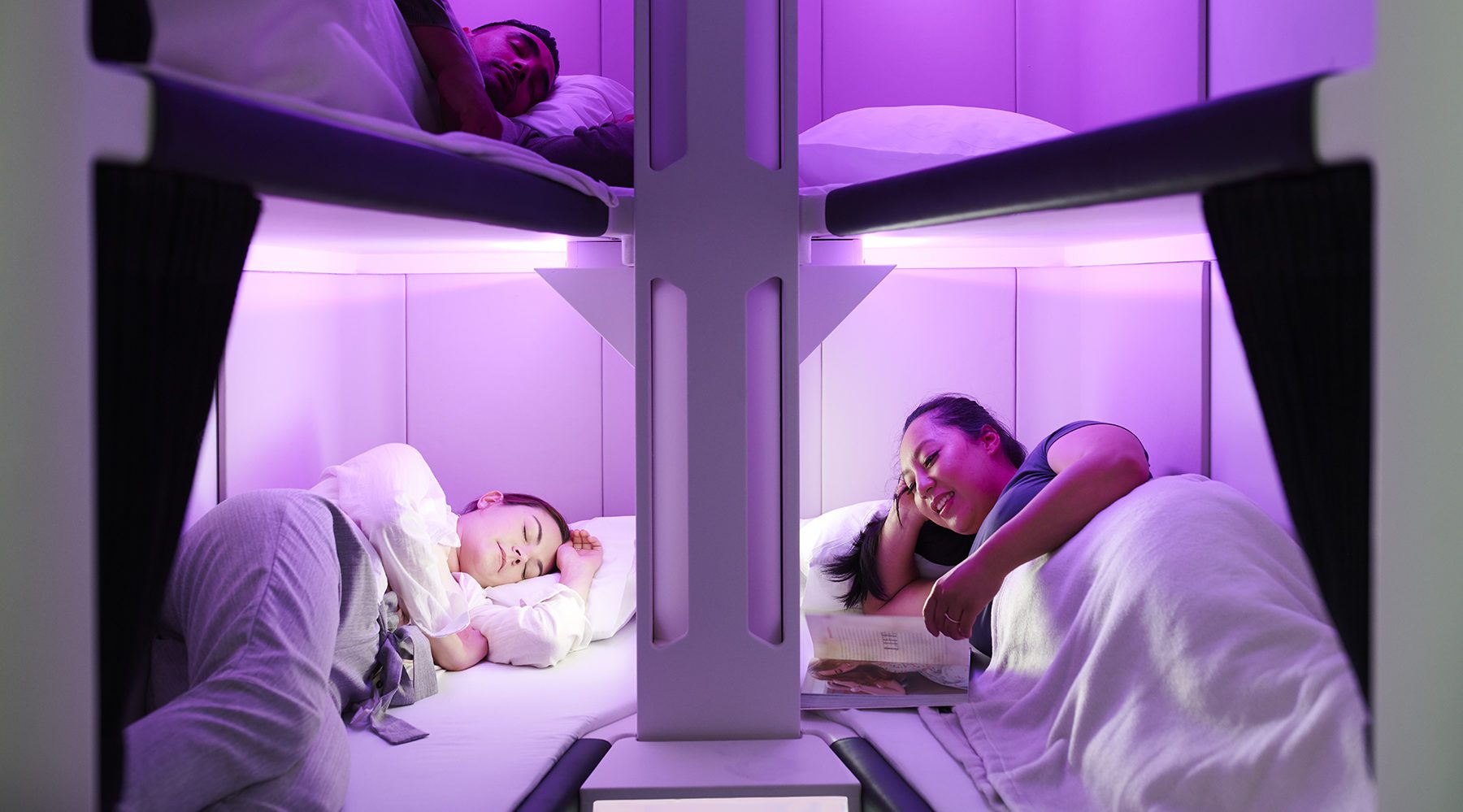
Air New Zealand will open reservations for its new Skynest economy sleep pods in May, with the first flight from Auckland to New York on the Boeing 787-9 scheduled for November. The airline is betting that getting a few winks (4-hours) on an 18-hour flight will be well worth nearly $500 for economy travellers on top of their ticket price.
Here’s what Skynesting passengers can expect for their money.
A return to beds in the sky—this time for everyone
For decades, lie-flat sleep in the air has been an exclusive benefit of flying in premium cabins. Now, Air New Zealand is bringing back a concept largely absent since aviation’s early years—berths onboard—this time exclusively designed for economy passengers.
Its long-awaited Economy Skynest introduces six lie-flat sleep pods that offer passengers a horizontal rest option on long flights.
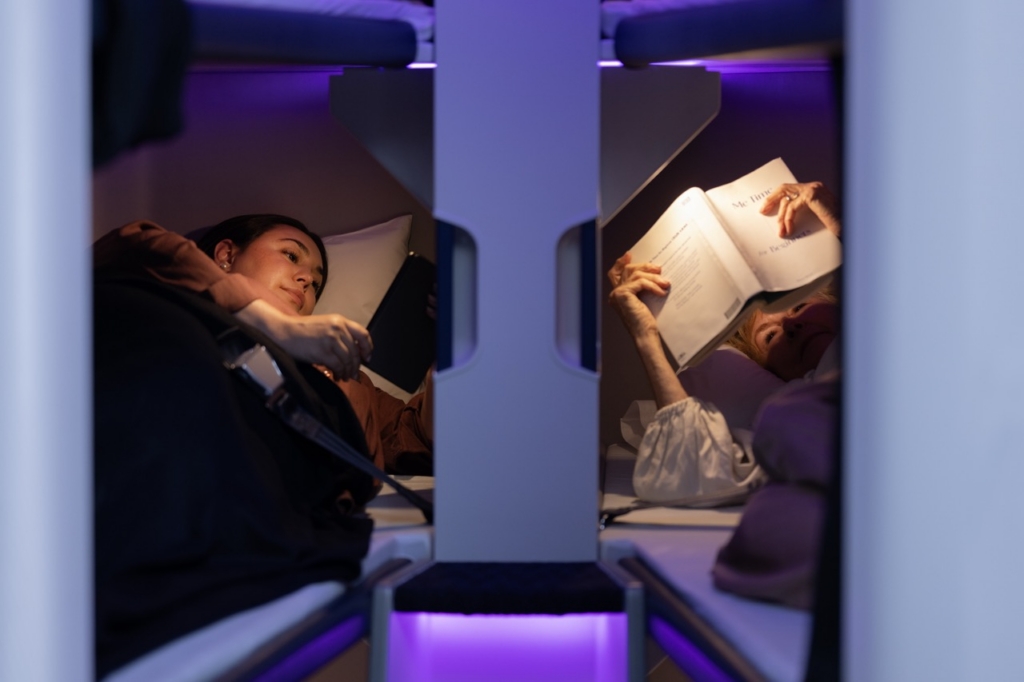
The Skynest is a radical rethink of how long-haul economy comfort is sold and experienced. Passengers will still sit in their economy seat, but they can book a four-hour sleep session in a dedicated bunk-style pod between meal services.
The process is simple: leave your seat, slip into your pod, and snooze comfortably.
Inside the Skynest: what passengers actually get
Skynest is a six-pod sleep zone arranged in a triple-tier bunk configuration, positioned between economy and premium economy cabins.
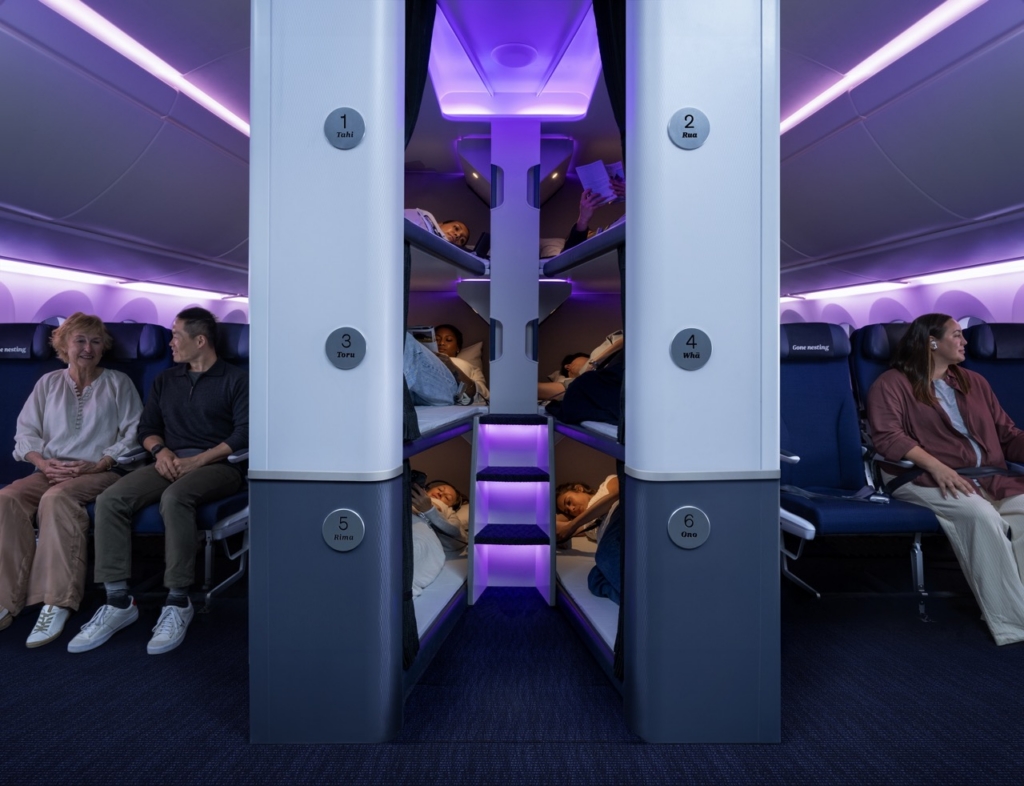
Each pod is designed to create a controlled and comfortable sleep environment.
Key features of the Skynest pods
- Full-length lie-flat bed sized for adult passengers—travellers must be at least 15 to sleep in the nest. Each individual nest measures 6’6” long. Width at the shoulder is 25” and the sleeping surface tapers to 16” at the feet.
- Top and middle nests are elevated, while bottom nests are at floor level, so passengers may need to climb or crawl to bed.
- Mattress, pillow, sheets, and blanket refreshed between users
- Privacy curtain to create a personal sleeping space
- Reading light and ambient lighting designed to support rest cycles
- USB charging port for personal devices
- Ventilation nozzle for airflow control
- Seatbelt for safety while lying down
- Earplugs and sleep kit included
The Skynests’ design borrows heavily from crew rest compartments on aircraft. It is compact, functional, and focused mainly on sleep rather than lounging.
What it’s like to use Skynest onboard
Using Skynest is less like upgrading your seat to business class and more like booking time in a shared sleep facility.
Passengers reserve a single four-hour slot per flight, with time buffers between sessions for cleaning and bedding changes. The two four-hour slots are sandwiched between meal services, so passengers in the first session will eat, then sleep, and passengers in the second session will sleep until just before it’s time to eat again.
The airline will send notifications to your seat’s in-flight entertainment screen to alert you that your sleep pod will be available 30 minutes and 5 minutes before you’re scheduled to sleep. Passengers who miss their alerts will be approached by a friendly crew member to remind them.
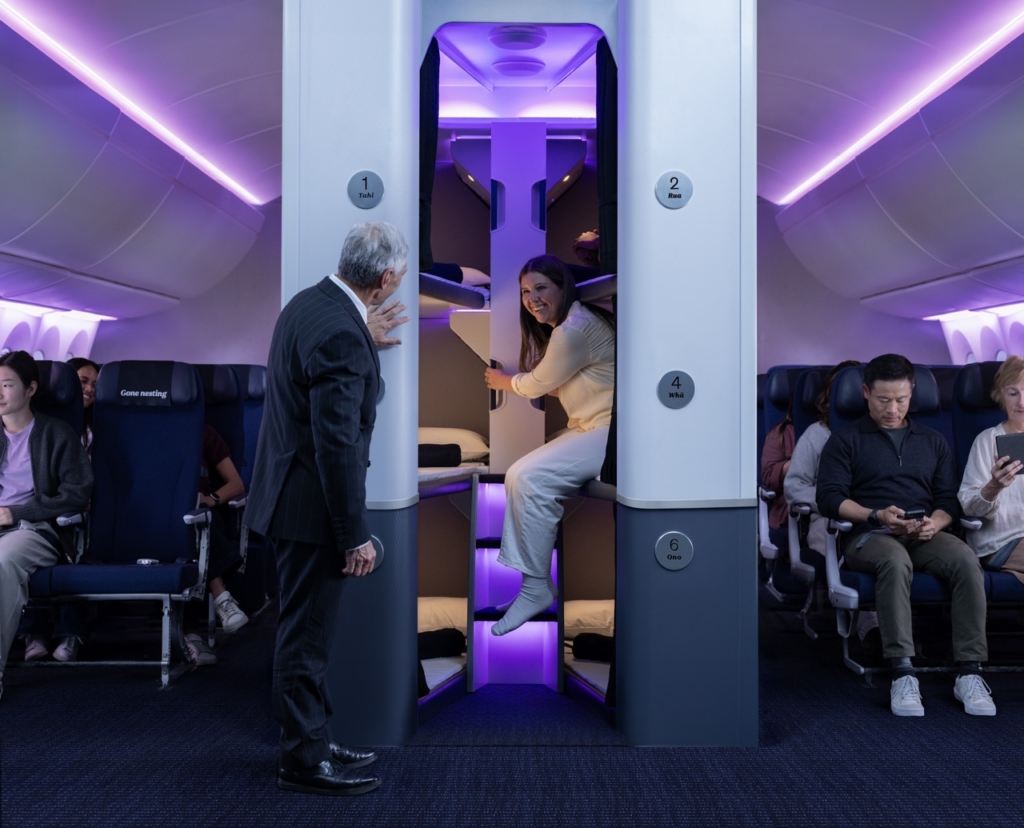
Accessing your bed is part of the experience. Depending on the pod, passengers may need to climb or crawl into position, and once inside, the space is optimised for lying down rather than sitting upright. Still, passengers can bring books, video or audio entertainment on their devices, should they wish to do so. Out of respect for other passengers, Skynests are quiet zones. You should use earphones to listen to programmes and music.
The airline recommends carrying very little other than what you might need to sleep, wearing comfortable clothing and using the restroom before entering the Skynest. While a water bottle is permitted, snacks and other beverages are not allowed.
You won’t oversleep. A gradual increase in light signals the end of your session, with a gentle wake-up from cabin crew if needed.
A brief history of berths in the air
While designed to meet modern air safety standards, Air New Zealand’s Skynest builds on a rich history of berths offered to passengers in-flight.
From the 1930s into the early 1960s, airlines offered sleeper berths and convertible seats that doubled as beds, allowing passengers to lie flat in curtained compartments. Inspired by train sleeping berths, they met the needs of travellers who were only just getting accustomed to flying long distances.
These designs disappeared as modern jets prioritised higher seating density and profitability. There were occasional exceptions. In the 1980s, Philippine Airlines introduced “Skybeds” on its Boeing 747 upper deck—14 berths exclusive to first class passengers, which were notably certified for use even during take-off and landing.
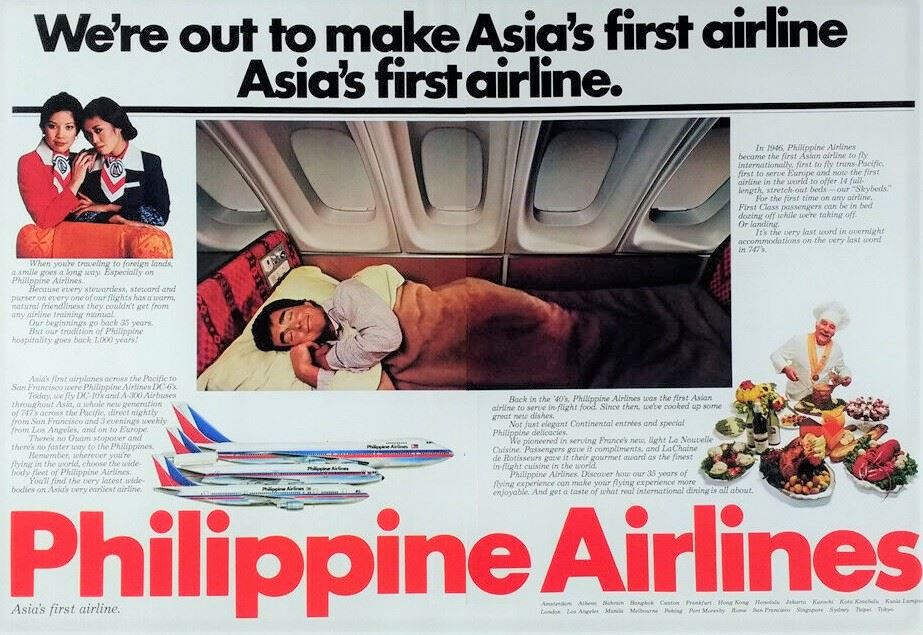
What sets Skynest apart is not the concept itself, but its democratisation. The airline is bringing berths back, not for higher fare-paying passengers, but for economy and premium economy travellers.
The rules of the nest: Air New Zealand’s “Nestiquette”
The airline has gone beyond hardware, offering a comforting Nestcessities amenity kit that includes a sleep mask, socks, earplugs and skin- and dental-care items.
It has also published a detailed guide on how passengers should behave in the Skynest—effectively creating a new in-flight etiquette for shared sleep spaces.
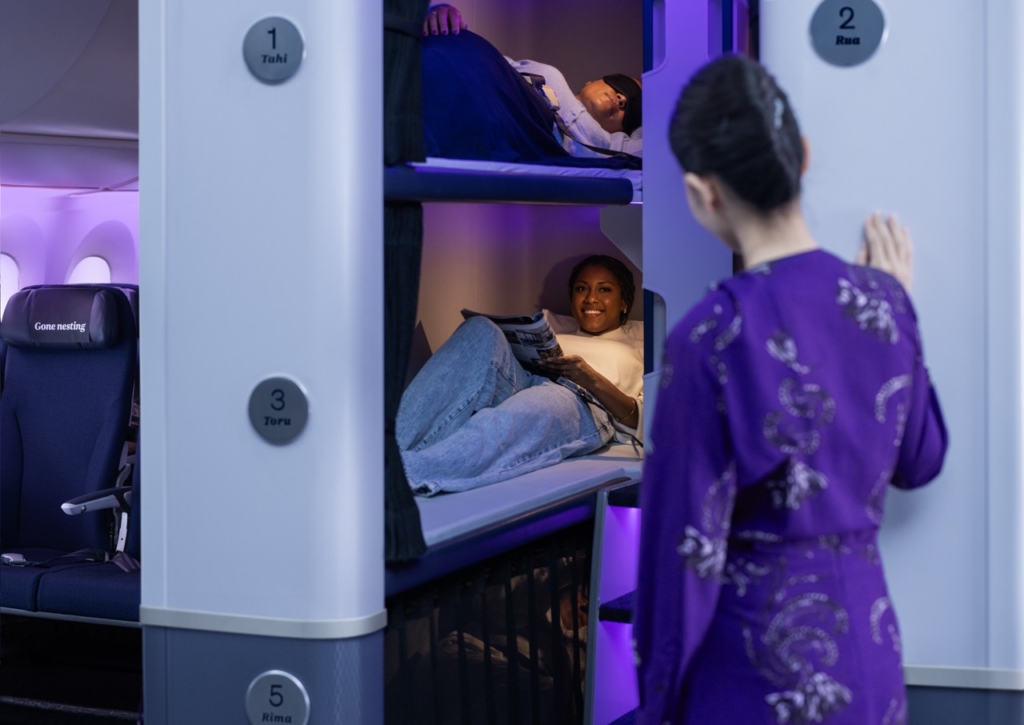
The essentials of “Nestiquette”
- One person per pod — no sharing or “double bunking”
- No food inside the pods to maintain cleanliness, water is okay
- Avoid strong scents such as perfume, which might offend others.
- No shoes in the nest—wear socks provided in the Nestcessities kit
- You have a curtain for privacy—be sure to use it.
- Be mindful of others — snoring might be inevitable, but disruptive behaviour is not
- Follow crew instructions for entry, exit, and wake-up timing
- Safety first—nests are equipped with safety belts to protect passengers during turbulence. Be sure yours stays on over your blanket so the crew don’t have to wake you up to check.
The Air New Zealand Skynest is a shared sleep zone, and its success depends as much on passenger behaviour as on the airline’s clever design.
A new tier in long-haul comfort
Skynest bridges the long-haul comfort gap between cramped upright economy seating and expensive lie-flat business class. It also complements Air New Zealand’s Skycouch, which turns a row of seats into a couch-like surface. Skycouch a better sleeping choice for those travelling with small children than the Skynest.
The question is whether Skynest will set a new trend for ultra-long-haul travel, bringing berths back to other carriers. As airlines focus on the premium cabin footprint, they will ultimately face the challenge of limited floor space. Instead of upgrading every seat, airlines may choose to unbundle comfort, as they have done with baggage and meals, selling sleep and privacy as optional extras.
Air New Zealand has updated one of aviation’s oldest ideas—the bunk bed in the sky. For passengers facing an economy class passenger experience on ultra-long-haul flights—especially gruelling routes like Auckland to New York—the Skynest could make the difference between endurance and genuine rest. That might be well worth a fee that starts at $495.
Featured Image: Air New Zealand