China’s AG600 amphibious aircraft completes open water scoop-and-drop tests

3 min read
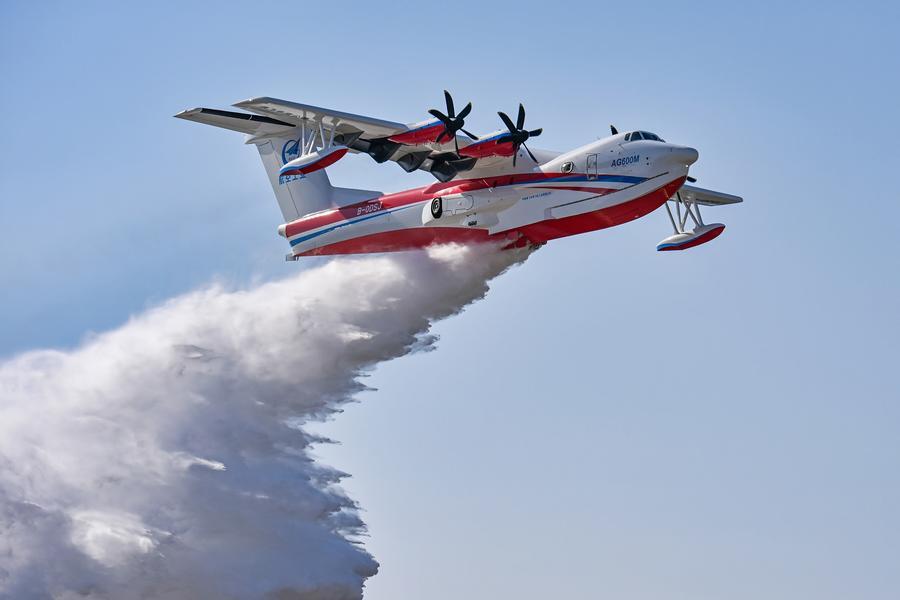
Ahead of imminent deliveries, China’s domestically produced AG600 large amphibious turboprop aircraft has completed open-water scoop-and-drop tests, highlighting its role as a water bomber.
China’ home-grown AG600 completes first scoop-and-drop test
According to reporting by China Daily, China’s new AG600 Kunlong amphibious aircraft has completed its first scoop-and-drop drill in open water. The aircraft is being produced by the Aviation Industry Corporation of China (AVIC).
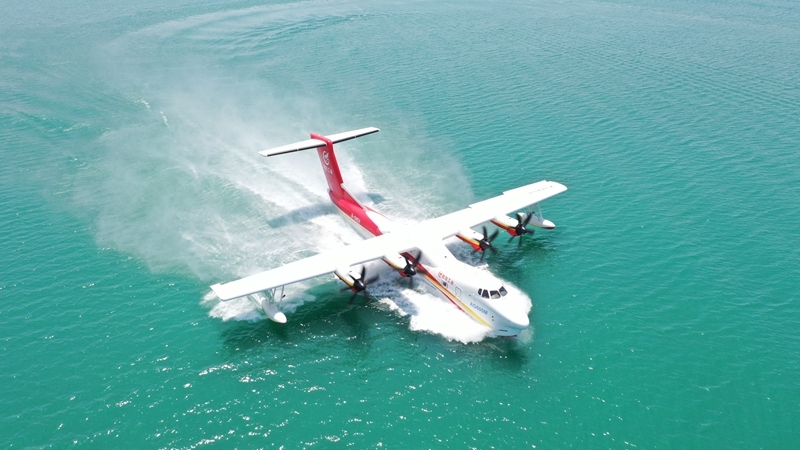
AVIC stated the AG600 flew around 190 kilometers to China’s Songhua Lake in the northeastern province of Jilin. This was the first open water test, as previous drills had been conducted in the test flight base.
The aircraft tanked 12 tonnes of water. In all, the aircraft is able to skim ten fills from a lake, enabling it to drop some 120 tonnes of water. AVIC says this is enough to soak over four hectares of land with heavy rainfall intensity while fighting fires.
China’s independently developed AG600 large amphibious firefighting aircraft has successfully completed its first field-environment water-scooping and aerial water-dropping flight test in northeast China’s Jilin Province. With a capacity of carrying up to 12 tonnes of water, the… pic.twitter.com/bOWa2mGMet
— China Science (@ChinaScience) October 29, 2025
The aircraft has a maximum practical range of 4,500 kilometres, a minimum level flight speed of 220 km/h and a minimum operating flight altitude of 30 to 50 meters above the treetops.
In mass production and poised to enter service
The AG600 was cleared for mass production in June when it received its Civil Aviation Administration of China (CAAC) type certificate. The first three waterbombers have now completed their acceptance flights and are expected to be delivered to their new owners before the end of 2025.
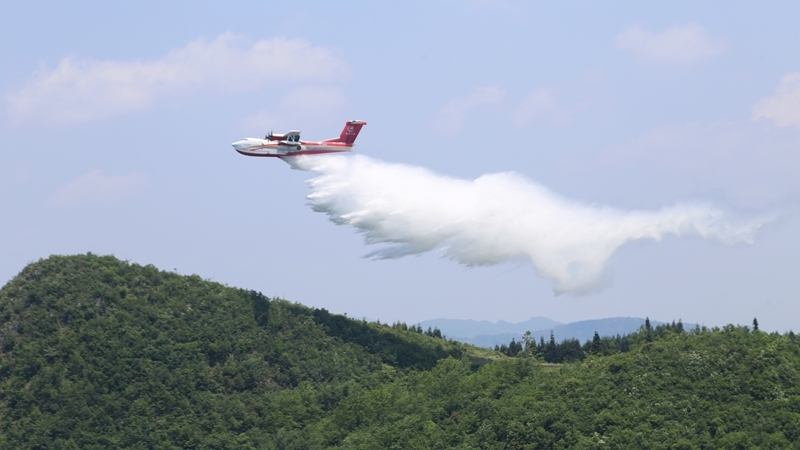
The Chinese Government hailed the aircraft as “China’s first large civil special-purchase aircraft.” It says the aircraft was developed to meet the urgent needs of “the national emergency rescue system and the national natural disaster prevention and control system.”
The AG600’s development commenced in 2009 and has taken 15 years. The type completed its maiden flight in 2017, and it performed its first water-based takeoff in 2018. Its first over-the-sea maiden flight took place in 2020, and by 2023, the aircraft was able to carry out firefighting tasks.
The 3rd batch-produced AG600, China's independently developed large amphibious firefighting aircraft, has rolled off the assembly line and completed its production test flight. Meanwhile, the nose part of the 4th batch-produced aircraft has been delivered.
— China Science (@ChinaScience) October 10, 2025
The AG600 has a maximum… pic.twitter.com/2i6L7FpbhJ
While Chinese media highlights its role as a fire-fighter, it is also suggested that the aircraft could have a role in supporting China’s military and logistic requirements in the South China Sea. Separately, China has also been observed developing a new ekranoplan/ground effect vehicle that could also aid in the South China Sea.
Claimed to be the biggest of its kind
In terms of dimensions, it has a length of 38.9 meters, a height of 11.7 meters, and a wingspan of 38.8 meters. China also claims the aircraft is the world’s largest civil amphibious aircraft as measured by takeoff weight, coming with a maximum takeoff weight of 60 tonnes.
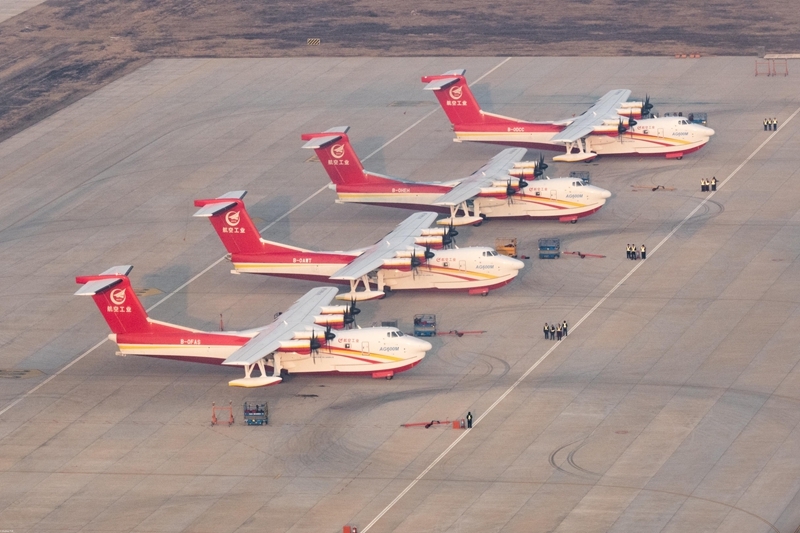
This is sort of true when limiting the criteria to modern aircraft and those used for waterbombing. Some early passenger seaplanes and the massive one-off wooden Hughes Hercules were considerably bigger.
But the AG600 boasts a greater MTOW than the Soviet/Russian Beriev Be-200 (41 tonnes) and the Japanese ShinMaywa US-2 (47.7 tonnes). For comparison with passenger airliners, the popular Boeing 737 MAX 8 has a maximum take-off weight of 82 tonnes.
Beriev Be-12P-200 Chaika and a Beriev A-40. (📷Leonid Faerberg – Russian AviaPhoto Team) pic.twitter.com/yHQeaZG2rG
— J.J. (@kadonkey) November 12, 2021
The Soviet Beriev A-40 is heavier (86 tonnes), although only two prototypes have been built. The aircraft first flew in 1986 and was then developed into the smaller Be-200. The A-40 was shelved with the collapse of the Soviet Union.
Like other old Soviet-era aircraft, Russia is trying to revive the Beriev A-40 (as the A-42) project to serve a jet-powered amphibious anti-submarine warfare role.
Featured Image: Xinhua
Sign up for our newsletter and get our latest content in your inbox.


More from


October 17, 20264 min read