Atlantic Airways orders two more A320neos with Paris and London expansion in sight

6 min read
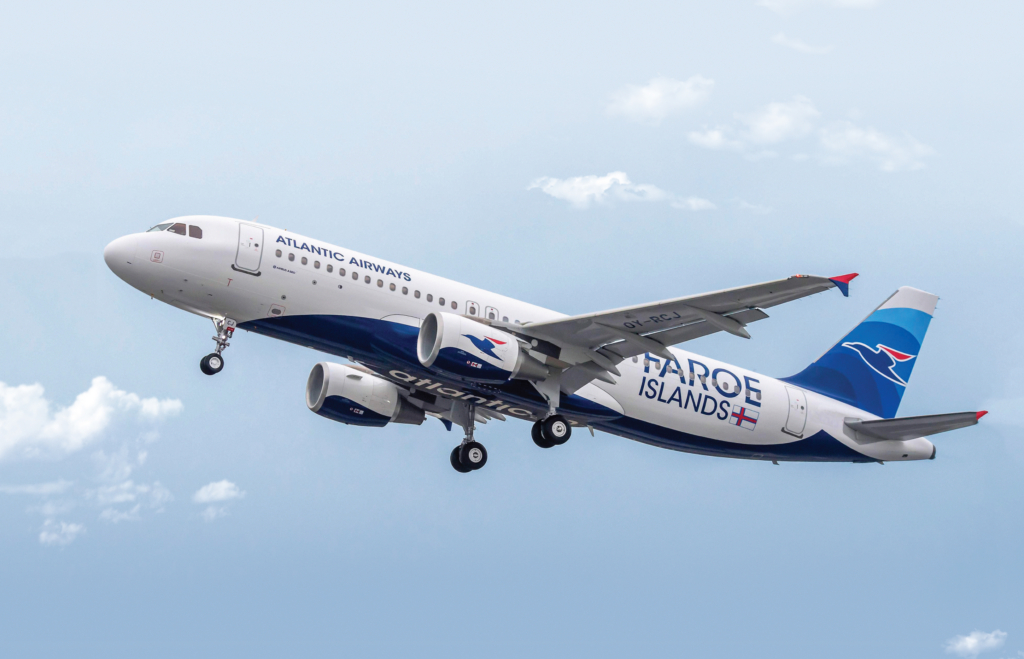
On Tuesday, Airbus announced that Faroe Islands flag carrier Atlantic Airways had signed a deal for two additional A320neo aircraft, bringing its total commitment for the type to six. Two of those have already been delivered, currently operating alongside an older-generation pair of A320ceos.
The latest addition to the order forms part of the carrier’s fleet expansion plans, allowing it to bolster frequencies on core routes, meet growing travel demand for outbound and inbound tourism from the Faroe Islands, and better connect to hubs that are key for feeder traffic with its airline partners.
Atlantic Airways is modernising its fleet
It hopes to transition to an all-A320neo fleet in the 2030s. It has two A320neos expected for delivery in 2028 and 2029, allowing it to replace (and slightly uplift) existing capacity with its ceo fleet.
The delivery timeline for the A320neo order announced on Tuesday has not yet been set.
“We are going for the most sustainable solution for our size,” CEO Jóhanna á Bergi told Aerospace Global News in an interview on Wednesday. “That means we are acquiring neo aircraft, and we have had an ambition over many years that by 2030, or in the early 2030s, we should be fully neo.”
“We are a very small company, but we have an important task: connecting our islands. It is critical infrastructure. Of course, we also want a modern means of transport, and for us the Airbus neo is a perfect fit.”
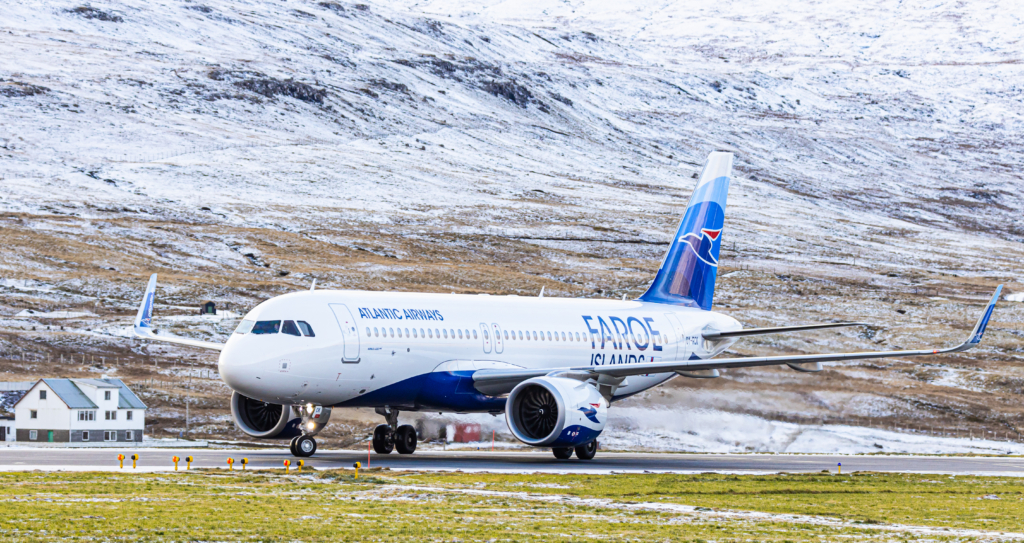
The carrier’s fleet choice is limited by the runway length (1799m) at its Vágar Airport hub. “We have looked at the A321 and so on,” á Bergi said, but “concluded that the A320 is a perfect match if you want to use the full capacity and also have the range.”
It hopes to have a clearer picture of the phase-in and phase-out dates of its new A320neos and A320ceos respectively early next year.
Atlantic Airways eyes more flights to London and Paris
Atlantic Airways hopes to use the additional capacity primarily to expand existing routes. The CEO identified Paris and London as destinations it hopes to grow. It currently serves both summer-seasonally and anticipates moving them to year-round operations.
Last year, the airline transported just under 380,000 passengers on scheduled flights, 12% more than in 2019. Non-Faroe Island residents made up 50% of its business for the first time this year.
Its main scheduled business is primarily concentrated in the summer season. “If you look now in November, December, January, February, we have maybe 25 to 30 departures per week. And if you’re in the high season, we have more than 60 departures.”
For its size, Atlantic Airways’ network is quite vast. Its operation spans 13 destinations which á Bergi describes as “a lot for our small society.” The Faroe Islands is home to about 55,000 people.
| Seasonal destinations (2026) | Year-round destinations (2026) |
|---|---|
| Paris Charles de Gaulle | Copenhagen |
| London Gatwick | Billund |
| Barcelona | Oslo |
| Las Palmas (winter-seasonal) | Aalborg |
| Tenerife (Autumn-seasonal) | Edinburgh |
| Reykjavík Keflavik |
Introducing additional frequencies to Paris will also serve traffic looking to fly onwards with its partner carriers.
“At the moment we have three flights per week to Paris, and it looks very good in cooperation with Air France-KLM and so on.”
Milan and London are also useful for feeder traffic purposes, á Bergi says. Milan Malpensa (MXP) will join the network next summer.
As for its core destinations in Scandinavia, the CEO says that there is “sufficient capacity” but added that subject to demand, its operations could be expanded further down the line. Given that the Faroe Islands are part of the Kingdom of Denmark, the links between the two are of particular importance. Denmark accounts for roughly 50% of its traffic.
Should it finally get slots in Amsterdam – something it has been eyeing for some time – it would also deploy capacity to the Netherlands, capturing feeder demand via partner KLM.
No to New York – for now
Atlantic Airways used to operate an Airbus A320 flight to New York Stewart International Airport for a limited time in the summer in both 2023 and 2024. Only 150 seats out of the 174 total were available for use given the distance.
Demand was lower than expected, and after just two seasons in operation, the airline pulled the route. When asked, the CEO says that there are no plans “in the short run” to reintroduce New York.
“The short story about New York is that we are a small airline with narrow-body aircraft, we don’t have a long runway, and we fully utilise our aircraft. We did it [launching New York] because we could, and we tried it.”
The A320s took roughly six hours to complete each leg. “We think we can do other things better, or more sensibly, in Europe. If you go to the US, you are away with your aircraft for a day or two. If you fly in Europe, you can do several trips. With our very small fleet, at the moment we are concentrating on Europe.”
Passengers looking to fly from the Faroe Islands to North America can do so via Reykjavík through codeshare partner Icelandair.
Atlantic Airways now competes against 3 new players in the Faroe Islands
Traffic to the Faroe Islands has grown considerably in recent years, driven primarily by Atlantic Airways. However, new players have also entered the market. Scandinavian Airlines (SAS) introduced flights to Copenhagen in 2017, Widerøe to Bergen in 2021 and Icelandair to Reykjavík in 2024.
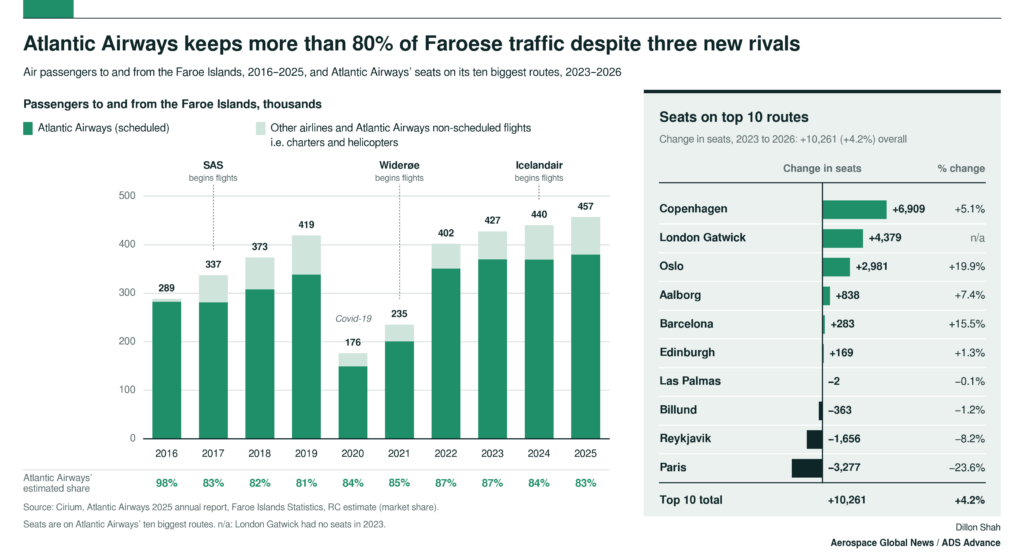
“It’s like everywhere else in that you are both working and are good together and you’re also competing,” á Bergi responded when asked whether the company views the additional capacity as a threat. She highlighted that new players provide customers with the freedom of choice, and that is something that “we just have to live with.”
It currently has a codeshare agreement with Icelandair, and “would really like to have” one with SAS.
Charter operations balance out lower demand in the winter season
During the winter, the carrier relies on its charter business to keep its aircraft and employees busy – and, crucially, ensure its bottom line stays positive.
Most of its charter flights operate from Denmark in collaboration with leisure experts Apollo and FolkeFerie. This includes flights to places like Malta which is “one of the big ones” alongside services to Greece and other places in the Mediterranean.
During the winter, the carrier also operates ski charters and transports different national teams. “We even had some military transport up to Greenland,” á Bergi revealed.
“So we do a lot of different ad hoc work, but we always serve the Faroese market first, and then we see where we have excess capacity. In that way, we optimise our business.”