500 engineers push Shield AI’s X-BAT towards flight testing this year

3 min read

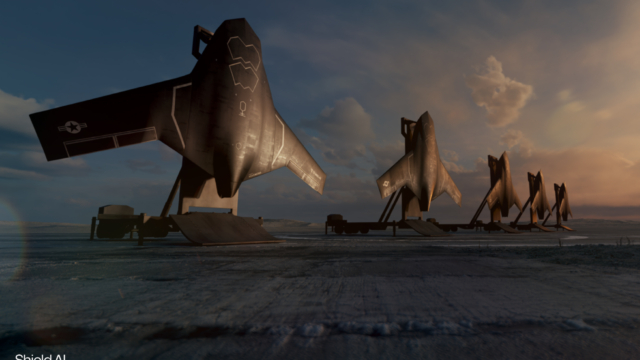
Backed by hundreds of engineers, Shield AI says its VTOL X-BAT remains on track to begin flight testing in 2026. As a sign of rising interest and confidence in the programme, the Navy has announced another significant investment, on top of the funding it announced in August.
X-BAT’s 500 engineers working towards late 2026 flight testing
A team of 500 engineers is currently working on making the Shield AI tail-sitting X-BAT autonomous combat aircraft a reality. The current plan remains for the aircraft to achieve its first flight testing in late 2026.
Those engineers are based at Shield AI and key suppliers, including GE Aerospace, which provides the engine.
AGN previously reported the programme has completed its first engine light-off and thrust-vectoring nozzle integration. Shield AI made use of an experimental nozzle developed for the experimental NF-16D VISTA testbed aircraft and tested during the 1990s.
The programme has also seen the validation of weapons bay aerodynamics in low- and high-speed wind-tunnel testing. X-BAT is being designed to carry its munitions (up to the 2,000 lbs class) internally.
X-BAT’s AI pilot or ‘brain’ is to be Shield AI’s advanced Hivemind mission autonomy software. This is the same agent that the Air Force has selected to run its Anduril FQ-44 Fury Increment 1 Collaborative Combat Aircraft.
Armor Harris, senior vice president of aircraft at Shield AI, said, “We are testing early and often while working on the aircraft, mission systems, ship suitability and production in parallel.”
Harris added this approach helps the company to identify and resolve issues sooner and lower overall development risk.
$400 million in committed X-BAT funding
Yesterday, Shield AI’s X-BAT programme got a major boost by attracting investment from the US Navy. The service has executed the $150 million modification with funding. Shield AI is to match the investment with $150 million of its own.
The funding is coming from the Navy’s Office of the Under Secretary of War for Acquisition and Sustainment through its Defense Exportability Features programme.

This follows a separate $50 million funding effort by the Navy for the X-BAT project in August. Under that agreement, Shield AI also committed $50 million of private capital alongside the effort. Together, this brings announced public and private commitments to X-BAT to $400 million.
Why X-BAT’s runway independence is attractive to Navy and Marines
X-BAT is a component of the Defense Innovation Unit’s (DIU) Runway Independent Maritime Expeditionary Strike (RIMES) Project. In a future high-end conflict, aircraft are expected to be vulnerable on the ground.
The RIMES Project is an effort to develop long-range strike assets that are able to take off and land vertically from ships, islands, and austere sites independent of runways. The Marine Corps, in particular, is focused on finding ways to reduce its dependence on fixed runways that are bound to be targeted.

Shield AI’s pitch of its low-observable, VTOL, multirole X-BAT has attracted the attention of the US Air Force, Navy, Marine Corps, foreign export partners, and possibly the US Army.
Former commanding officer of the aircraft carrier USS Gerald R. Ford, J.J. “Yank” Cummings is now Shield AI’s head of mission solutions for the US Navy.
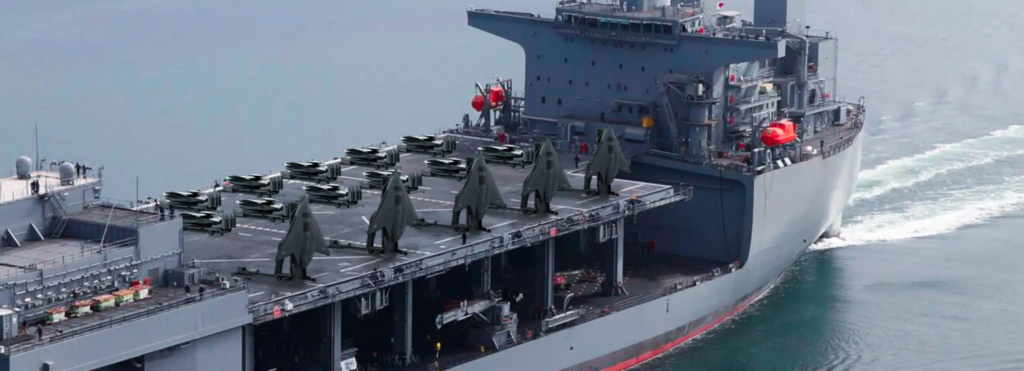
Referring to the Navy’s aircraft carriers, amphibious assault ships, and other large ships, he said, “Its runway-independent design and small deck footprint can increase sortie generation and extend long-range air combat power from CVNs, LHAs, LHDs, and ESBs.”