


How low is too low? The safety margins behind Airlink’s extraordinary Cape Town flyover

9 min read
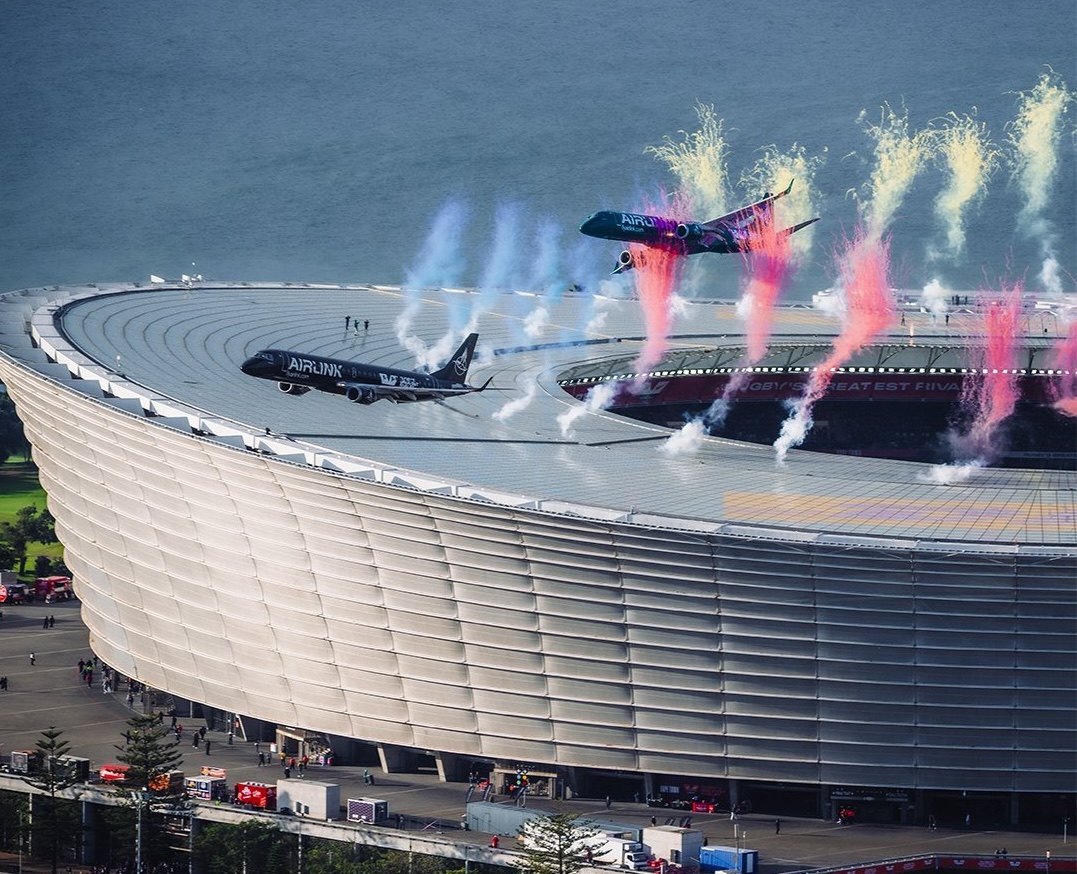
At first glance, the footage of two Airlink passenger jets passing over Cape Town’s DHL Stadium seemed almost unreal. Widely shared on social media, the clips showed two of the airline’s Embraer 195 passenger jets flying in formation just over the stadium roof ahead of Saturday’s Springboks-All Blacks rugby match.
Airlink itself promoted the flyover on X, mentioning the coordinated planning that went into it. But the dramatic footage sparked a debate online, with some questioning whether it constituted a dangerous stunt.
How close did Airlink’s aircraft come to DHL Stadium?
Just how close the aircraft came to the stadium is undetermined. Flightradar24 estimates that the lead Embraer E195 passed approximately 41–46ft (12.5–14m) above the stadium roof.
Planning. Precision. Performance. ✈️✈️
— Airlink (@Fly_Airlink) August 29, 2026
Spectacular scenes of Airlink’s double Embraer flyover at the DHL Stadium.
Airlink is Proud Official Sponsor of Rugby’s Greatest Rivalry, presented by Castle Double Malt 🏉#Airlink #FlyAirlink #FlyTheLink #Skybucks #RugbysGreatestRivalry pic.twitter.com/3tPNepftLS
Airlink says the flight was carefully planned, rehearsed and approved by the South African Civil Aviation Authority (SACAA), with support from Air Traffic Navigation Services (ATNS). The airline says its flight-recorder data shows both aircraft remained within the altitude and speed limits authorised by SACAA.
Airlink has voluntarily handed the data from both aircraft to SACAA so the regulator can independently verify that the flypast complied with its authorisation.
Still, the footage has prompted an aviation safety debate. It raised the question: when an airliner is deliberately flown at very low altitude over tens of thousands of people, how is an acceptable safety margin determined?
The answer involves more than the number of feet between an aircraft and a stadium roof.
Does 41 feet of clearance mean 41 feet of safety margin?
Flightradar24 calculated the estimated clearance using the aircraft’s ADS-B barometric altitude, atmospheric pressure, the stadium’s elevation and its estimated 164ft height.
It calculated an altitude of approximately 205–210ft above mean sea level for the lead aircraft, resulting in an estimated 41–46ft roof clearance.
That figure is not an official measurement. ADS-B data has limitations, and Airlink’s flight data recorders should provide more precise information on the aircraft’s actual flight parameters.
More importantly, vertical clearance is only one element of a flypast’s safety margin.
The tactical masterclass of today is by South Africa in getting people to buy the more expensive seats lower down 💰 🇿🇦
— The Rugby Issue (@TheRugbyIssue) August 29, 2026
If you’re not afraid of heights in the nose bleeds, surely you’d be afraid of a 747 flying towards your head✈️💥#Rugby #RSAvNZL #RGR26 #Springboks pic.twitter.com/M1VLuFeQ3F
Planners must consider the aircraft’s speed and energy, lateral flight path, obstacles, weather, crowd position, aircraft performance and what trajectory would remain available if something went wrong.
How does SACAA assess the safety of a flypast?
South Africa has specific regulatory provisions for such operations.
SACAA’s published guidance on flypasts and demonstration flights states that operators must apply for individual approval for each event and submit their proposed plan. Approval is granted for a particular event at a particular venue. SACAA’s current Aeronautical Information Circular index continues to reference the document, although the guidance itself dates from 2001.
Among other things, the plan should identify holding areas, run-in directions and suitable emergency landing areas.
What happens if an aircraft suffers an engine failure during a low flyover?
Commercial twin-engine jets are designed and certified to cope with the loss of an engine under defined conditions. But in general, flying close to the ground reduces the time pilots have to respond to such an incident.
SACAA’s published flypast guidance specifically distinguishes between aircraft according to their performance following an engine failure.
For multi-engine aircraft capable of maintaining altitude following an engine failure, the guidance appears to provide for descent during the run-in to 300ft above the highest obstacle. It requires greater altitude for aircraft that cannot maintain level flight after losing an engine.
Earlier today, Airlink performed a pre-match flyover at DHL Stadium in Cape Town.
— Flightradar24 (@flightradar24) August 29, 2026
Our lowest recorded ADS-B altitude was 50 ft at standard pressure, or approximately 205–210 ft AMSL when corrected for the local QNH of 1019 hPa. With DHL Stadium standing about 164 ft tall near sea… pic.twitter.com/vxyxFaNl0w
If Flightradar24’s estimate is accurate, the aircraft were considerably closer to the stadium than the 300ft figure contained in the published guidance.
That does not imply that Airlink breached a regulation or operated unsafely. SACAA may have authorised a different profile under other regulatory provisions or exemptions. Airlink explicitly says the flown altitude was within SACAA’s approved limits.
Why aircraft speed matters during a stadium flypast
Airlink says the aircraft crossed the stadium at around 150 knots, equivalent to roughly 173mph or 278km/h.
Aircraft need sufficient airspeed and energy to manoeuvre and climb away safely. SACAA’s flypast guidance calls for aircraft to fly “at their best manoeuvring speed in compliance with ATC speed restrictions and approval, however not faster than Mach 0.90.” Mach 0.90 is equal to approximately 685 miles per hour (1,102 km/h)
But the selected flypast speed has to balance aircraft performance, manoeuvrability, formation stability and reaction time.
How are emergency escape routes planned for low-altitude flyovers?
At very low altitudes, an emergency escape route cannot simply involve turning away from the stadium. A significant turn requires space, while climbing requires sufficient aircraft performance and energy.
SACAA guidance says flypast planning should consider suitable emergency landing areas, densely populated areas and nearby traffic zones.
A detailed plan can also establish points at which a flypast must be abandoned if the aircraft is not in the correct position, configuration or speed.
Instead of improvising after a failure, crews can have predetermined responses based on their position along the flight path.
What risks do bird strikes, gusts and obstacles pose during a flypast?
Flying close to the ground puts an aircraft in an environment where bird strikes are more likely, while leaving considerably less altitude to deal with the consequences.
Modern twin-engine passenger aircraft are certified to withstand a bird strike affecting one engine. A multiple-bird encounter that damages both engines would be more challenging. Regulators would have to consider these risks.

Weather is also an important factor. Wind direction, gusts and turbulence can affect the aircraft’s flight path relative to both the stadium and the other aircraft in the formation. Nearby structures can also influence airflow locally.
Airlink introduced another variable in this display—formation flying—by operating two aircraft.
The pilots must manage their aircraft while maintaining the planned position relative to the lead jet. Videos of the event also show the trailing aircraft entering the coloured smoke plume generated as part of the stadium display.
The positioning, timing and expected dispersion of pyrotechnic smoke would be another potential consideration in an event risk assessment.
Why did Airlink put three captains on each aircraft?
Airlink assigned three senior captains to each Embraer aircraft.
“The flight demanded careful planning and rehearsal, as it required navigating at low altitude, at around 150 knots,” Airlink said. “The two aircraft were flown by highly-experienced crew, with each comprised of three senior captains operating in the roles of commander, co-pilot and safety/technical officer.”
Get ready Ellis Park ✈️
— Airlink (@Fly_Airlink) August 22, 2026
We’ve got something unprecedented planned to commemorate today’s historic Test Match between the Springboks and All Blacks. Keep your eye on the sky 👀
Airlink is a proud Official Partner of Rugby’s Greatest Rivalry, presented by Castle Double Malt.… pic.twitter.com/ebZjlRiyza
An additional experienced pilot can potentially reduce cockpit workload. They can independently monitor aircraft parameters, the approved flight profile, the formation, communications and technical indications so the flying pilots can concentrate on controlling the plane.
An additional safety officer could also monitor predetermined limits and abort criteria.
There is an interesting parallel in UK Civil Aviation Authority guidance for flying displays, which permits additional flight crew or specialist maintenance personnel on commercial air transport display flights when their presence has been identified in the operator’s safety case and accepted by the regulator.
How do regulators approve an airliner flypast?
One-off display flights are different from normal airline operations. Under normal circumstances, aircraft are subject to minimum-height rules specifically intended to keep them well clear of obstacles and gatherings of people.
South African regulations generally prohibit flight over a congested area or open-air assembly below 1,000ft above the highest obstacle within 2,000ft of the aircraft. However, the regulations provide for lower operations with prior approval from the Director of Civil Aviation.
SACAA’s flypast guidance says operators should obtain individual approval for the event, along with local authority and airspace-management approvals, and submit the proposed flight plan to the regulator. Airlink followed through on these requirements.
In the UK, the CAA also requires a commercial air transport operator proposing a flying display to submit its intended display profile as part of its safety case.
Regulators can independently determine what additional evaluation is necessary before approving the operation.
What happens next in SACAA’s review of the Airlink flypast?
Airlink says the most accurate evidence of what actually happened over DHL Stadium is contained in the aircraft’s flight data.
“The data recorded by both aircraft’s digital flight data recorders (black boxes) indicate that the flights were performed within the SACAA’s approved and rehearsed safety altitude and speed limits for the flypast,” the airline said. “Airlink, on its own initiative, has volunteered these data sets to the SACAA so it can independently review and verify that the flypast was in accordance with the flight authorisation.”
The airline said it would refrain from further comment while SACAA reviews the data. A representative confirmed to Aerospace Global News that the data had been submitted to SACAA on Monday.
So, how low is too low for a commercial aircraft flypast?
A spectacularly small vertical clearance does not, on its own, suggest that an operation was unsafe. Nor does regulatory approval alone explain how the safety margin for this flight was calculated.
The important question is what would happen if something deviated from the plan.
Airlink says the display was carefully planned and rehearsed and that both aircraft remained within SACAA’s approved altitude and speed limits. The regulator’s review of the flight-recorder data should establish whether the aircraft flew that authorised profile.
The question becomes not how low the aircraft flew, but how SACAA determined that low was high enough.
Plane attempts extremely low flyover on live TV 😳 https://t.co/VY9duuLEju pic.twitter.com/VWfUIls4gW
— Matt Wallace (@MattWallace888) August 29, 2026
Fortunately, the low-altitude display was completed successfully and without incident. However, the post-event review may influence approval of future aerial displays and ultimately decide whether Airlink’s amazing feat was a one-off or may be attempted again.
Sign up for our newsletter and get our latest content in your inbox.


More from

August 31, 20265 min read


August 31, 20264 min read


