


airBaltic reveals scaled-back business plan as the airline cuts A220 fleet


Latvian flag carrier, airBaltic, has unveiled its strategy to strengthen its long-term competitiveness by reducing its fleet and building year-round ACMI partnerships.

Following an announcement from the Latvian Prime Minister that airBaltic must make fundamental changes, Latvia’s national airline has revealed its strategy to create a more resilient business with improved financial stability.
Plans include combining a more focused network centred around Riga, with a reduced all-Airbus A220-300 fleet, while building stronger year-round ACMI partnerships and improving operational efficiency.
How airBaltic plans to reach over $1billion revenue by 2031
Under its revised business plan, the airline is forecasting revenues will reach around $0.9 billion in 2027, increasing to $1.04 billion in 2029 and $1.15 billion by 2031.
To address immediate liquidity requirements, airBaltic has asked bondholders to approve around $260 million in interim financing. In the longer term, the airline is planning a recapitalisation of around $259 million in new debt financing plus $115 million in new equity capital.
Struggles exacerbated by geopolitical developments
The airline’s financial struggles can be traced in part to the start of the US-Israeli war with Iran, as well as geopolitical events in Ukraine, both of which have increased costs and uncertainty in the market. Additionally, constraints over the availability of Pratt & Whitney engines have impacted the carrier and its operations.

“Every successful airline must continuously adapt to a changing market,” said Erno Hildén, President and CEO of airBaltic. He added that the airline’s updated business plan reflects a move to make disciplined choices that “strengthen airBaltic’s long-term competitiveness while preserving what matters most – reliable connectivity and operations, together with financial stability.”
Why airBaltic is putting financial stability ahead of expansion
The revised plan is made in connection with airBaltic’s discussions with key stakeholders and prospective providers of interim financing. The airline’s previous business plan, which was developed in preparation for a planned initial public offering, envisaged sustained growth in passenger volumes and ticket revenues. This growth was expected to support expansion towards a 100-aircraft fleet. Since then, and alongside a change in leadership with the airline’s previous CEO Martin Gauss stepping down in April 2025, airBaltic’s operating environment has shifted significantly, with a decrease in demand and revenue growth.
In response, the airline is deliberately shifting its priorities. Financial stability comes first, growth second.

The revised business plan “provides a stronger foundation for the company’s future and positions us to create long-term value for our customers, partners and Latvia,” said Hildén. He explained that it prioritises cost discipline alongside revenue growth with improved margins.
Future growth will be measured and focused on opportunities that support sustainable profitability, cash generation and a stronger balance sheet.
airBaltic to reduce Airbus A220 fleet from 54 to 36 aircraft
With a network strategy centred on Latvia’s capital, Riga, as the airline’s primary hub, the airline will focus on expanding its footprint in existing markets and developing selected point-to-point services. Meanwhile, tactical and seasonal flights will improve fleet utilisation across the year.
By the end of 2026, airBaltic, which currently operates a fleet of 54 Airbus A220-300s, aims to reduce that to just 36 aircraft. This will gradually increase to 40 by 2031. Operations will be boosted by enhanced collaborations with ACMI partners to enable more efficient year-round aircraft deployment, while reducing seasonal volatility.
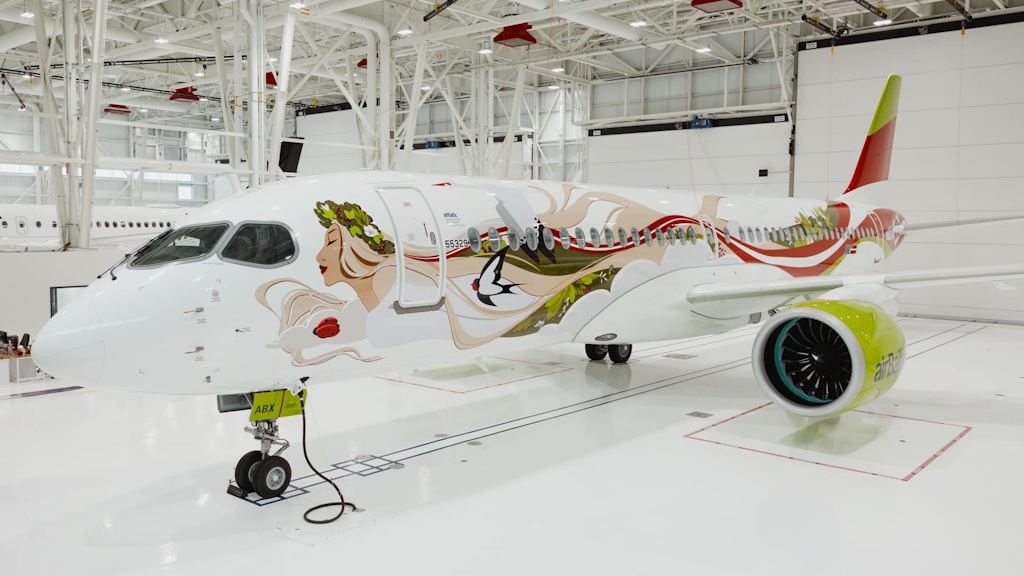
In a statement, the airline said: “Scheduled service Available Seat Kilometres (ASKs) are projected to decline from approximately 9.6 billion in 2026 to 8.7 billion in 2027, before gradually increasing to approximately 10.5 billion by 2031, reflecting a more focused network strategy centred on profitable growth.”
How ACMI partnerships will help airBaltic improve profitability
Following the end of its ACMI operations in 2024, airBaltic’s renewed commercial partnerships with ACMI customers are integral to supporting the airline’s return to profitability under its new model. This will enable the airline to deploy capacity more balanced across both summer and winter seasons while reducing the cost burden during periods of low traffic.
Through its combined fleet, network and operational initiatives, airBaltic is targeting around €45 million in recurring annual benefits.
Alongside the airline’s bold financial outlook with revenue reaching $1.15 billion by 2031, EBITDAR (earnings before interest, taxes, depreciation, amortisation and restructuring) is projected to increase to around $221 million in 2027, $280 million in 2029 and $346 million in 2031. This represents an EBITDAR margin of around 25-29%.


