US Air Force eyes E-4C ‘doomsday plane’ for return to ‘Looking Glass’ nuclear mission

9 min read

After a 28-year hiatus, the US Air Force (USAF) is now preparing to again take responsibility for America’s crucial Airborne Command Post (ABNCP) mission from the US Navy.
While the USAF is currently assessing the requirements needed for its future ABNCP jets, one option could see the air arm’s new Boeing 747-based E-4C Survivable Airborne Operations Center (SAOC) fleet being lined up for this critical tasking.
Known informally as ‘Looking Glass’, the ABNCP mission forms the backbone of US nuclear command-and-control, ensuring that critical directives can be relayed to the nation’s air- and land-based deterrent forces under all conditions.
These include the USAF’s bomber fleet, notably the B-2A Spirit and B-52H Stratofortress, as well as the silo-based Minuteman III intercontinental ballistic missile force, distributed across hardened underground facilities throughout the continental United States.

The ABNCP mission serves a vital role in the US military. Serving as a key second-strike capability for Washington, it allows the US to maintain its ability to direct a nuclear response even if the country’s ground-based C2 facilities have been attacked or destroyed.
Conceived during the height of the Cold War, the mission was designed to counter the threat of a Soviet nuclear attack on America.
EC-135C: The USAF’s ‘Looking Glass’ veteran
From the mid-1960s to late-1990s, America’s ‘Looking Glass’ mission was controlled by the USAF, which employed almost a dozen EC-135Cs for the role.
These ‘doomsday planes’ were formerly KC-135B Stratotanker air-to-air refuelling aircraft before undergoing extensive modifications to effectively perform this critical mission under the USAF’s now-defunct Strategic Air Command (SAC).
Having formally entered operational service under the EC-135C moniker on 1 January 1965, the platform would be responsible for the USAF’s ABNCP tasking for more than 30 years. During this period, at least one aircraft from this fleet was airborne at any given time to cover the round-the-clock ‘Looking Glass’ mission, ensuring that the second-strike capability was active in the case of nuclear attack.

Following the formal inactivation of the USAF’s SAC on 1 June 1992, the ‘Looking Glass’ mission fell under the command of the US Strategic Command (USSTRATCOM), which still controls this mission to this day. Shortly after – on 1 October 1998 – the US Navy took over responsibility for the ‘Looking Glass’ mission with its 16-strong Boeing 707-based E-6B Mercury fleet.
The USAF’s final EC-135C, serial 62-3582, was later converted into a WC-135C Constant Phoenix, a specialised platform tasked with collecting atmospheric samples to detect and identify radioactive debris associated with nuclear tests. The aircraft remained in service in this role until its retirement in 2020.
Today, a single EC-135C survives, serial 63-8049, preserved at the Strategic Air Command & Aerospace Museum, where it stands as a rare reminder of the airborne nuclear command-and-control era.
E-6B Mercury: The current ‘Looking Glass’ platform
First entering operational service with the US Navy as the E-6A in July 1989, the Mercury was initially acquired as a replacement for the service’s EC-130Q Hercules in the Take Charge and Move Out (TACAMO) mission.
The TACAMO mission is very similar to the ‘Looking Glass’ doctrine, although the former focuses on relaying orders to the Navy’s nuclear-powered Ohio-class submarines – which are armed with nuclear-tipped Trident II D5 submarine-launched ballistic missiles (SLBMs) – even while submerged.
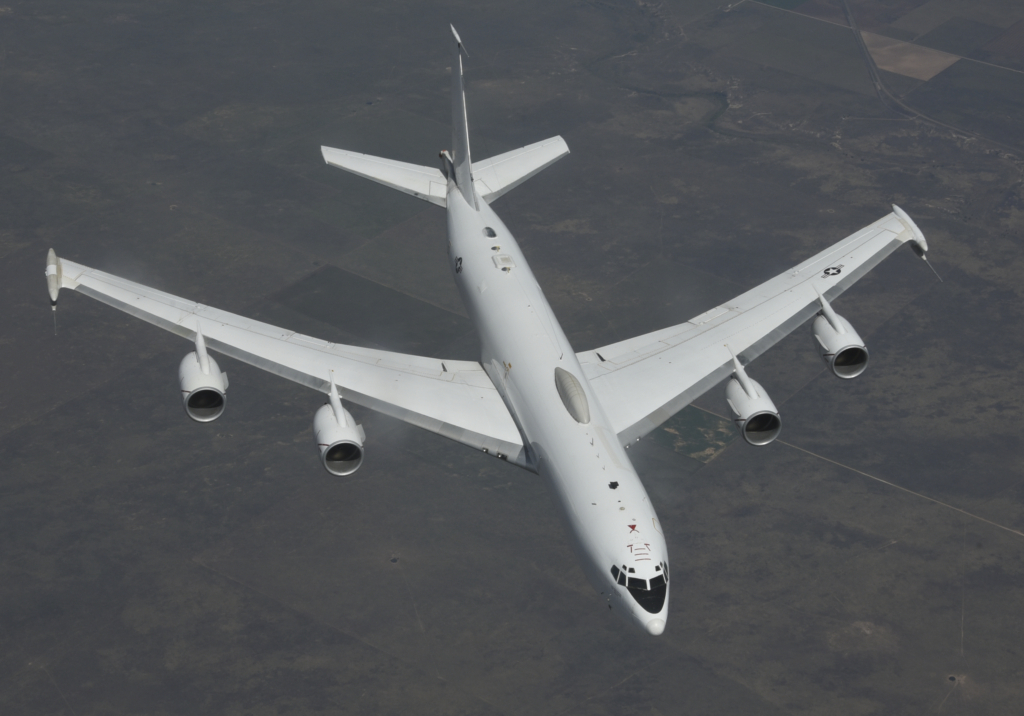
Following the decision to consolidate both its ABNCP and TACAMO missions onto a single platform from 1998, the Navy’s E-6A fleet was upgraded to E-6B-standard to cater for the additional ‘Looking Glass’ mission set.
The Navy accepted its first upgraded E-6B in December 1997, with the final example to go through this process being handed over in December 2006. Since 1998, the ‘doomsday planes’ have operated with joint crews of both Navy and Air Force personnel.
New TACAMO aircraft platform on its way for the Navy
Despite the critical nature of its role, the US Navy’s ageing E-6B Mercury fleet is slated for replacement by a new, TACAMO-focused platform by the mid-2030s. The need for recapitalisation became clear in 2015, when both the US Air Force and US Navy separately concluded that their long-serving airborne command-and-control aircraft, the USAF’s E-4B Nightwatch and the Navy’s E-6B Mercury, were approaching the limits of their viable service lives.
At the time, both fleets were based at Offutt Air Force Base, prompting early consideration of a common replacement platform. That concept was short-lived. As requirements matured, it became clear that the Air Force’s Airborne Nuclear Command, Control and Communications (ABNCP) mission and the Navy’s TACAMO mission imposed fundamentally different operational demands, making a single, shared aircraft impractical.

In December 2020, the Navy announced that it had selected an extensively modified variant of Lockheed Martin’s multi-mission C-130J-30 Super Hercules to succeed the E-6B in the critical TACAMO role. To be known as the EC-130J Phoenix II in Navy service, the acquisition marks a return to the TACAMO mission for the C-130 family.
To date, the US Navy has ordered three pre-production EC-130Js. One aircraft will be dedicated to air vehicle testing, while the remaining two will be used for mission systems integration and evaluation. Procured in FY23, the first of these aircraft is scheduled for delivery in FY26.
Looking ahead, the Navy plans to place an order for its first three production Phoenix II aircraft in FY27, followed by a further six airframes in FY28 as the programme transitions toward operational capability.
E-4C SAOC: The USAF’s future ‘Looking Glass’ jet?
While the Navy has progressed with the recapitalisation of its TACAMO mission, the USAF has yet to nail down its plan to reintroduce the ‘Looking Glass’ tasking into its own doctrine.
However, in a recent exclusive interview with The War Zone, Gen Stephen Davis – the new head of US Air Force Global Strike Command (AFGSC) – shed some light on the situation, noting that the air arm’s future E-4C SAOC fleet is being considered as the service’s forthcoming ABNCP platform.
Davis told The War Zone that the Air Force has now been assigned the ‘Looking Glass’ mission and is developing the associated requirements, but no decision has yet been made on whether it will involve a separate platform or be integrated into the SAOC programme.

The USAF currently operates four E-4B National Airborne Operations Center (NAOC) ‘doomsday planes’ – which are also known as ‘Nightwatch’ aircraft – from Offutt AFB. Based on the Boeing 747-200, these survivable strategic C2 aircraft are reaching the end of their viable service lives and are becoming increasingly more difficult and costly to operate and maintain.
While these aircraft serve a similar role to the E-6B, despite their larger size, they are not equipped with the Airborne Launch Control System (ALCS) that allows onboard crews to directly command the launch of land-based ICBMs while in flight.
While the USAF has tested the ALCS aboard an E-4B in the past – before the EC-135C was formally retired – the service ultimately decided that it would be too expensive to use its ‘Nightwatch’ fleet for the ‘Looking Glass’ mission.
Is the E-4C the USAF’s best ‘Looking Glass’ solution?
With its ageing Nightwatch fleet nearing the end of its service life, the USAF selected Sierra Nevada Corporation in April 2024 to develop a replacement based on the Boeing 747-8i.
A month later, SNC confirmed the acquisition of five former Korean Air 747-8is for conversion to the E-4C Survivable Airborne Operations Center (SAOC) standard. All five aircraft were delivered by September 2025 for modification, with the first entering flight testing in August 2025.
Under programme requirements, the E-4C will feature aerial refuelling to support extended airborne operations, along with hardening against electromagnetic pulse and nuclear effects. The aircraft will also field nuclear command, control and communications (NC3) systems, supported by secure, Modular Open Systems Approach (MOSA)-based communications and mission planning capabilities.
We've commenced early risk reduction flight testing under the U.S. Air Force's Survivable Airborne Operations Center contract! These early test flights will reduce development risk to the program to ensure on-time delivery of the modernized E-4C aircraft. https://t.co/PX7QjpaAAF pic.twitter.com/f7CvLMKROf
— Sierra Nevada Corporation (@SierraNevCorp) September 25, 2025
While the USAF has historically operated just four E-4Bs, current acquisition plans for the E-4C point to a larger fleet. Recent reporting suggests the Air Force could acquire between six and eight E-4C aircraft, potentially doubling its ‘doomsday plane’ inventory, with all aircraft based at Offutt Air Force Base.
As the E-4C is intended to directly replace the E-4B in the Airborne Command Post role, questions remain over the cost and feasibility of also integrating the Airborne Nuclear Command Post (ABNCP) mission, particularly the requirement for continuous availability. One potential solution would be a larger E-4C fleet, allowing the USAF to equip some, or all, SAOC aircraft with the systems needed to sustain the critical ‘Looking Glass’ mission on a round-the-clock basis.
Exciting news! The second 747-8i has arrived at our AITC in Dayton, Ohio for transformation into the Airborne Command Post of the future. #TeamSNC #TeamSAOC
— Sierra Nevada Corporation (@SierraNevCorp) November 1, 2024
More: https://t.co/S4mAtNecR6 pic.twitter.com/XKAlljSBRh
Despite these uncertainties, the United States Air Force continues to view the E-4C as a credible option as it refocuses on the Airborne Nuclear Command Post (ABNCP) mission. That does not preclude alternative solutions.
Congress has asked the service to examine whether other platforms, including a Hercules-type aircraft similar to the US Navy’s future TACAMO replacement, or even a business jet, could meet the requirement.
Regardless of the eventual platform choice, the Air Force is now moving to reassert its role in the ‘Looking Glass’ mission, whether through the E-4C or a different aircraft entirely, as it works to restore a resilient, continuous airborne nuclear command-and-control capability.
Featured image: Sierra Nevada Corporation