Operation Eagle Hawk: How the Red Arrows are crossing the Atlantic for America’s 250th anniversary

7 min read
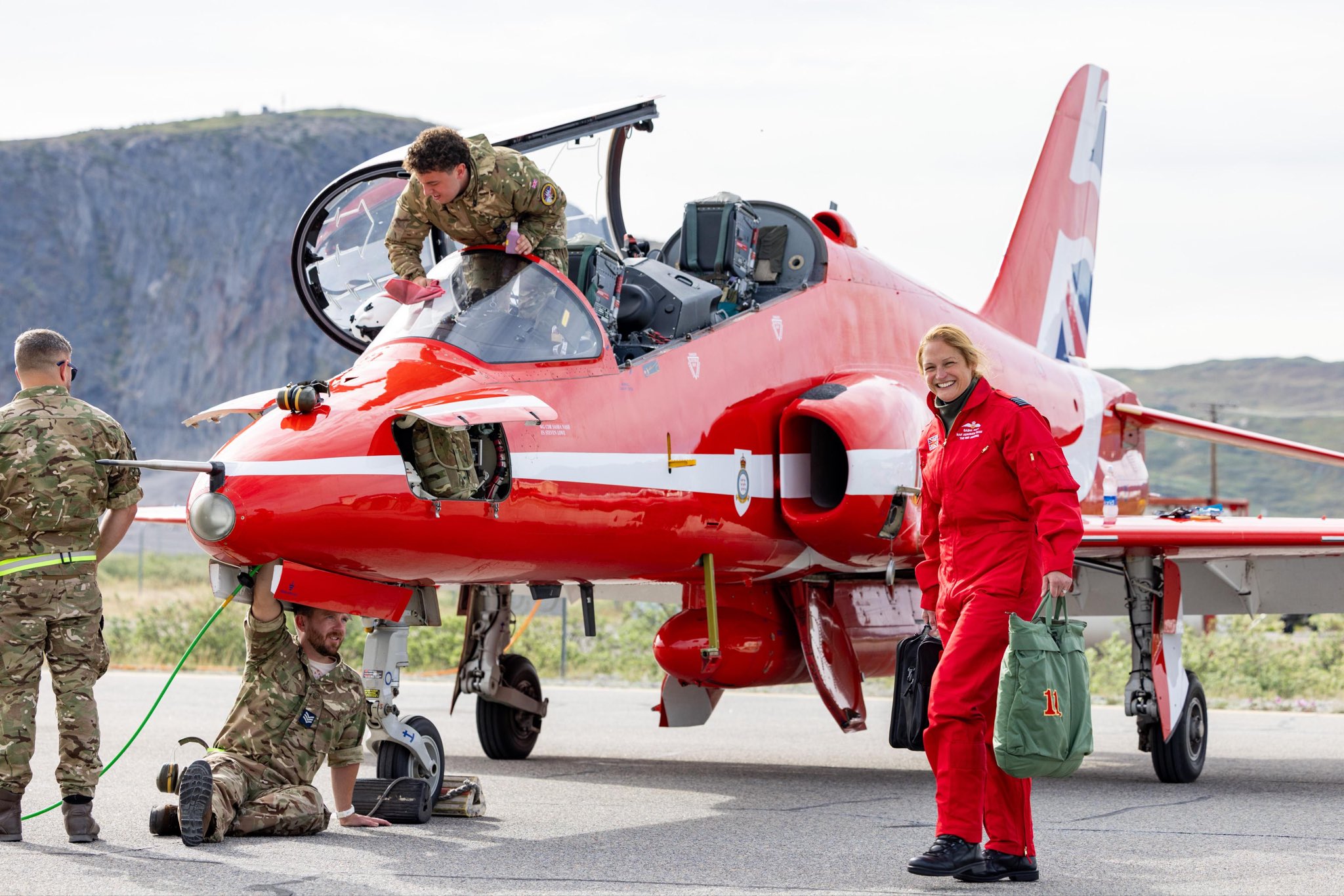
The Red Arrows, the Royal Air Force Aerobatic Team, have begun Operation Eagle Hawk, a month-long deployment to the United States supporting celebrations marking the 250th anniversary of American Independence.
With the team now confirmed to have reached Greenland after an earlier stop in Iceland, the complex Atlantic crossing is already underway.
The tour will see the Red Arrows perform at events across several states and participate in a major international flypast over New York on Independence Day.
For Britain’s famous aerobatic team, however, reaching American skies is almost as challenging as performing in them. Getting 11 Hawk jets across the Atlantic requires days of planning, specialist support aircraft and a carefully coordinated operation that begins long before the first display.
Operation Eagle Hawk: Taking a short-range T1 transatlantic
Unlike modern combat aircraft, the Hawk T1s flown by the Red Arrows cannot be refuelled in the air.
That limitation turns what would normally be a transatlantic crossing into a carefully choreographed island-hopping expedition stretching across thousands of miles.
In a Royal Air Force social media video released as the deployment began, Squadron Leader Stuart Roberts, Red 10 for 2026, explained the challenge.
Operation Eagle Hawk – the Red Arrows’ tour to the United States marking the nation’s 250th anniversary of independence – begins today, with the team departing our home. But how do we get the Hawks, that can’t refuel in the air and have limited range, there?#RedArrows | #RAF pic.twitter.com/0XOeZbPe7p
— Red Arrows (@rafredarrows) June 17, 2026
“You may have heard we’re taking the aircraft to North America to support the 250th anniversary of the independence of the United States, and you might be wondering how we do that,” he said.
“The aircraft can only travel about 700-750 miles, depending on the weather conditions, in one go. We don’t have any air-to-air refuelling capability, so the routing needs to take us from our base at Waddington all the way around via Iceland, Greenland, Northern Canada, before we finally make it down into the US.”
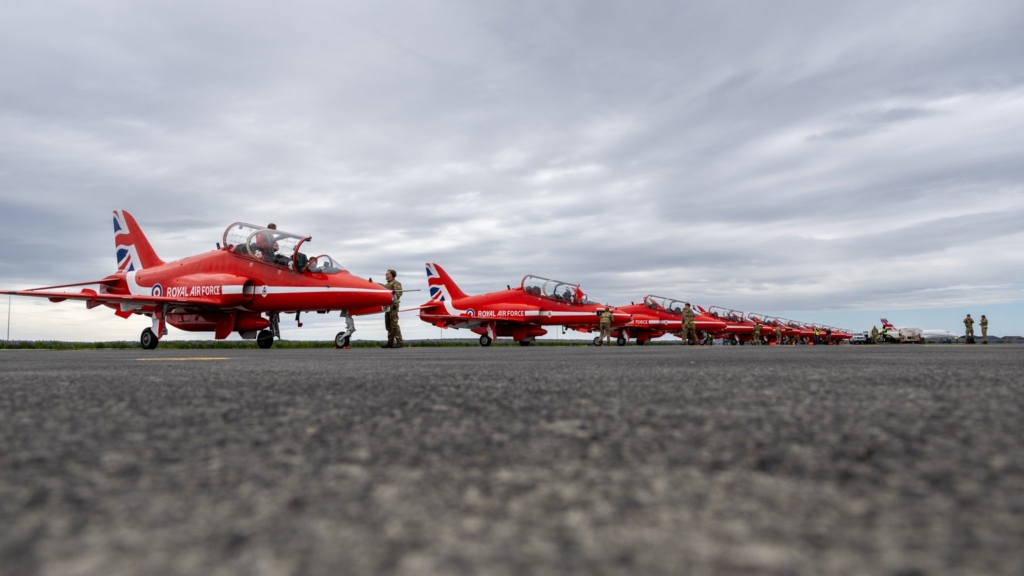
The journey began at RAF Waddington in Lincolnshire before taking the team north through Scotland. From there, the team landed in Iceland on 17 June, before confirming today that they had arrived in Greenland.

Next, they will head for eastern Canada before turning south towards the United States.
Each leg must be planned carefully around fuel reserves, weather conditions and diversion airfields.
The RAF support aircraft behind the Red Arrows’ US tour
The familiar Red Hawks may be the public face of the operation, but they are only one part of a much larger deployment.
Roberts explained that the crossing relies on a supporting cast of RAF aircraft carrying personnel, equipment and specialist capabilities.
“Taking 11 single-engine fast jets across the Atlantic can’t be done without some support aircraft,” he said. “So we’re taking two A400s, which will have our engineers and our support equipment on them.
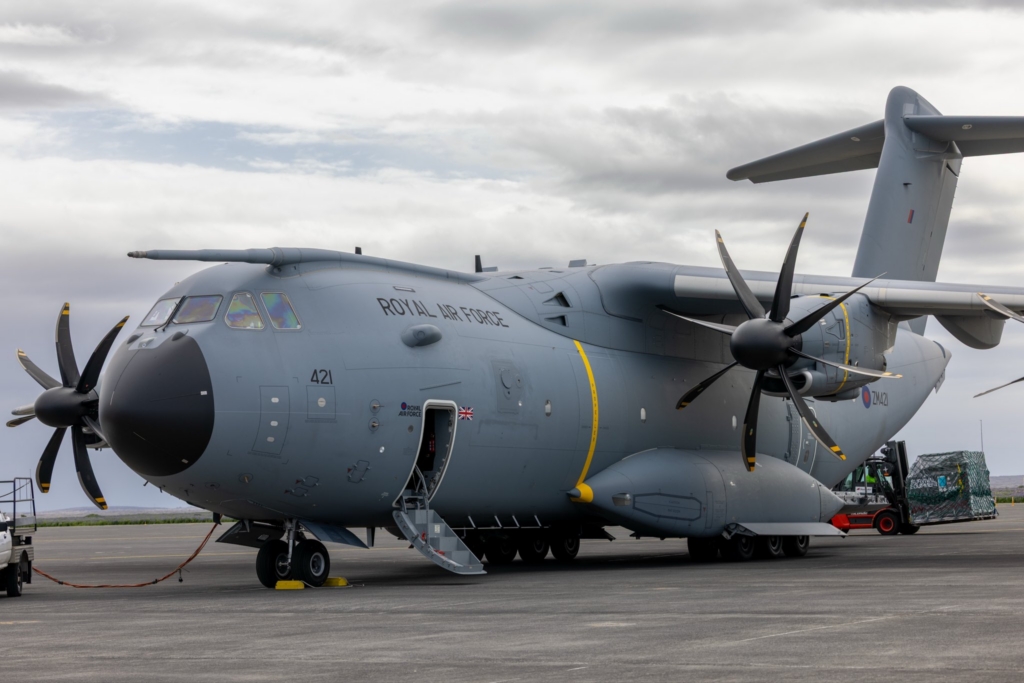
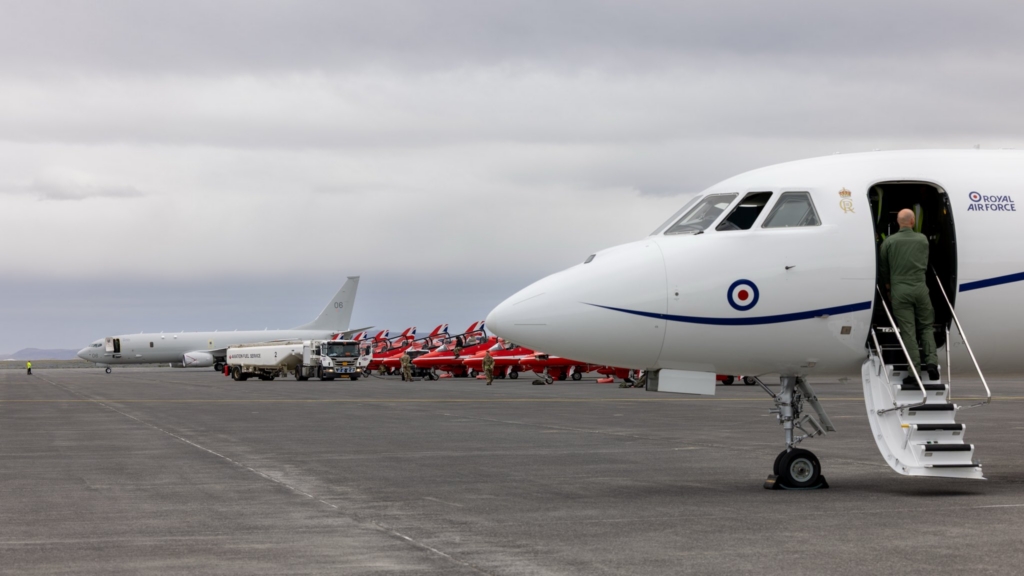
“We’ll also have a P-8, which will provide search and rescue overwatch should we need it, as well as an Envoy, which will be helping with communications relay at those longer ranges.”
The two A400M Atlas transport aircraft carry the engineers, spare parts and logistical support needed to keep the Hawks flying throughout the deployment.

The P-8A Poseidon provides additional situational awareness and search-and-rescue coverage, while the Envoy IV helps maintain communications when the formation moves beyond normal radio coverage.
Without that support network, the crossing would be considerably more difficult and potentially far riskier.
Crossing the Atlantic via Iceland, Greenland and Canada
Flying over the North Atlantic has never been routine, even in the age of satellite navigation.
The route chosen for Operation Eagle Hawk passes across vast stretches of open ocean, the Greenland ice cap and sparsely populated regions of northern Canada.
“Some of the other challenges we face are the inhospitable terrain that we’ll be passing over,” Roberts said. “The open waters of the North Atlantic, the Greenland ice cap, as well as the uninhabited northern areas of Canada.”
The geography is only part of the challenge.
Weather systems moving across the North Atlantic remain among the most unpredictable encountered by military aviators. Strong jet streams, low cloud, fog and rapidly changing conditions can alter flight plans with little warning.
“We also have to contend with the changeable and often severe weather conditions over the North Atlantic,” Roberts added.
The team monitors conditions not only along the route but also at each destination airfield, where deteriorating weather can force delays or diversions.
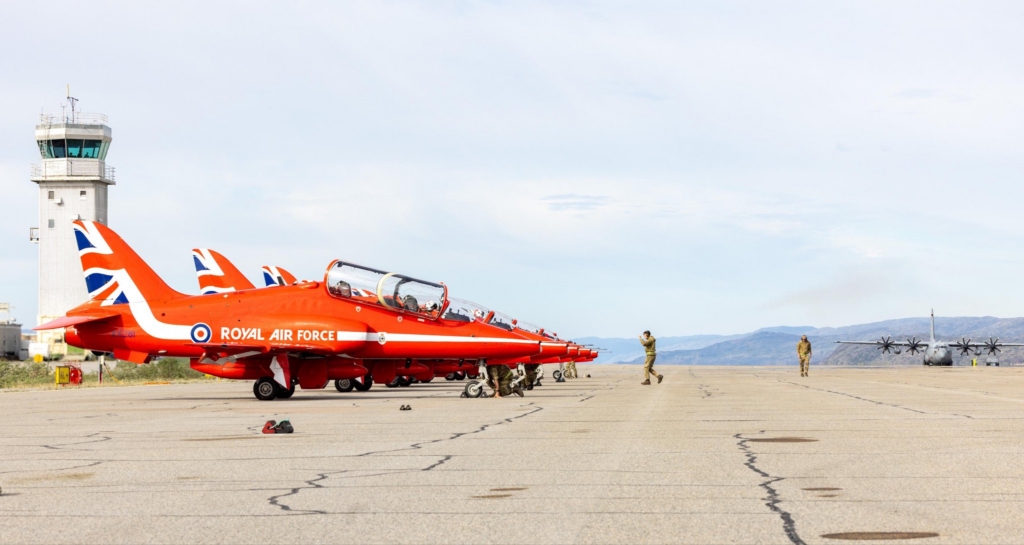
That challenge is no longer hypothetical. With the Red Arrows now having reached Greenland, one of the most remote and weather-exposed stages of the crossing is already behind them.
Cramped, lonely and long: What it is like to cross the Atlantic in a Hawk T1
For the pilots, the crossing is as much an endurance exercise as a navigation challenge.
Wing Commander Jon Bond, the Red Arrows’ team leader, described some of the realities of the journey in comments reported by the BBC.
“Unfortunately, we don’t have any air-to-air refuelling capability and our aircraft can only carry about an hour-and-a-half to an hour-45 worth of fuel,” he said.
The aircraft themselves present another challenge.
“These cockpits, that are 40 or 50 years old, can be quite cramped,” Bond told the broadcaster.

Unlike modern transport aircraft, there is little room to move around. Pilots remain strapped into their seats throughout each sector while monitoring fuel consumption, weather and formation positioning.
“It’s a little bit lonely on these transits,” Bond said. “I’ve done these a couple of times now in the T1 and the two hours goes quite slowly.”
The comments offer a reminder that while the Red Arrows are famous for close-formation aerobatics, much of their work involves long hours of disciplined flying far from public view.
Red Arrows to join America’s 250th anniversary flypast in New York
Operation Eagle Hawk forms part of a broader British military contribution to celebrations marking 250 years of American Independence.
The Red Arrows will perform at events across New York, Wisconsin, Maine, Maryland and Michigan during the month-long deployment, while Royal Navy ships and the Band of His Majesty’s Royal Marines will also take part in commemorative activities. The centrepiece is expected to be a major international flypast over New York on 4 July.
Bond told the BBC that the scale of the event could be unprecedented.
“We’ve got a massive flypast over New York on the 4th of July, with an incredible amount of aeroplanes,” he said. “It’s all to be finalised over the next week or so, but I’ve been told there’ll be in excess of 140 or 150 aeroplanes, with many nations taking part.”
“It’s going to be a really big event.”
For the RAF, the deployment is also intended to underline the close defence relationship between Britain and the United States, a partnership repeatedly highlighted by military leaders on both sides of the Atlantic.
Operation Eagle Hawk: More than an airshow tour
The crossing comes at an interesting moment for the Red Arrows.
The team is now operating a reduced seven-aircraft display formation from the traditional nine-aircraft ‘Diamond Nine’ formation as the RAF manages the ageing Hawk T1 fleet and prepares for an eventual transition to a successor aircraft.
However, according to an RAF official, the Red Arrows will still fly all nine aircraft during the flypast and commemorative appearances linked to the 250th anniversary of American Independence.
The Hawks undertaking Operation Eagle Hawk are among the last examples of a type that has served the Red Arrows since 1980. That makes the deployment something more than another overseas tour.
It is a reminder that even in an era of long-range airliners and global connectivity, moving a formation of small military jets across the Atlantic remains a complex undertaking requiring detailed planning, specialist support and a measure of patience.
When the Red Arrows finally arrive over New York in red, white and blue smoke on Independence Day, most spectators will see only the finished performance.
Few will have witnessed the three-day journey across ocean, ice and wilderness that made it possible.
Featured image: Support crews check over the Hawk T1 during a stopover in Greenland. Photo: RAF