


Airline extras are growing twice as fast as revenue – what are passengers paying for?

5 min read
Airlines are becoming increasingly reliant on everything they sell around the basic ticket, with revenue from seat selection, baggage, loyalty programmes and other extras growing almost twice as fast as overall airline revenue.
The latest IdeaWorksCompany Yearbook of Ancillary Revenue found that ancillary revenue increased 13.4% among 58 airlines for which comparable figures were available for 2024 and 2025. Their overall revenue increased 7.2%.
In dollar terms, those airlines added $13.2 billion in ancillary revenue in a single year. Thirty airlines now generate at least $1 billion annually from ancillary products, compared with 27 a year earlier.
The figures show airfares are only the start of what an airline can earn from each passenger. For some low-cost carriers, extras now account for more than half of earnings.
Frontier gets 60% of its revenue from ancillaries
Frontier Airlines topped the 2026 Yearbook when ancillary revenue was measured as a proportion of total revenue.
Extras accounted for 60.2% of Frontier’s revenue in 2025, meaning the airline generated more revenue from ancillary sources than from the remainder of its business.
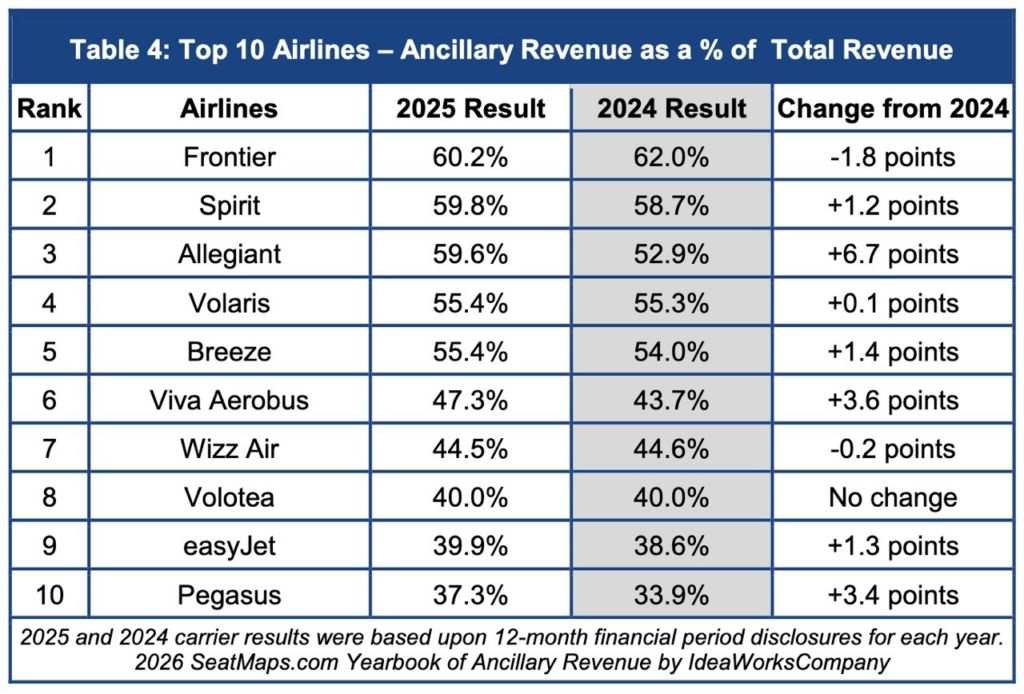
It was not alone. Spirit Airlines reached 59.8%, Allegiant 59.6%, while Volaris and Breeze Airways each generated 55.4% of total revenue from ancillary sources.
The top ten was dominated entirely by low-cost airlines.
The Yearbook notes that many of these airlines have strategically adopted policies that encourage passengers to pay separately for larger cabin bags and other services.
Ancillary revenue comes from more than airline fees. IdeaWorksCompany includes a la carte products such as baggage and seat assignments, as well as commissions, frequent-flyer programme revenue, and other products sold in connection with travel.
That distinction matters when comparing low-cost airlines with large US network carriers.
United makes $11.5 billion beyond the basic fare
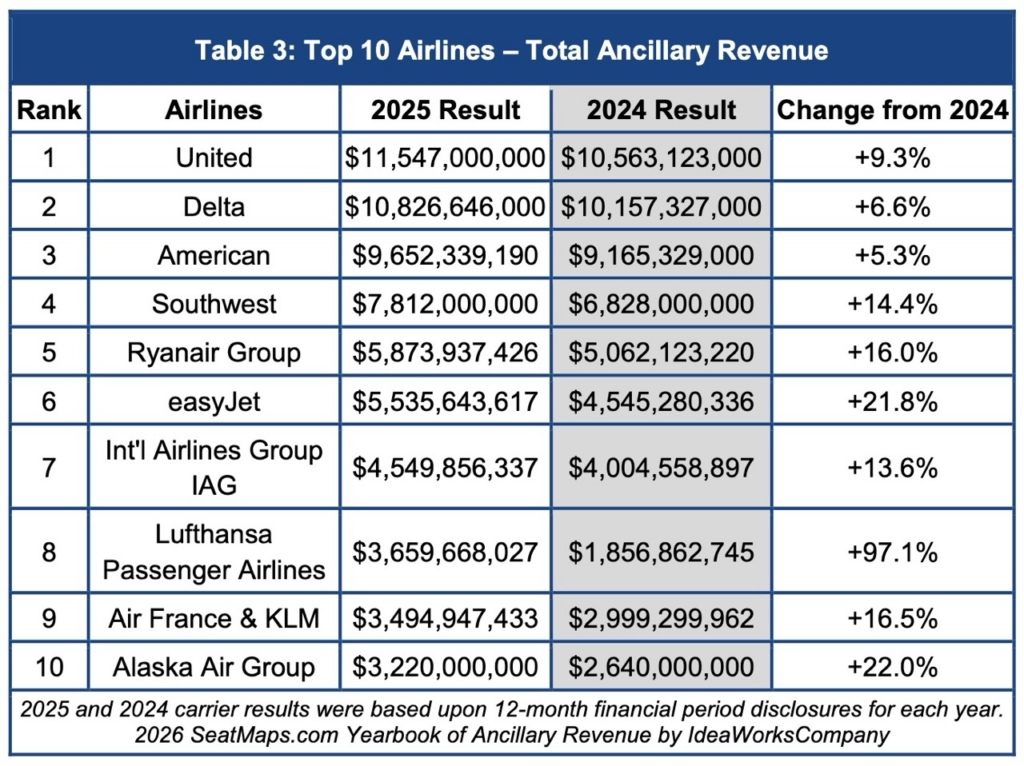
United Airlines generated more ancillary revenue than any other carrier examined, at $11.5 billion in 2025, up 9.3% from the previous year.
Delta followed with approximately $10.8 billion and American with $9.7 billion.
For the largest US airlines, loyalty programmes and their lucrative relationships with credit-card issuers contribute significantly to the result.
American, Delta, Southwest and United together generated $27.9 billion from their frequent-flyer programmes in 2025, equivalent to an average of $37.72 for every passenger they carried.
That makes the ancillary business of a large network airline fundamentally different from that of an ultra-low-cost carrier. Frontier relies heavily on passengers buying individual travel extras. United can earn billions from customers’ interaction with its loyalty programme, including spending that occurs away from an aircraft.
Jet2 sets a $100-per-passenger record
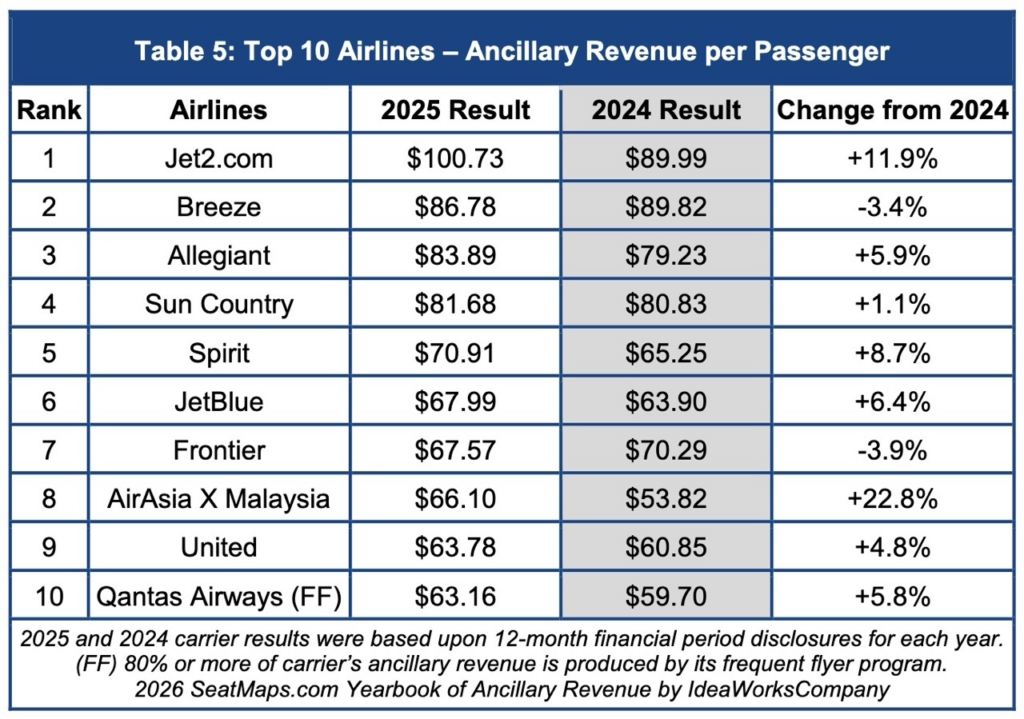
UK leisure airline Jet2.com led another important measure: how much ancillary revenue an airline generates for each passenger.
Jet2 reached $100.73 per passenger, the highest figure recorded in the Yearbook’s 19-year history.
The result explains why airlines focus on what passengers buy after selecting a flight.
A customer attracted by a low headline fare may subsequently pay for a checked bag, larger cabin bag, preferred seat, extra legroom, priority boarding, food, WiFi or other services. Airlines can also bundle several of these products into branded fares that encourage passengers to move above the cheapest ticket.
IdeaWorksCompany President Jay Sorensen said seat assignments and branded fares have been particularly important to recent growth.
“Ancillary revenue gains over the past five years have been powered by the airline industry’s embrace of seat assignment fees and greater reliance on branded fares,” he said.
Sorensen described ancillary revenue as unusually resilient through changing economic conditions, saying it has often adapted more effectively than passenger fares.
Separate IdeaWorksCompany research illustrates just how valuable seats have become. United collected approximately $1.3 billion from seat fees in 2023, exceeding the $1.2 billion it collected for checked baggage that year.
Southwest shift shows what happens when a previous perk becomes a fee
Perhaps the clearest example of the industry’s changing economics is Southwest Airlines. The carrier began charging for checked baggage and introduced assigned seating as it moved away from several policies that had historically differentiated it from US rivals.
Its ancillary revenue per passenger jumped nearly 20% to $58.25 in 2025, according to IdeaWorksCompany.
Southwest’s success helps explain why airlines find it difficult to resist unbundling services, especially once competitors have shown passengers will pay separately for them.
Airlines have more reasons to sell the seat twice
The growth also coincides with greater airline investment in premium seating.
“Ancillary revenue growth on the pace and scale revealed in this Yearbook ‒ double the rate of overall revenue and increasing $13.2 billion among like-for-like airlines – puts a spotlight on how both core and ancillary products are merchandised. As airlines invest in new seat designs and premium capacity, accurate data and visual content help make those high-value options more visible in direct and indirect sales channels, enable airlines to merchandise their cabins more effectively and help passengers make informed choices and know what to expect onboard,” said Djois Franklin, Chief Executive of SeatMaps, which sponsored the Yearbook.
Better digital merchandising gives airlines more opportunities to sell an upgrade, preferred seat or additional service after a passenger has already decided to travel.
Ancillary revenue is now growing much faster than passenger numbers. Comparable airlines in the Yearbook increased ancillary revenue by 13.4% in 2025 while passenger traffic grew only around 5.3%, according to IATA.
In other words, airlines are not earning more because they are carrying more people. They are getting substantially more revenue from each journey through products beyond the airfare.
For airlines, the aircraft seat may get the passenger through the door, but everything sold around it is becoming an increasingly important part of the business.


