


SpaceX cleared to deploy a million AI satellites as Musk looks towards a Kardashev Type II civilisation

6 min read
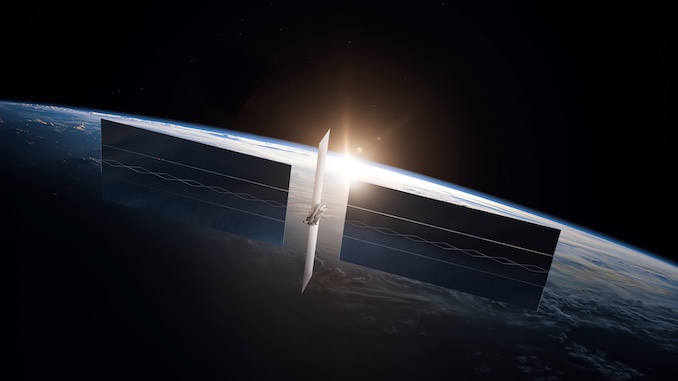

The US Federal Communications Commission (FCC) has authorised SpaceX to deploy up to one million satellites equipped with artificial intelligence (AI) computing hardware, paving the way for what could become the largest satellite constellation ever assembled.
The approval, announced on 25 November, lets SpaceX proceed with its Starmind project, which aims to use solar energy collected in orbit to power space-based data centres and transmit the results of their computations back to Earth.
The US regulator has granted the first authorisation for a constellation of orbital data centres, amid growing concerns over the availability of electricity, land and water to support the rapid expansion of AI infrastructure on Earth.
However, SpaceX founder and chief executive Elon Musk has a much larger ambition for the project, one rooted in a scientific theory proposed by a Soviet astronomer more than six decades ago.
Musk sees orbital data centres as an early step towards humanity becoming a Kardashev Type II civilisation, a hypothetical society capable of harnessing the entire energy output of its host star.
The FCC itself referred to the concept in announcing its decision as its chairman Brendan Carr said, “More fundamentally, it ( the constellation of data centres in space) promises to bring the human race closer to a Kardashev II civilisation—one that can harness the full power of the sun.”
“This action opens a bold new frontier for the computing infrastructure needed to power America’s leadership and growth,” Carr said, adding, “Compute campuses or data centres are essential to sustaining America’s leadership in SI. By moving compute capacity beyond Earth, SpaceX and the many competitors working on their own orbital data centres are meeting the moment.”
SI, or superintelligence, refers to artificial intelligence that would surpass human intellectual capabilities.
The regulator said the system also operates consistent with the FCC’s orbital debris rules, and that it is continuing to assess other proposals for orbital data centres.
What is SpaceX’s Starmind project?
Unlike SpaceX’s Starlink satellites, which primarily provide communications and internet connectivity, Starmind spacecraft are designed to process data in orbit.
Each satellite would effectively function as a small data centre, carrying computer processors, solar arrays, communications equipment and a system to dissipate the heat generated by its electronics.
Multiple satellites would be connected through high-speed optical links, allowing them to exchange information using lasers. Starlink would provide the communications network through which the results of AI computations could be transmitted back to users on Earth.
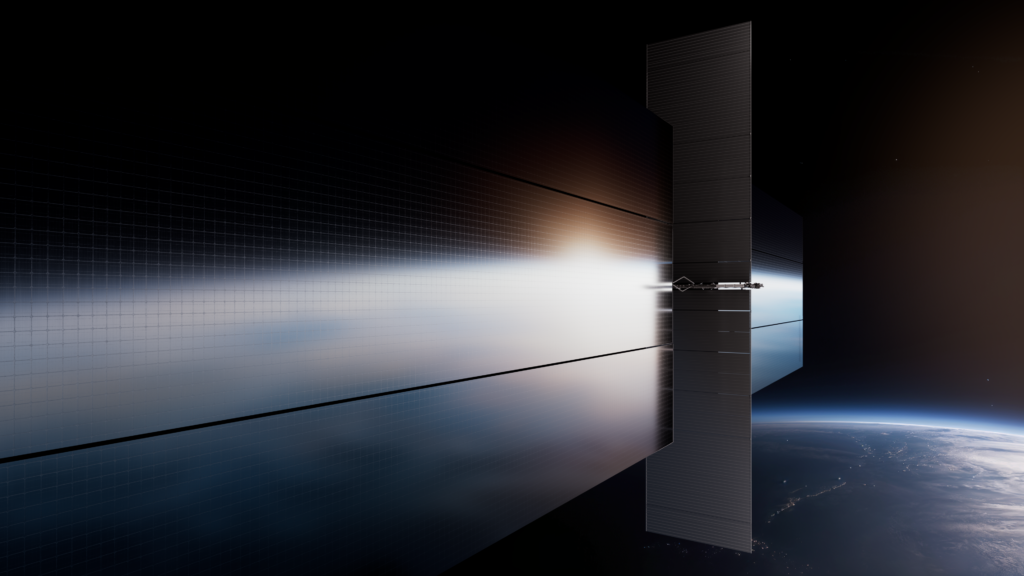
SpaceX has already unveiled its AI1 satellite design, which draws on technologies developed for its Starlink constellation.
According to specifications published by SpaceX, the spacecraft will feature a 210kW solar array with a power generation density of 250 watts per square metre. The solar technology is being manufactured by SpaceX in Bastrop, Texas.
The company has also designed the spacecraft to accommodate computing modules from different chip manufacturers, allowing it to take advantage of advances in semiconductor technology without being tied to a single supplier.
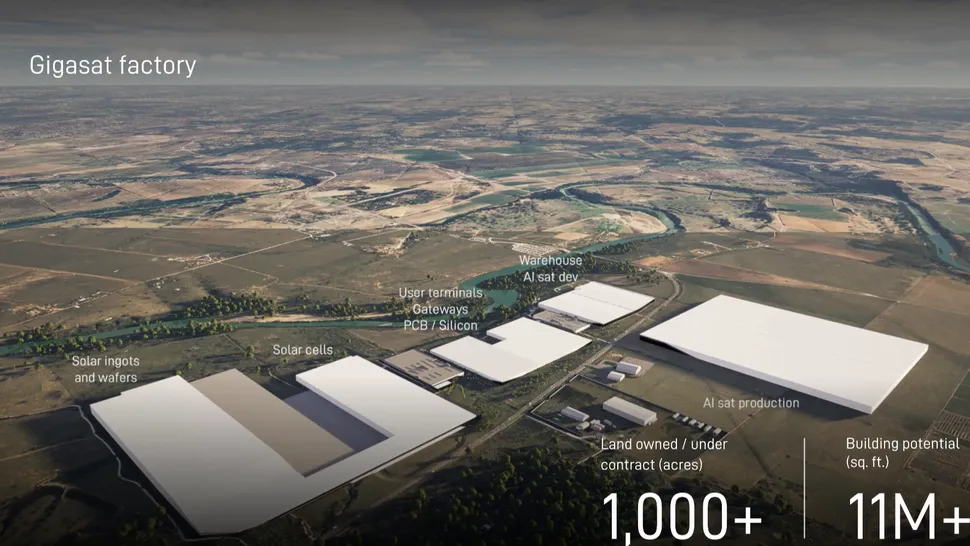
SpaceX is building a dedicated manufacturing facility, called Gigasat, in Bastrop. The company expects the facility to support the production and deployment of thousands of AI satellites starting as early as late 2027.
Why does SpaceX want to move data centres into space?
The expansion of AI has created a growing demand for electricity. Large terrestrial data centres require substantial amounts of power to operate their processors and cooling equipment. They also need land, access to electricity networks and, depending on their cooling systems, considerable quantities of water.
SpaceX believes it can overcome some of these constraints by moving the computing infrastructure into orbit, where solar energy can be collected without interference from clouds or the Earth’s atmosphere.

The company intends to operate its AI satellites in sun-synchronous orbits. These are orbits in which a satellite passes over locations on Earth at approximately the same local solar time. Carefully selected orbital configurations can provide near-continuous exposure to sunlight.
Cooling, however, presents a different engineering challenge in space.
Although the surrounding environment is cold, the absence of air means that heat cannot be carried away from electronic equipment through convection. Satellites instead rely on radiators to release waste heat as infrared radiation.
SpaceX claims its approach could reduce the power required for cooling by a factor of 10 compared with conventional terrestrial data centres.
The FCC authorisation also allows SpaceX to use radiofrequency communications as a backup to its optical network. Separate radio links will support emergency communications, spacecraft tracking and command functions.
What is the Kardashev scale?
In 1964, Soviet radio astronomer Nikolai Kardashev published a scientific paper titled Transmission of Information by Extraterrestrial Civilizations.
At the time, astronomers were investigating whether signals from technologically advanced extraterrestrial societies could be detected from Earth.
Kardashev approached the question by considering how much energy such civilisations might have at their disposal. The greater their energy resources, the more powerful their potential communications systems could be.
His classification subsequently became known as the Kardashev scale. In its widely used modern interpretation, it divides civilisations into three broad categories.
A Type I civilisation would be capable of exploiting energy resources on a planetary scale. In Earth’s case, this would encompass energy received from the Sun as well as other available resources.
A Type II civilisation would have access to the entire energy output of its host star, requiring infrastructure extending far beyond its home planet.
A Type III civilisation would be capable of harnessing energy on the scale of an entire galaxy, potentially drawing power from billions of stars.
American astronomer Carl Sagan subsequently refined the classification in the 1970s by introducing intermediate values, according to Britannica.
Why Musk wants to capture a millionth of the Sun’s energy
The Sun produces approximately 3.8 x 1026 W of power. Earth intercepts less than one two-billionth of that output, and humanity currently uses only a small fraction of the solar energy that reaches the planet.
Capturing even one-millionth of the Sun’s total output would provide approximately 380 trillion kilowatts of power, more than 1,000 times the total solar power intercepted by Earth.
Musk has used this comparison to illustrate the potential scale of energy generation beyond the planet.
“Our progress toward a Kardashev Type II civilisation, let’s have an aspiration that if we say that our goal is to get even a millionth of the Sun’s energy, that would be more than 1,000 times as much energy as could possibly be produced on Earth,” Musk said.
The Starmind project would operate on a considerably smaller scale.
The Starmind doesn’t envisage transmitting electricity back to Earth. The energy would be consumed by the spacecraft themselves.
Starship critical to SpaceX’s orbital data centre ambitions
Much of SpaceX’s ability to realise the Starmind project will depend on Starship, the company’s heavy-lift launch vehicle designed to be fully reusable.

Deploying one million satellites would require manufacturing and launch capabilities far beyond those currently available to the global space industry.
To put the number into perspective, approximately 28,800 satellites have been launched since the beginning of the space age in 1957, through about 7400 rocket launches, till early this year, according to figures cited by the European Space Agency (ESA).
SpaceX is targeting the third quarter of 2027 for the first Starmind satellite launches, according to reports.
SpaceX is also facing competition. Google, Starcloud, Blue Origin and Cowboy Space are among the companies exploring space-based computing. Google and Starcloud have already launched experimental AI satellites.
Sign up for our newsletter and get our latest content in your inbox.



More from


November 26, 20262 min read




