Not enough for a hotdog: African airlines battle rising costs and thinner margins

5 min read
While some African hub carriers are benefiting from strong growth in traffic as airlines re-route to avoid Middle East airspace, rising fuel costs and shrinking margins are creating a painful squeeze for smaller airlines, according to IATA.
While on the surface it appears to be a promising picture for Africa’s aviation sector, zoom out and it’s a more sobering story, according to the International Air Transport Association’s (IATA) financial analysis.
Net profits for the continent’s aviation sector are expected to fall sharply to $0.1 billion in 2026, down from $0.3 billion in 2025. Meanwhile, net profit per passenger is expected to fall to just $0.40, less than a quarter of the $2.10 achieved last year – “not even enough to buy a hot dog,” according to IATA’s Director General, Willie Walsh.
Any small gains are likely to be concentrated among the continent’s limited number of hub carriers with established long-haul routes connecting Africa to Europe and Asia. Smaller carriers and more fragmented operators are expected to bear the burden of the challenging operating environment. Furthermore, the region’s profitability is expected to weaken due to financial vulnerabilities related to jet fuel prices and supply.
Rising costs exacerbate structural constraints for Africa’s airlines
Beyond geopolitical tensions, the continent’s structural constraints continue. Airlines already battle against weak infrastructure, high operating costs, fragmented airspace and limited cross-border coordination. Limited financial capacity – including blocked funds, currency volatility and a lack of access to capital – further restricts fleet expansion and network development.
It’s not just Africa that’s impacted by geopolitical turbulence. IATA’s financial analysis underscores that airline profitability worldwide has fallen sharply due to rising fuel prices and disruptions affecting Middle Eastern airspace.
“War-related disruptions in the Middle East and rising fuel costs have shifted the outlook for airlines to the worse,” commented Walsh. Profits, he said, will shrink dramatically “from $45 billion in 2025 to $23 billion this year.”
IATA’s report flags a central reality: fuel remains the single largest cost for airlines. Rising oil prices (airlines are suffering from the current 70% rise in jet fuel) are having a significant impact on airline profitability. At the same time, the need to reroute flights to avoid conflict zones or disrupted airspace increases flight times, fuel burn and operational complexity.
African airlines feel the squeeze
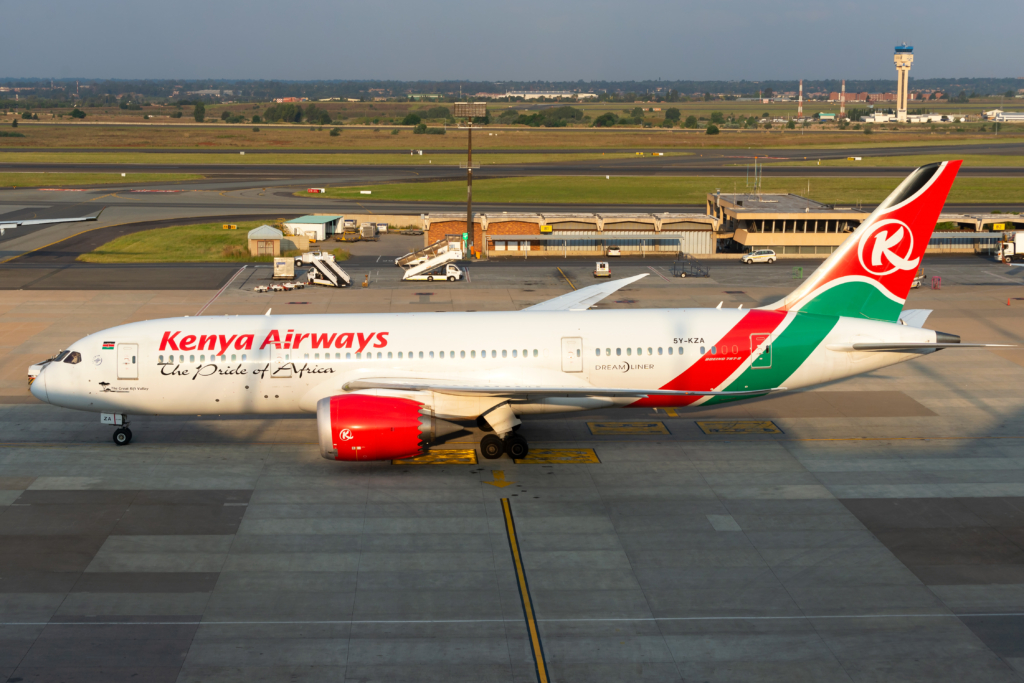
Many African hub carriers, such as Ethiopian Airlines and Kenya Airways, operate long-haul services connecting the continent with Europe, the Middle East and Asia. Geopolitical tensions forcing aircraft to avoid certain flight corridors mean longer flight times, and therefore greater fuel burn and costs, which in turn impact passenger fares.
African airlines already pay some of the world’s highest jet fuel prices due to limited refining capacity, taxes and supply chain constraints. Any global spike in fuel prices, therefore, has a direct impact on the continent’s carriers.
Other implications of rerouted flights include longer crew duty times, reduced aircraft utilisation and increased scheduling changes.
Currency volatility is another key issue. IATA’s regional vice president for Africa and the Middle East, Kamal Al-Awadhi, has previously spoken out about the challenge of African airlines earning revenue in local currencies while having to pay for aircraft leases, maintenance, and fuel in US dollars.
Uneven recovery, but strong demand
Despite financial headwinds from rising costs, passenger demand across Africa (and worldwide) continues to grow. IATA’s report forecasts that demand will continue to recover. Mainstream destinations, such as Mauritius, Kenya, South Africa and Tanzania, are all seeing strong demand from international travellers, while regional business is also gradually improving.
However, IATA’s report suggests that stronger demand alone may not be enough to offset rising costs. Airlines with limited financial reserves could struggle to absorb sustained increases in fuel prices or prolonged airspace disruptions.
Recovery is not the same as resilience
While airlines are adopting various measures to respond to current headwinds, including adjusting networks and expanding codeshares and alliances, the industry remains vulnerable to external shocks. So, while passenger traffic is improving, profitability is being squeezed by factors largely outside airlines’ control.

For Africa’s aviation sector, strengthening the industry’s financial foundations is key to sustainable growth. Investment in infrastructure, more competitive fuel supply chains, regulatory reforms and stronger regional connectivity are all vital.
IATA’s financial outlook for airlines globally
Globally, airlines are expected to achieve a combined total net profit of US$23 billion in 2026, roughly half the previously projected US$41 billion. It is also roughly half the US$45 billion estimate for 2025.
The net profit margin is expected to be 2% in 2026, around half the previously projected 3.9% and less than half the 4.2% estimate for the 2025 net profit margin. Meanwhile, net profit per passenger is expected to be US$4.50, half the US$9.10 achieved in 2025, while operating profits are expected to be US48 billion (down from US$76.4 billion in 2025).
Passenger numbers globally are expected to reach 5.1 billion in 2026 (up 2.4% on 2025).
Net profits not enough to buy a hot dog
Net profits per passenger wouldn’t even buy you a hot dog “Airlines are bearing the brunt of the fuel price shock,” concluded Walsh.

“While air fares are rising, airlines are still absorbing part of the hike in their bottom lines. Net profit per passenger is expected to fall to US$4.50, half of last year’s level. Under the circumstances, that shows resilience. But it won’t ever buy you a hot dog at most of the FIA World Cup venues, and it does not leave much of a buffer should other costs or taxes start rising.”
Featured image: Mateusz / stock.adobe.com
Sign up for our newsletter and get our latest content in your inbox.


More from

September 25, 20264 min read

September 25, 20264 min read