


Myanmar becomes first foreign operator of the Mi-38T helicopter amid deepening Russia–China ties

5 min read
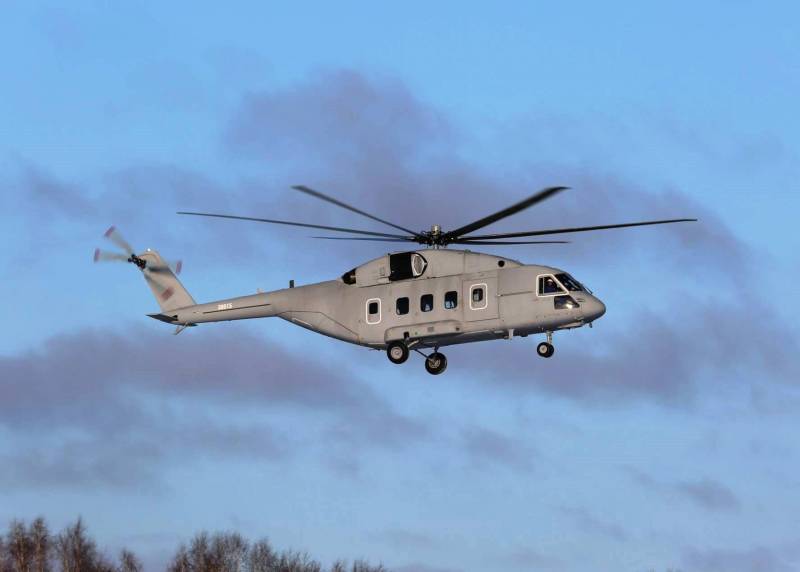
Myanmar has become the first country outside Russia to field the Mi-38T, taking delivery of three of the medium-lift helicopters in the first week of November during an induction ceremony in Naypyidaw.
The arrival of the aircraft, paired with the commissioning of two Chinese-made Y-8F-200W transports, has drawn attention in regional defence circles. At a time when Moscow has struggled to secure export breakthroughs for the Mi-38, Myanmar’s decision has prompted a simple question: Why buy this aircraft now?
Analysts at the Myanmar Defense & Security Institute (MDSI) say the answer lies in the Tatmadaw’s immediate operational pressures. With fighting intensifying across several fronts, the military has been forced to keep its forces moving and supplied largely by air.
That demand, according to MDSI, has drawn the Tatmadaw deeper into Russian and Chinese military supply networks — not only for new aircraft, but also for training, maintenance and systems support.
Get the latest aerospace defence news here on AGN.
Myanmar Air Force inducts Mi-38T helicopters and Y-8 transports
The Air Force usually rolls out new aircraft on 15 December, which it celebrates as Air Force Day. This time, however, the service broke with tradition.
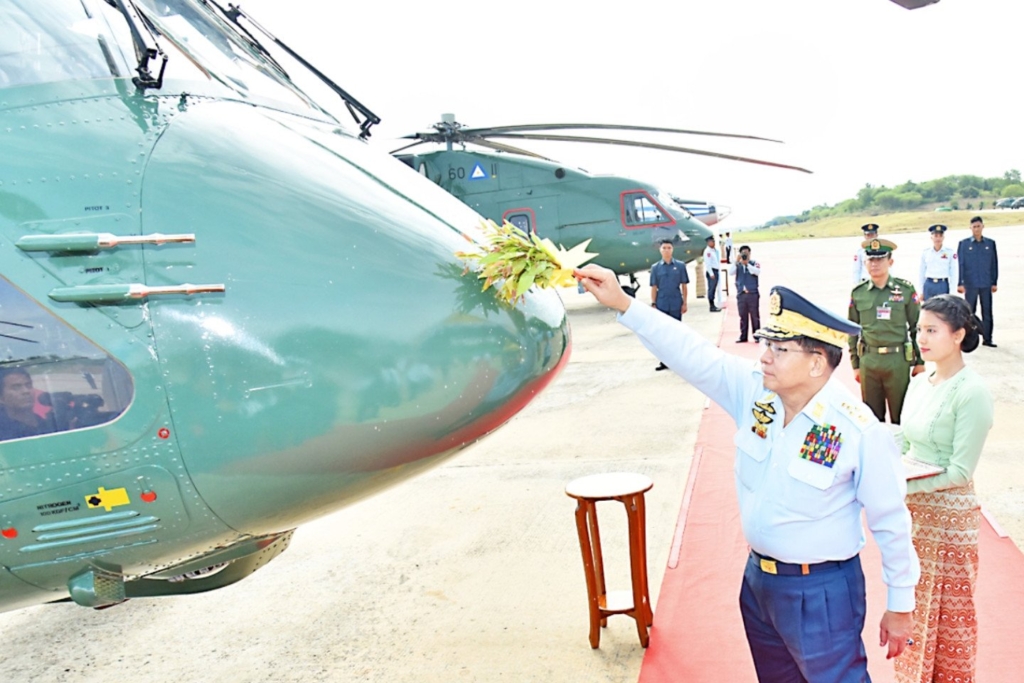
In a tightly choreographed ceremony overseen by Commander-in-Chief Senior General Min Aung Hlaing, officers and aircrew lined up on 7 November to receive the three Mi-38Ts and two Y-8s.
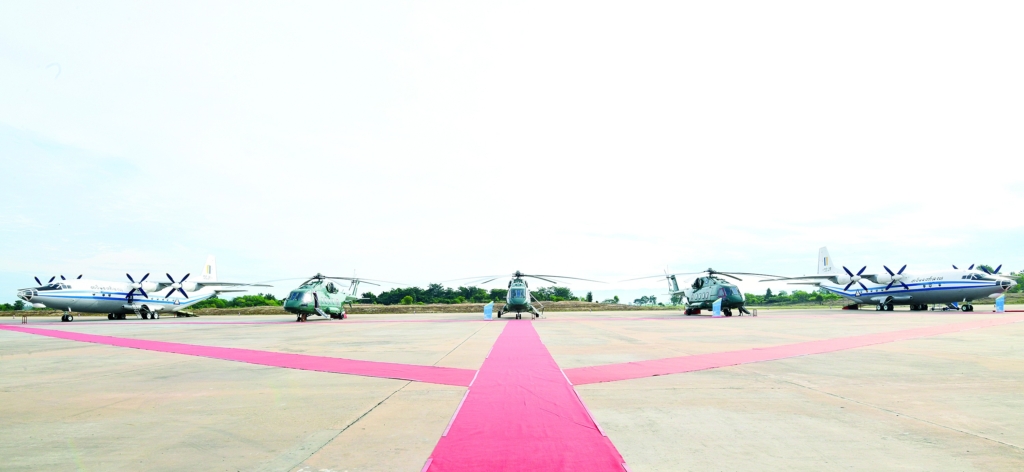
That deviation from the annual calendar was deliberate. MDSI, citing internal briefings, called it “a strategic reinforcement meant to expand operational flexibility at a time when battlefield supply routes and troop-movement requirements are shifting sharply.”
Mi-38T: a modern step beyond the ageing Mi-17 fleet
For decades, Myanmar has relied heavily on the rugged Mi-17. The Mi-38T represents a step into a different class altogether.
Built by Kazan Helicopters and powered by twin Klimov TV7-117V engines, the Mi-38T sits at the upper end of the medium-lift category and is promoted by Russia as a capable replacement for legacy Soviet-era designs.
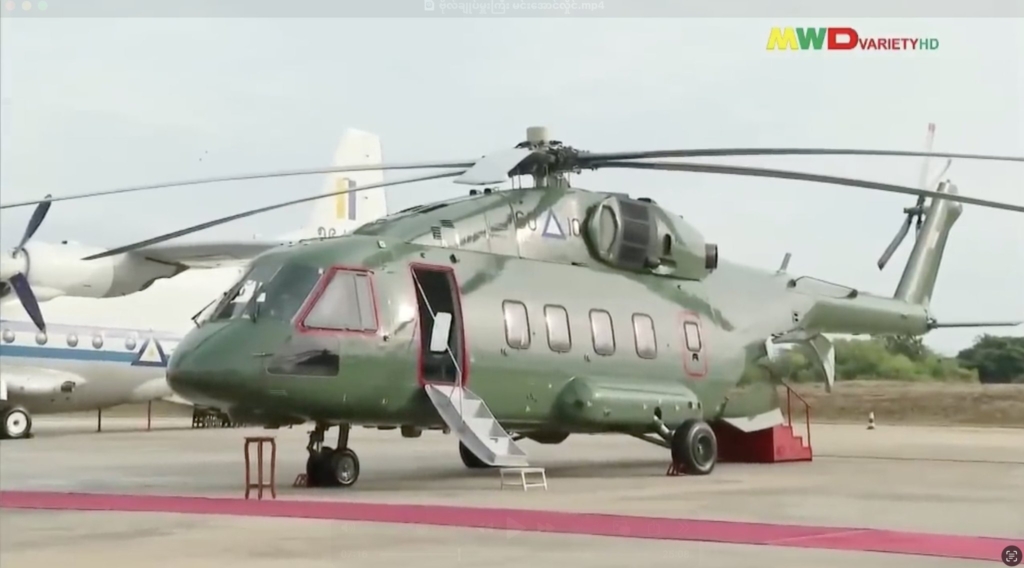
Technical data list a maximum take-off weight of 15,600 kg, a top speed close to 300 km/h, and a service ceiling of 6,300 m. It can transport up to 40 troops or carry heavy loads — 4,500 kg internally or 5,000 kg on an external sling. For the Tatmadaw, which often has to move troops quickly between contested zones, that lift capacity matters.
The cockpit is fully digital and equipped with night-capable flight-management systems, a clear upgrade from older analogue setups. Its flexibility for troop transport, VIP movement, medevac, search-and-rescue or offshore operations suits Myanmar’s varied terrain, from coastal marshes to mountainous interiors.
Chinese Y-8F-200W transports strengthen Myanmar’s airlift capability
The two Y-8F-200W aircraft inducted alongside the Mi-38Ts add to a fleet Myanmar already depends on. The Chinese-built transport can carry more than 90 personnel and is frequently used to haul ammunition, artillery and light vehicles.
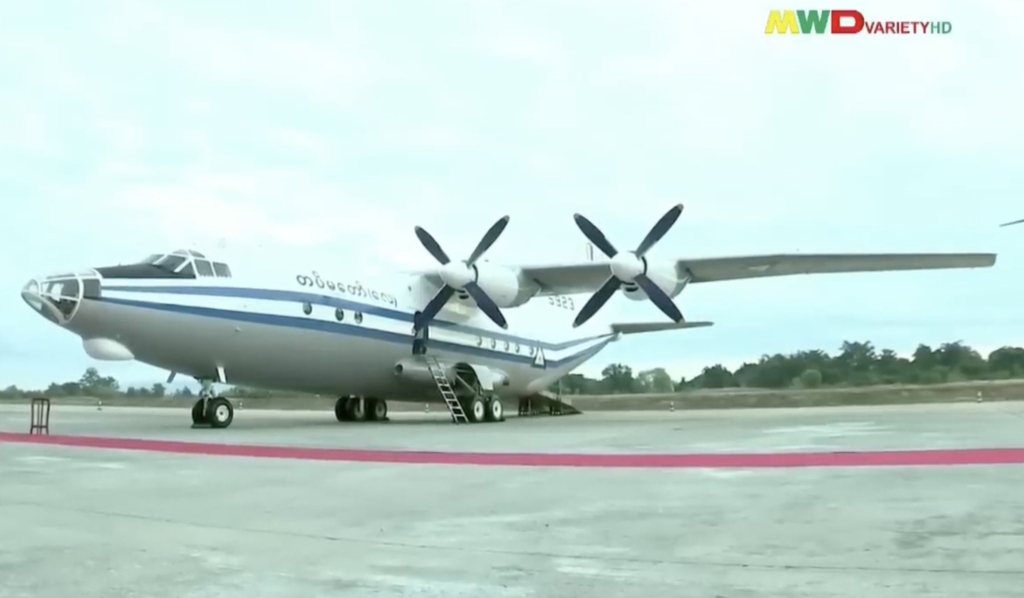
MDSI notes that smaller types in the inventory — such as ATRs, Beechcraft and Y-12s — simply cannot handle the heavy loads the Y-8s can shift over long distances. With many ground supply routes now vulnerable or broken, the Y-8s have become the backbone of the country’s logistics chain, especially for remote bases.
Airpower keeps Tatmadaw supply routes open amid intensifying conflict
MDSI’s assessment of the battlefield is stark. The conflict has splintered into multiple fronts, creating two distinct air-operations demands.
The first is counter-insurgency: guerrilla units are dispersed, mobile and difficult to target, making traditional fighter strikes uneconomical and often ineffective.
The second is the need to keep garrisons supplied when roads are mined, ambushed or impassable.
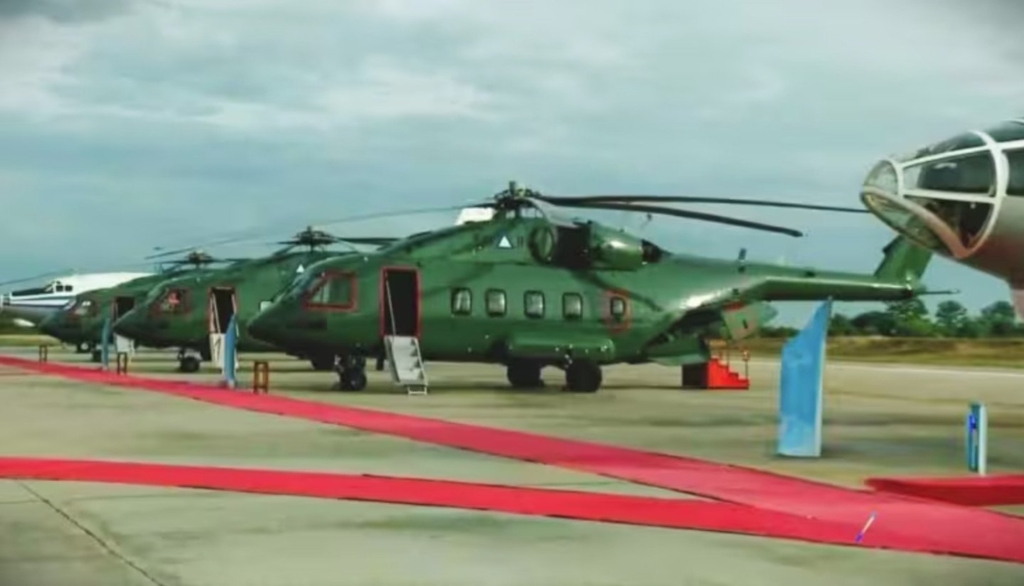
Helicopters and transport aircraft are, in MDSI’s view, the only practical means of sustaining these positions.
“The addition of these transport aircraft and helicopters will significantly enhance the SAC military’s ability to rapidly redeploy combat forces and improve air-based logistics support,” MDSI said. “Strategically, this will expand the military’s capacity to conduct airborne operations on a wider scale.”
The think-tank expects the new assets to be employed in mountainous terrain, air-mobility operations and rapid-insertion missions across the plains — reflecting the Tatmadaw’s evolving doctrine.
Min Aung Hlaing highlights national role of new Mi-38T and Y-8 aircraft
During the induction, Senior General Min Aung Hlaing framed the aircraft as more than military tools, highlighting their roles in search-and-rescue, environmental protection and national development. He also linked the acquisitions to Myanmar’s geographic position between major population centres and key sea lanes.
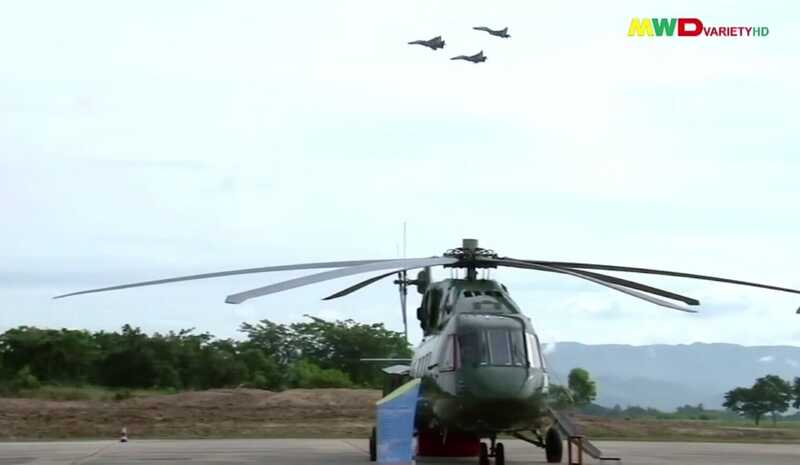
The ceremony, complete with an air show featuring Mi-17s, Bell-206s, H-125s, K-8 trainers, MiG-29s and Su-30 SMEs, served as a display of continuity and control — reassurance for military personnel and a signal to the outside world that the Tatmadaw remains operationally capable despite the country’s instability.
Russia and China step deeper into Myanmar’s defence space
The timing and mix of platforms — the Mi-38Ts from Russia and the Y-8s from China — underline a broader trend. With sanctions limiting access to Western equipment and finance, Myanmar’s procurement options have narrowed. Moscow and Beijing have stepped in, offering aircraft, training pipelines and maintenance support.
For Russia, Myanmar’s purchase represents a rare export success for the Mi-38T, potentially bolstering its pitch to other militaries watching closely. For China, the continued reliance on the Y-8 cements its long-standing role in Myanmar’s transport fleet.
Sign up for our newsletter and get our latest content in your inbox.


More from


October 25, 20266 min read

October 25, 20265 min read


