


Why virtual prototyping is becoming a competitive advantage in aerospace manufacturing


Mark Vrolijk is Senior Product Marketing Manager for Keysight’s CAE Virtual Manufacturing suite. He began his career with ESI Group in 2000 after completing a master’s degree in aerospace engineering at Delft University of Technology. He has since held technical support, product management, product marketing and strategy roles, with a specialist background in sheet metal forming and virtual manufacturing.
Aerospace manufacturing is undergoing a quiet but decisive shift. Rising development costs, tighter programme margins, and pressure to accelerate production readiness have made traditional prototype-driven iteration too slow and too expensive.
A single physical prototype for a complex aircraft component can cost anywhere from $50,000 to $500,000, depending on design complexity and tooling requirements, and those costs multiply quickly across programmes. Meanwhile, virtual prototypes can be created and iterated at a fraction of the cost and time.
This shift is already taking hold across the aerospace sector. Leading manufacturers are moving validation earlier in the lifecycle, “shifting left”, to catch manufacturability challenges before they become late-stage surprises.
The result is fewer prototype cycles, more predictable ramp schedules, and dramatically lower risk profiles.
Shift left: The foundation of virtual prototyping in aerospace manufacturing
“Shift left” means performing verification, performance assessment, and manufacturability analysis earlier in the design process while changes are still inexpensive and fast to implement.
Instead of waiting for the first physical component to reveal weld distortion, springback, porosity, acoustic issues, or system-level interactions, teams use virtual prototyping to detect and resolve risks while the design is still fluid.
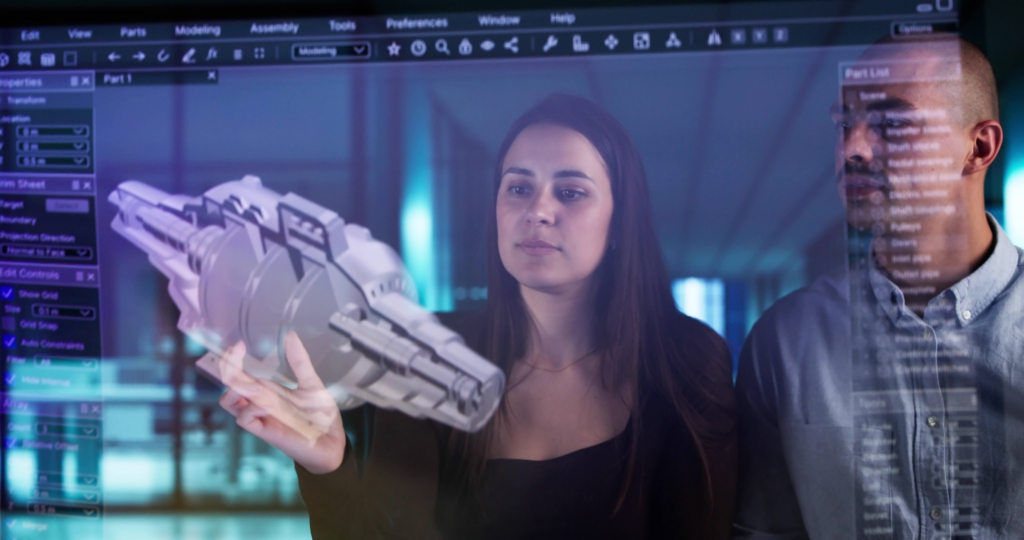
When product development integrates structural, vibroacoustic, and systems-level simulation, engineering and manufacturing teams deliver designs and products engineered for both performance and manufacturability.
The approach directly safeguards aerospace manufacturers’ schedules, costs, and production integrity.
Virtual prototyping ROI: What industry benchmarks show
Independent research reinforces what engineering organisations are experiencing daily. Aberdeen’s report, Shift Left: The Value of Virtual Prototyping, found that companies using virtual prototyping achieve:
- 52% increase in engineering productivity
- 49% increase in product quality
- 27% reduction in development cycle time
- 26% reduction in physical prototypes
These aren’t guarantees; they are best-practice benchmarks that demonstrate what’s possible when design, validation, and manufacturing move left in the lifecycle.
The core takeaway is simple: early virtual validation reduces the causes of late discovery, and, in aerospace manufacturing, late discovery is the most expensive kind.
A hybrid approach: Simulation to optimise, testing to confirm
Physical testing remains essential, especially for aerospace certification and structural integrity verification. Simulation does not replace required testing, nor should it.
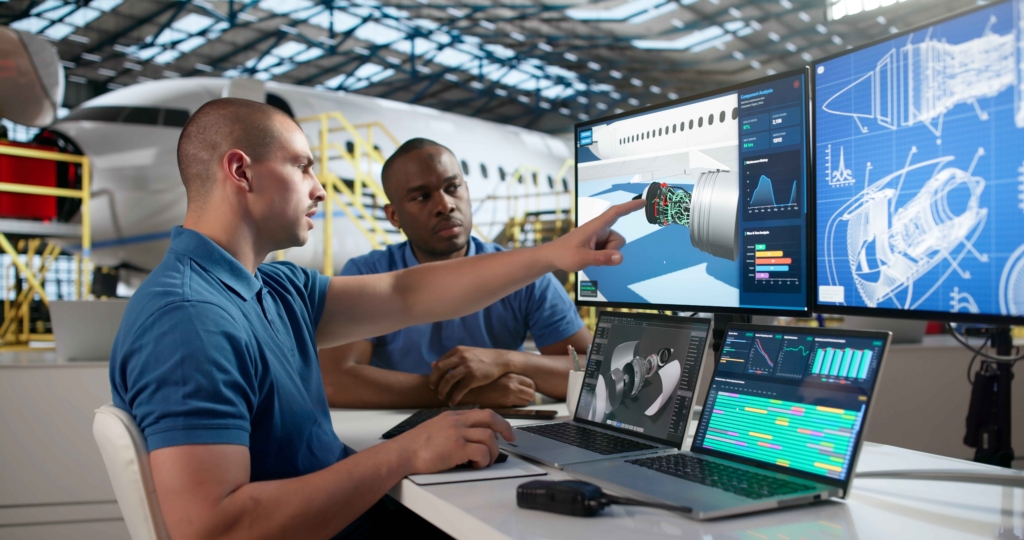
Instead, virtual manufacturing increases design maturity before hardware is produced. This reduces the number of physical cycles needed and enables targeted testing where empirical confirmation adds the most value.
Leading aerospace programmes increasingly rely on a hybrid model: simulate broadly, test purposefully, converge faster.
Why virtual manufacturing matters for aerospace programmes
Virtual manufacturing directly addresses recurring challenges in aerospace development:
- Reducing prototype loops: Digital validation identifies manufacturing and performance issues early, before they cascade into tooling changes, NCRs, or scrapped material.
- Compressing introduction-to-rate schedules: Programmes ramp faster when manufacturability constraints are resolved upstream, not discovered late on the shop floor or assembly line.
- Protecting structural, acoustic, and system integrity: When manufacturing insights influence design early, teams avoid late compromises in stiffness, fatigue life, NVH performance, or system-level behaviour.
- Minimising late-stage risk: Virtual manufacturing reduces both the frequency and severity of late discoveries, helping safeguard certification timelines and customer commitments.
- Scaling learning across programmes: Simulation assets become reusable digital knowledge, accelerating development and reducing risk across future platforms.
Simulation creates value across the aerospace supply chain
Optimising a single casting process, weld sequence, forming operation, or assembly method creates measurable value.
Scaling that improvement across dozens of components, suppliers, and stations creates exponential returns. Aerospace programmes are simply too complex and too cost-intensive to depend on late-stage fixes.
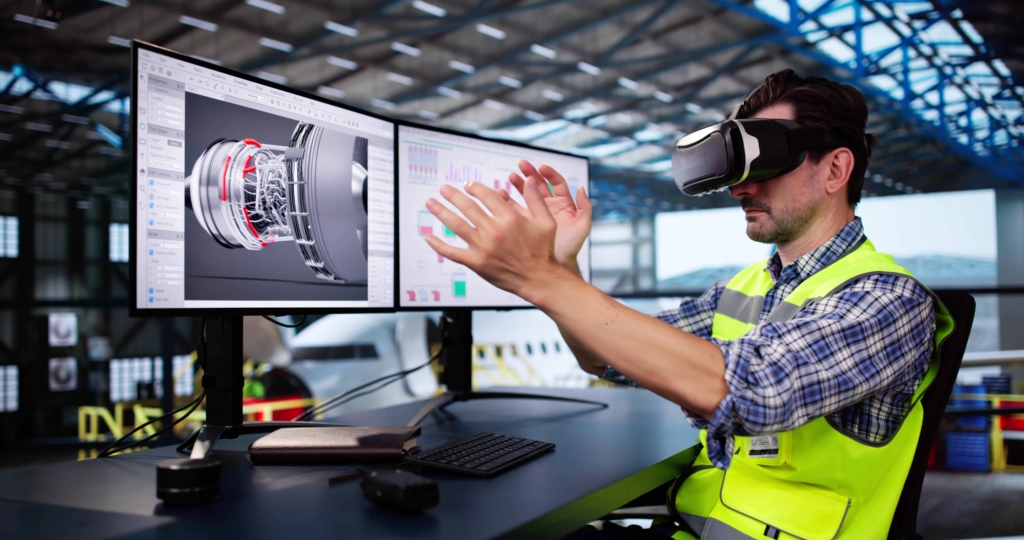
Virtual manufacturing produces a multiplier effect: fewer physical iterations, faster convergence, higher yield, and more predictable production.
The future of aerospace manufacturing is already here
Virtual manufacturing isn’t about eliminating physical testing; it’s about making every test count. It raises confidence earlier, identifies risk sooner, and supports faster delivery of production-ready designs.
For aerospace organisations aiming to reduce development cost, accelerate ramp, and maintain uncompromising integrity standards, virtual manufacturing has become a practical necessity and a significant competitive advantage.


