


A-10 Warthog proves its worth hunting Iranian fast-attack boats in Strait of Hormuz

10 min read
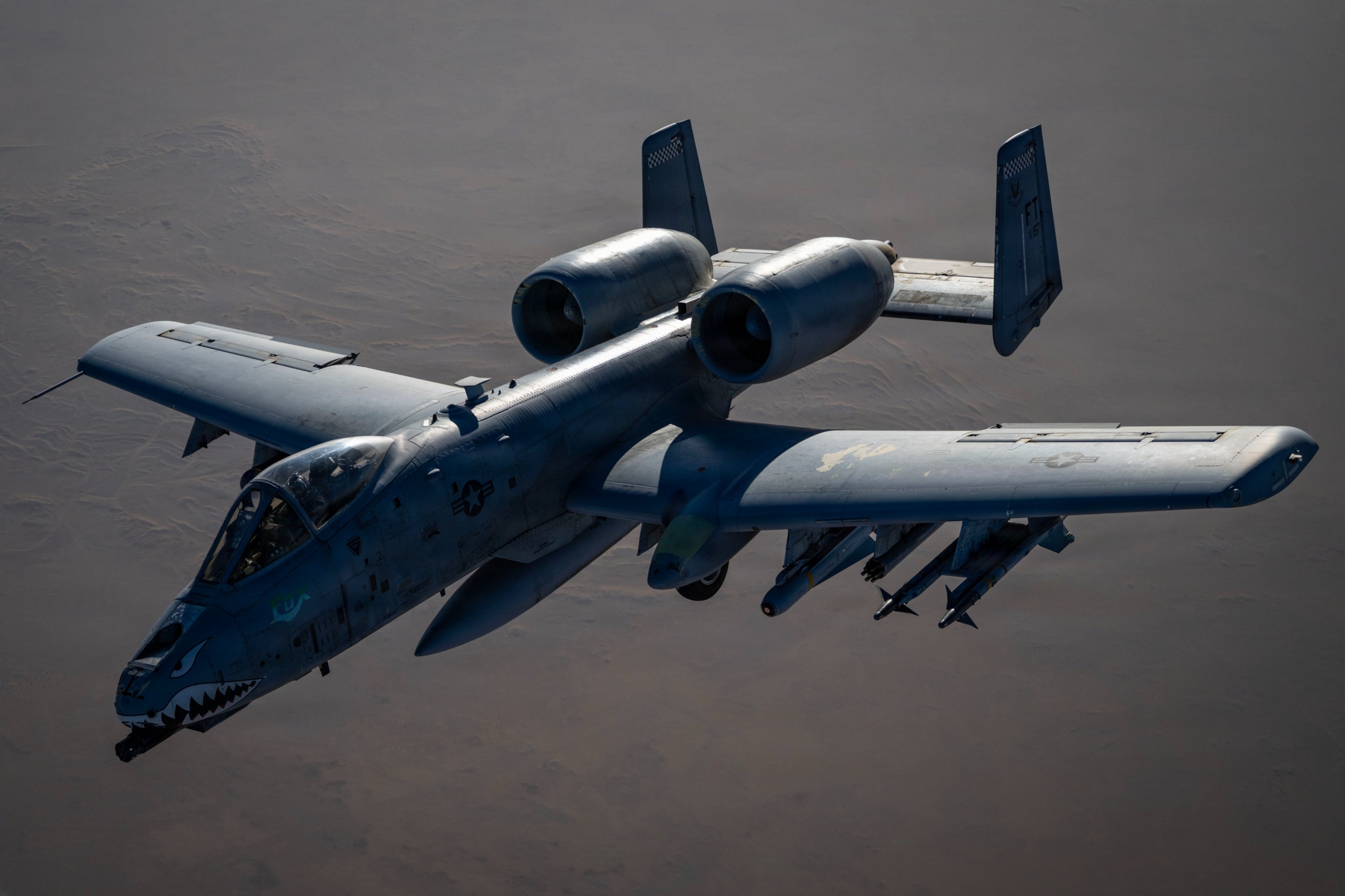
Often associated with close air support and ground attack missions, the US Air Force (USAF) has now deployed its iconic, Cold War-era ‘Warthog’ jets in their lesser-celebrated maritime role.
In support of Operation Epic Fury, the platform is now being used to hunt down and destroy warships and fast-attack watercraft operated by the Islamic Republic of Iran Navy (IRIN) and Islamic Revolutionary Guard Corps Navy (IRGCN) in the Strait of Hormuz and along the operation’s southern flank.
Such operations come as the US military works to reopen the Strait of Hormuz and restore normal international maritime commerce. Traffic through this highly strategic waterway nearly ground to a halt after Iran’s declaration of the Strait’s closure and a surge in Iranian attacks on commercial shipping following the start of Epic Fury.
The Strait remains one of the world’s most critical chokepoints, with roughly 20% of global liquified natural gas and seaborne oil trade passing through it annually between 2023 and 2025.
While the presence of A-10Cs in the Middle East in support of Epic Fury had previously been disclosed by Washington, the Chairman of the Joint Chiefs of Staff, USAF Gen Dan ‘Razin’ Caine, outlined the platform’s evolving contribution to the conflict during a press briefing at the Pentagon on 19 March.
“The A-10 ‘Warthog’ is now in the fight across the southern flank [of Iran] and is hunting and killing fast-attack watercraft in the Strait of Hormuz,” he confirmed.
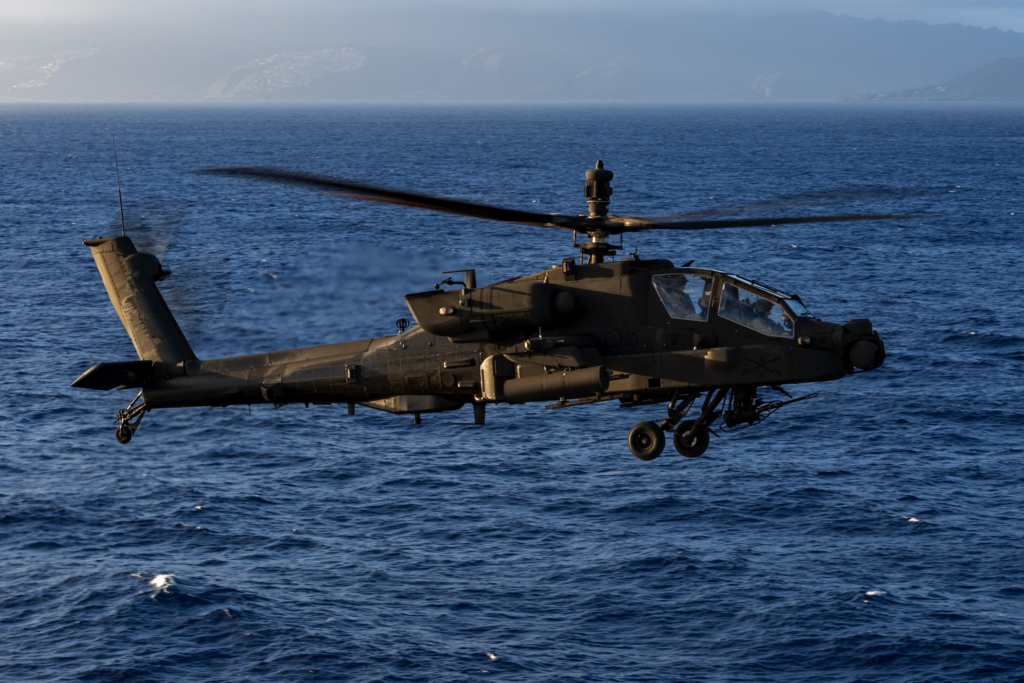
Caine also disclosed that US Army-operated AH-64D/E Apache attack helicopters are now operating alongside the ‘Warthogs’ over Iran’s southern flank and the Strait of Hormuz, though their exact mission was not confirmed.
While the Apache is capable of striking maritime targets, it remains possible that they are being used for counter-drone operations to destroy incoming Iranian one-way attack drones – a role that has already been adopted by several US allies across the region.
U.S. forces are destroying Iranian naval targets that threaten international shipping in and near the Strait of Hormuz. pic.twitter.com/qR6FJyI5ZS
— U.S. Central Command (@CENTCOM) March 19, 2026
“We continue to hunt and kill mine storage facilities and naval ammunition depots. We continue to hunt and kill afloat [Iranian] assets, including more than 120 vessels and 44 mine layers, and the pressure will continue,” Caine said when discussing the destruction of Iran’s standing naval forces, which is one of the core stated goals of Epic Fury.
The A-10 Warthog is proving its worth in Operation Epic Fury
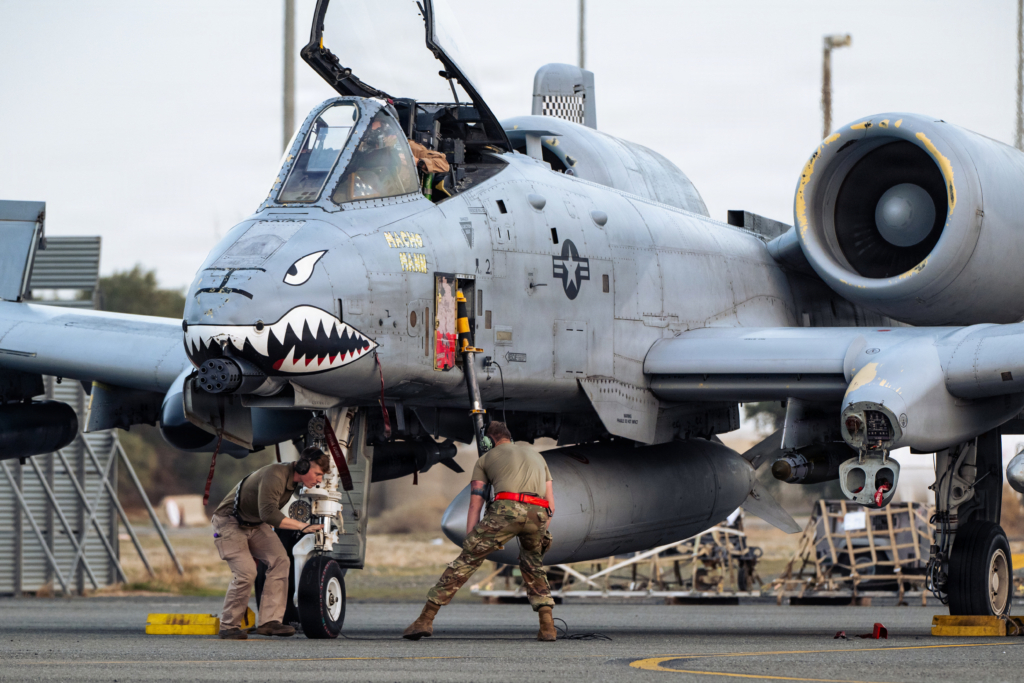
USAF A-10Cs were present in the Middle East long before the US began its mass build-up of military forces across the region. These jets – operated by the Moody-based 23rd Fighter Group’s (FG’s) 75th Fighter Squadron (FS) ‘Tiger Sharks’ – previously supported ground strikes against ISIS militants in Syria as part of Operation Hawkeye Strike in December 2025.
Currently forward-deployed in Jordan, these same ‘Warthogs’ have been used to engage Iran-backed militias in Iraq since Epic Fury began on 28 February.
However, Caine’s latest announcement marks a key expansion in the A-10C’s confirmed role in this rapidly evolving and escalating conflict with Iran, which is now severely damaging the flow of international trade and energy resources, along with the global economy.
This is increasingly becoming a major focus for the US military as Iran’s effective closure of the Strait of Hormuz has quickly become a global crisis, with the rest of the world now feeling the dramatic consequences of a war-engulfed Middle East region.
While the US has previously declared that the IRIN has now been rendered combat ineffective – with more than 120 vessels having been targeted or sunk – Iran still maintains a fleet of hundreds of smaller fast-attack boats, which are far harder to locate and destroy.
U.S. forces eliminated multiple Iranian naval vessels, March 10, including 16 minelayers near the Strait of Hormuz. pic.twitter.com/371unKYiJs
— U.S. Central Command (@CENTCOM) March 10, 2026
Unlike the larger warships operated by the IRIN and IRGCN, these fast-attack vessels – which are largely operated by the latter – employ more asymmetric warfare tactics to damage and disrupt military/commercial shipping operations across the region.
These boats do not require large ports to operate from and can be armed with short-range anti-ship missiles and rockets, while also boasting an ability to lay sea mines. This remains a key threat across the Strait of Hormuz, for which the A-10C is perfectly suited to counter.
A-10C: A maritime game-changer in the Strait of Hormuz?
The ‘Warthog’ is often considered to be a ‘single mission’ platform, given that it was purpose-built for close air support operations in support of ground forces in a land-based battlespace.
This narrative has long supported the argument that America’s ageing A-10C fleet must be withdrawn from use as it boasts limited capabilities in modern warfare against near-peer adversaries, even if the veteran attack aircraft remains the cheapest tactical jet to operate in the USAF’s current inventory.
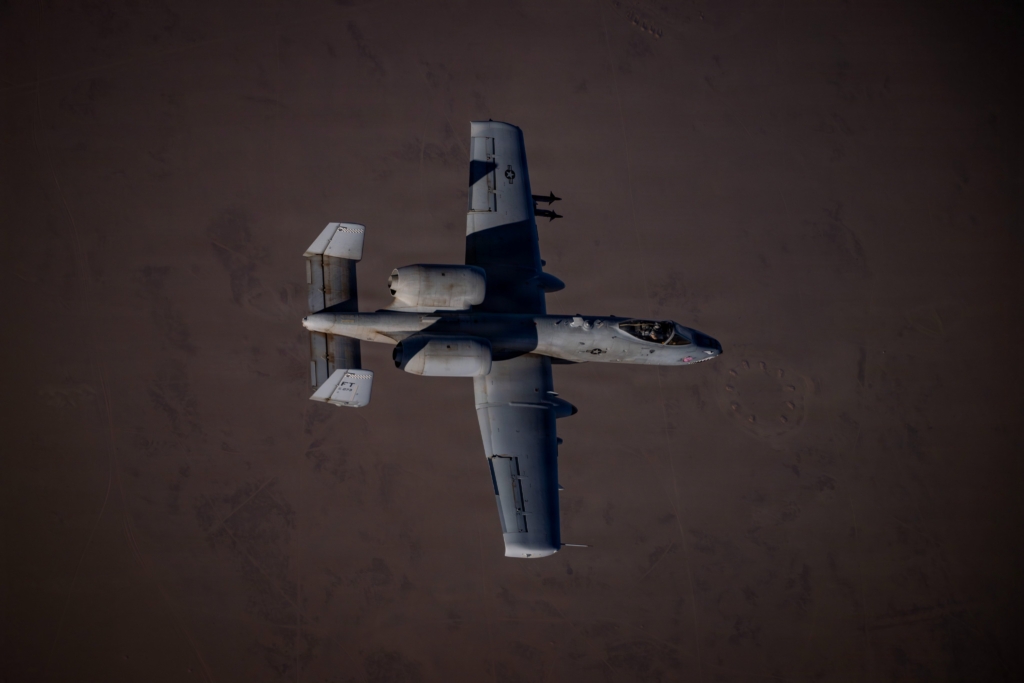
However, this is not strictly the case. Built to fly low and slow over a tightly contested battlespace, the ‘Warthog’ is designed to loiter for hours at a time, making it perfectly suited to providing direct fire support to ground troops in land-based conflicts and joint forces in littoral environments.
While its core mission is close air support, the A-10C’s design and capabilities make it well-suited for maritime operations in contested littorals and its crews have long trained for and performed missions in support of this secondary tasking.
This was underscored by the USAF just weeks before Epic Fury began, when several ‘Warthogs’ conducted maritime training with the US Navy’s Independence-class littoral combat ship, USS Santa Barbara (LCS-32) – a counter-mine vessel – in the Persian Gulf in early February.
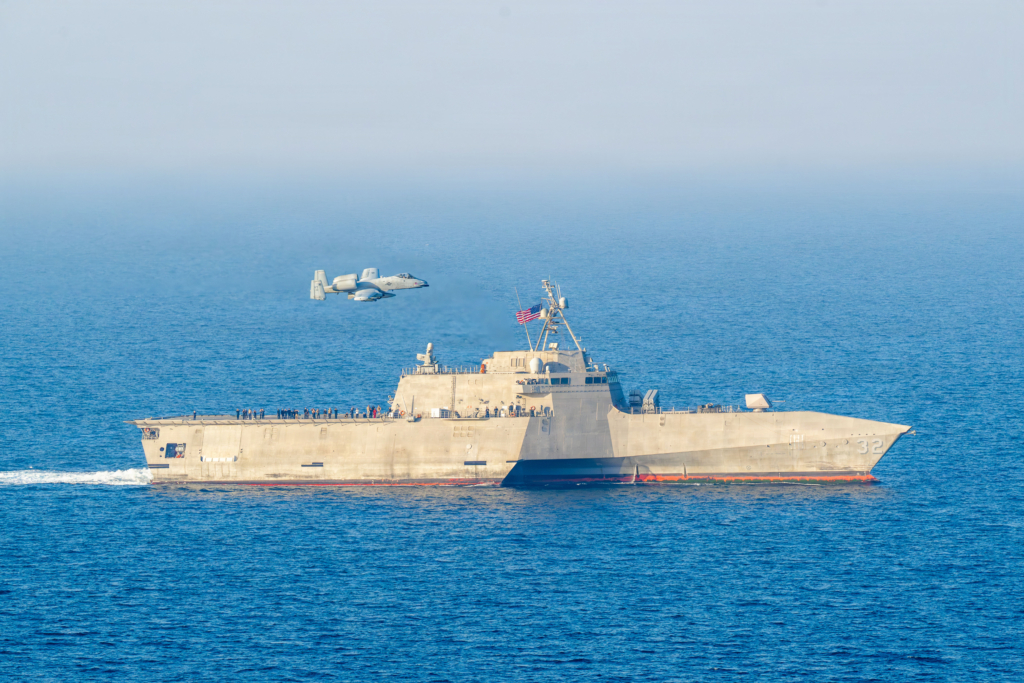
In reflection, this particular drill highlighted the dangers posed by Iranian sea mines and how the A-10Cs deployed to the region can be used to protect allied vessels conducting minesweeping operations.
Santa Barbara is one of three Independence-class littoral combat ships to have been forward-deployed to the Middle East since last year to plug the gap left by the removal and subsequent decommissioning of four Avenger-class mine countermeasures ships.
While three of these vessels were deployed to the region, just one has remained in the Middle East since Epic Fury began, with both USS Tulsa (LCS-16) and Santa Barbara being relocated to the Indo-Pacific in an unexplained move by the US Navy.
Can the ‘Warthog’ counter Iran’s small boat threat?
As stated, the threats posed by Tehran’s fleet of fast-attack boats – which can be operated as unmanned swarms or explosive-laden ‘kamikaze’ vessels – pose a major risk to any military or commercial shipping operations in the Strait of Hormuz.
Iran and its regional proxies pioneered the use of these vessels and has long used these modern asymmetric warfare techniques and capabilities as part of its current warfighting doctrine. These capabilities are now being employed to keep the Strait of Hormuz closed to regular traffic.
U.S. forces are degrading the Iranian regime's ability to project power at sea and harass international shipping. For years, Iranian forces have threatened freedom of navigation in waters essential to American, regional and global security and prosperity. pic.twitter.com/gIBN02mowh
— U.S. Central Command (@CENTCOM) March 10, 2026
While these boats are hard to detect, track and destroy, four core factors make the A-10C unsurprisingly well-suited to combatting these asymmetrical threats.
The platform’s ability to loiter over contested areas, such as the Strait of Hormuz, for extended periods enables greater persistent surveillance and rapid response against fast-moving small boats. This critical capability allows the A-10C to engage these vessels, which can appear quickly, unpredictably and en masse.
Secondly, the Thunderbolt II’s ability to fly low and slow increases the pilot’s situational awareness over the region, better enabling the visual identification of small, fast-moving vessels.
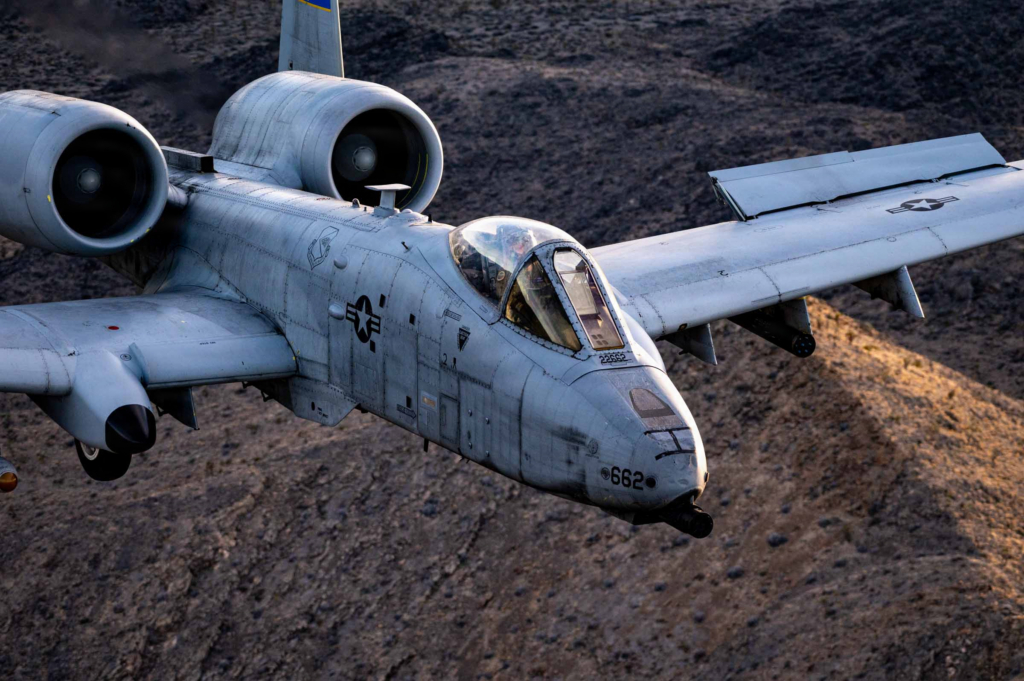
This becomes especially useful when distinguishing between civilian craft and hostile fast-attack boats. It is also something that faster, albeit more advanced tactical jets, can struggle with if they are not fitted with relevant targeting systems.
Thirdly, the A-10C – thanks to its core close air support mission – was developed to be a highly durable and survivable platform.
The jet’s titanium-armoured cockpit (often referred to as the ‘titanium bathtub’), combined with its redundant flight systems, allows the type to absorb significant damage and continue to effectively fight under punishing circumstances that would ground most other combat aircraft, which are less hardened.

Finally, the ‘Warthog’ boasts a diverse, highly flexible weapons loadout. The A-10C can employ precision-guided munitions, such as the AGM-65 Maverick air-to-surface missile and 70mm AGR-20 Advanced Precision Kill Weapon System (APKWS) II laser-guided rockets, to target larger vessels.
In addition, the aircraft’s iconic 30mm GAU-8/A Avenger autocannon is extremely effective against smaller, lightly armoured boats, especially those being used as part of a drone swarm.
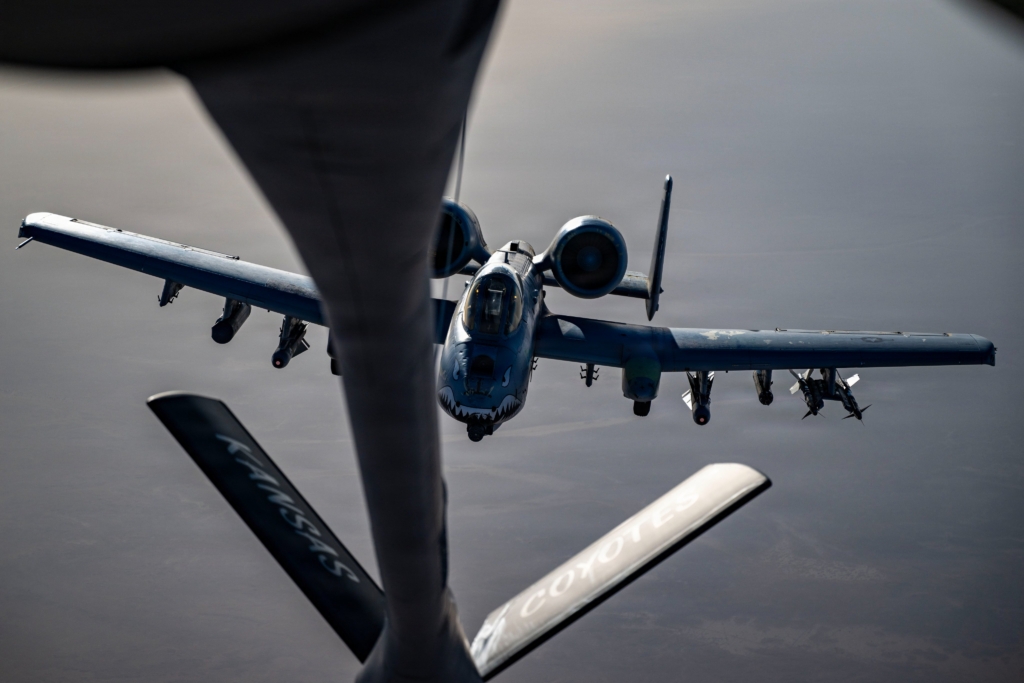
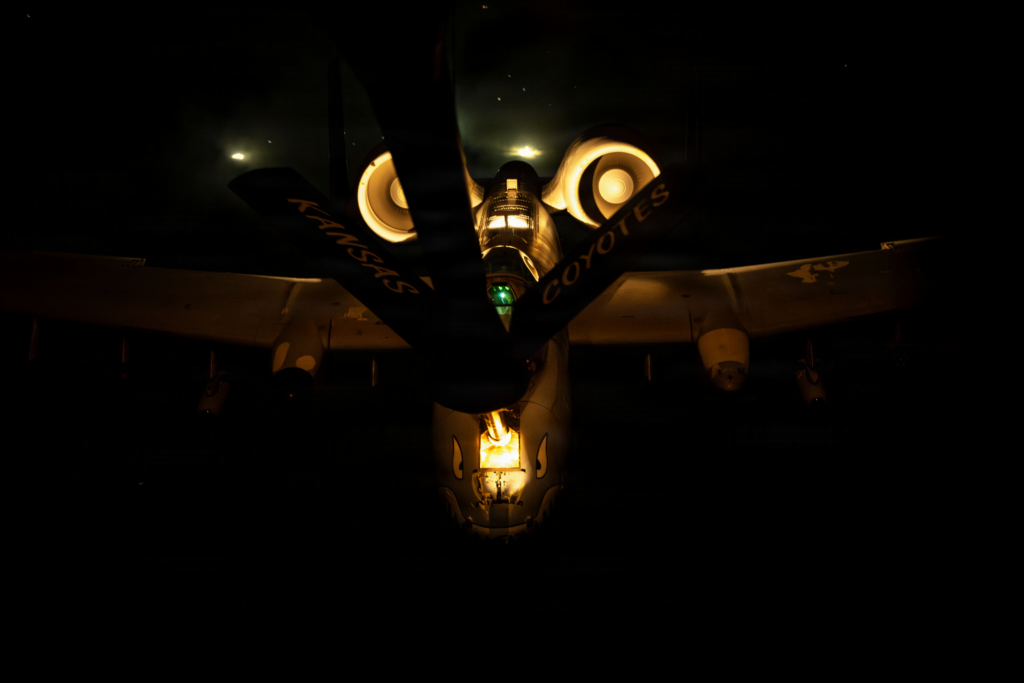
On 15 March, US Central Command (CENTCOM) released images of an A-10C being refuelled during a mission in support of Epic Fury. These images showed the ‘Warthog’ equipped with AGM-65 Maverick missiles, as well as AGR-20 APKWS II rockets and AIM-9M Sidewinder short-range air-to-air missiles.

The inclusion of AIM-9Ms in this loadout will largely be for self-defence purposes, but these missiles could also be used to engage Iranian one-way attack drones operating over the Strait of Hormuz, if required.
Washington delays retirement of USAF’s remaining A-10 Warthogs
The evolving use of the venerable ‘Warthog’ in support of Epic Fury comes after US Congress moved to protect the iconic Cold War-era attack jet from further divestment efforts by the USAF in FY2026.
As part of the National Defense Authorization Act (NDAA) for FY2026, Washington blocked the USAF’s plan to retire its last remaining A-10Cs by the end of this year.
Instead, Congress mandated that the USAF retain a minimum of 103 A-10Cs in operational service through 30 September 2026 and required a detailed fleet transition plan. Despite this slight reprieve, the Air Force is still expected to part ways with its veteran ‘Warthogs’ before the end of this decade.
Featured Image: CENTCOM


