South Korea’s counter-drone drill shows why no single weapon can stop a swarm

6 min read
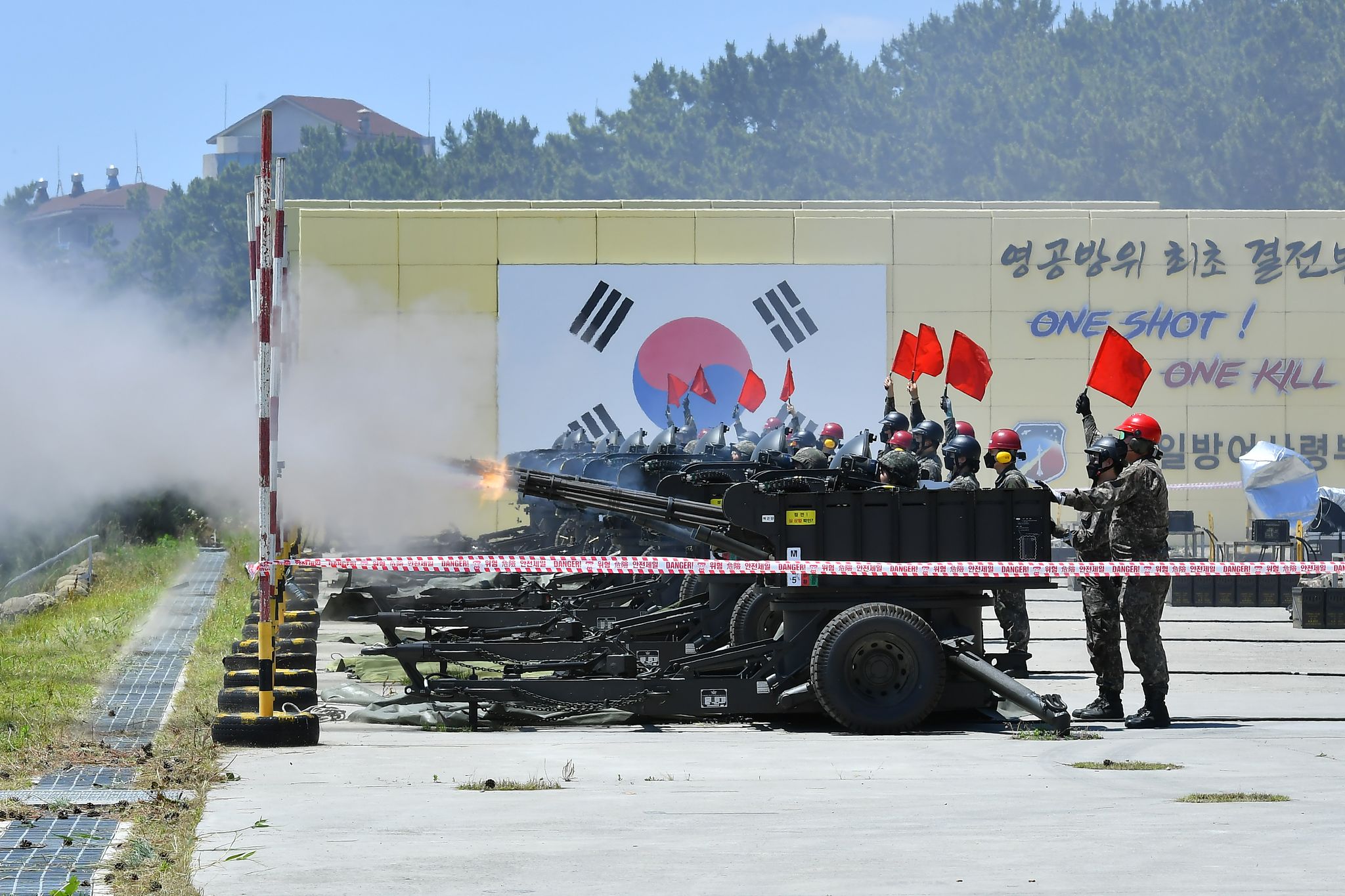
The search for the perfect anti-drone weapon continues. South Korea’s latest exercise suggests it is looking for something more practical: a layered defence.
Instead, the Republic of Korea Air Force has chosen a different approach. During its first live-fire exercise against a swarm of drones, it relied on three very different weapons to defend the same target.
Cold War-era Vulcan anti-aircraft guns opened the engagement. A portable laser took over as the drones closed in. Finally, soldiers armed with shotguns destroyed the last few aircraft that slipped through.
The exercise, first reported by the JoongAng newspaper and later confirmed by the Air Force, reflected a lesson that has emerged from recent conflicts: no single counter-drone system can deal with every threat. Instead, militaries are increasingly looking at layered defences, where different weapons complement one another rather than compete.
Conducted on 23 June at a training range on South Korea’s west coast, the exercise was organised by the Air Force Missile Defense Command to test how existing air defence assets could respond to a simulated swarm attack.
South Korea tests layered defence against drone swarms
The scenario involved 50 drones approaching at low altitude from a distance of around one kilometre.
Eight Vulcan air defence guns engaged the incoming swarm first, firing simultaneously to create a dense wall of 20 mm projectiles. Forty-four drones were destroyed before they reached the defended area.
The six remaining drones were intercepted at close range using a portable laser weapon and five combat shotguns.
“This was our first exercise to defend against the growing threat of drone swarms using existing assets, including Vulcan cannons,” said Colonel Nam Hyung-joo, Chief of Intelligence and Operations at the Air Force Missile Defense Command.
“We will continue to develop our counter-drone capabilities based on the results and lessons learned from the exercise,” he added.
Rather than introducing a new weapon, the drill examined how several existing systems could be combined into a single defensive network.
That distinction matters. Around the world, armed forces are investing heavily in counter-drone technologies, but few now expect one system to defeat every type of threat.
Vulcan air defence guns are repurposed to take on drones
Perhaps the most unexpected participant in the exercise was the Vulcan air defence gun.
The weapon is built around the M61 Vulcan, a six-barrel rotary cannon originally developed in the 1950s for American fighter aircraft. Designed to destroy fast-moving jets rather than slow-flying quadcopters, it became one of the most widely used aircraft cannons of the Cold War before being adapted into ground-based air defence systems such as the M167 Vulcan Air Defense System and the tracked M163 Vulcan Air Defense System.
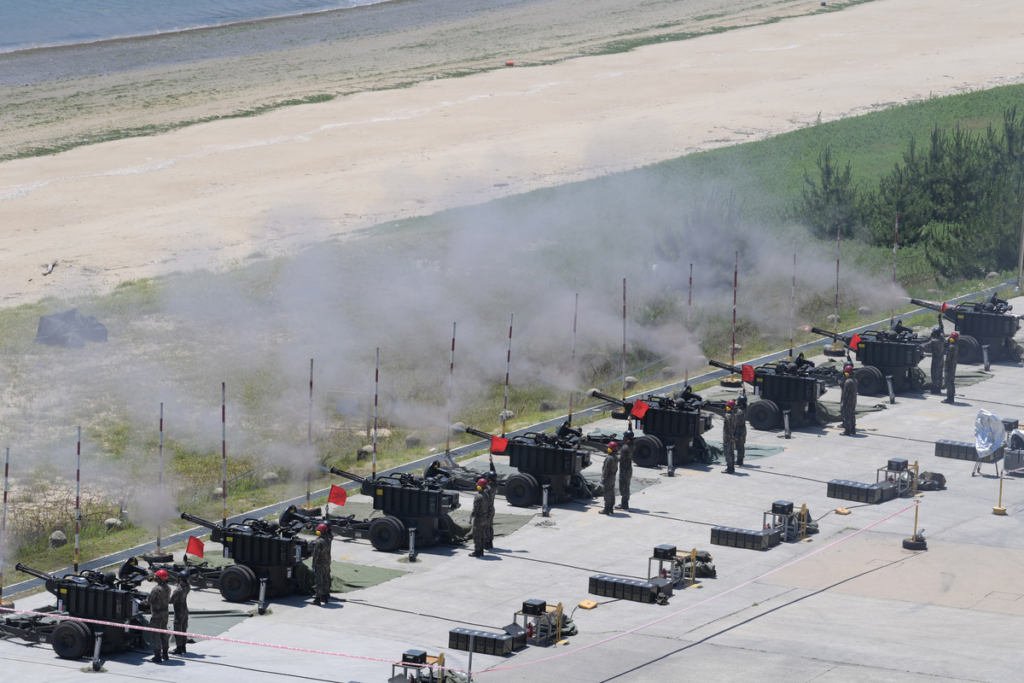
South Korea later produced its own licence-built version through Daewoo and continues to operate the system as part of its short-range air defence network.
Unlike missile systems that rely on precision interception, the Vulcan works differently.
Its electrically driven rotating barrels can fire up to 3,000 rounds per minute, creating a dense stream of projectiles that effectively forms a wall of fire across the flight path of an incoming target.
That characteristic, once intended to defeat fast jet aircraft flying at low level, is now proving useful against a very different threat. A swarm of drones may consist of dozens of small targets arriving almost simultaneously, making the volume of fire as important as accuracy.
The South Korean exercise illustrated how a weapon conceived more than half a century ago can still contribute to modern air defence, not because its original mission has changed, but because its fundamental strengths remain relevant.
Laser weapons are only one layer of counter-drone defence
Directed-energy weapons are becoming an increasingly important part of military counter-drone programmes.
Unlike missiles or conventional ammunition, lasers require no explosive warheads, and each engagement costs only a fraction of a traditional interceptor. As long as sufficient electrical power is available, they also avoid many of the logistical challenges associated with ammunition resupply.
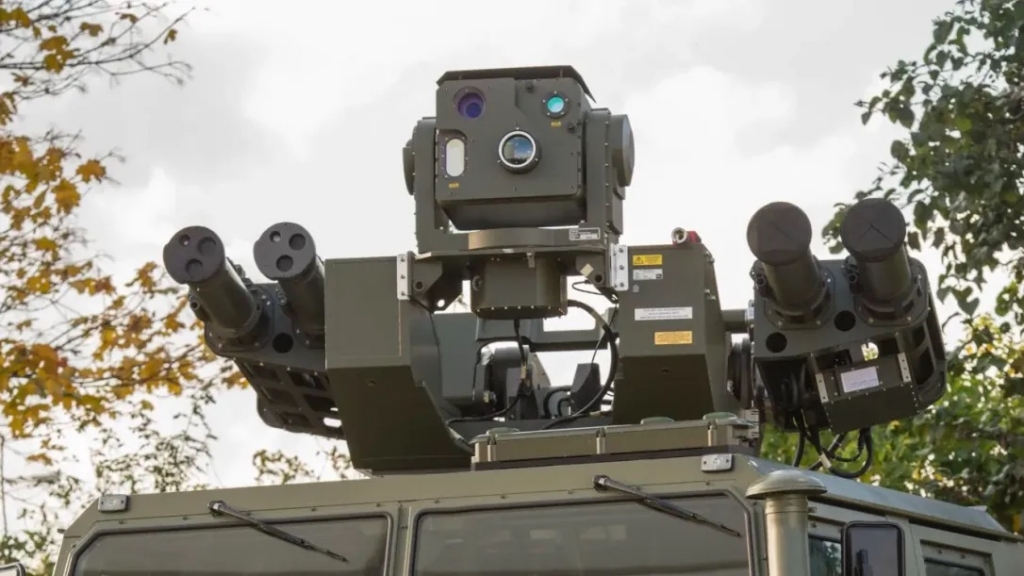
Yet they also have limitations.
Heavy rain, fog, smoke or dust can reduce their effectiveness, while engaging numerous targets arriving simultaneously remains difficult.
That is why many defence planners now see lasers as one layer of a wider defensive system rather than a replacement for guns or missiles.
South Korea’s exercise reflected that thinking. The portable laser was used to engage drones that had already penetrated the outer defensive ring created by the Vulcan guns.
The shotgun has become an unlikely but effective last line of defence against drones
The final stage of the exercise surprised many observers. Five shotguns were used to destroy the last six drones.
It may sound primitive, but shotguns have quietly found a place in several militaries as a close-range defence against small commercial-style quadcopters.
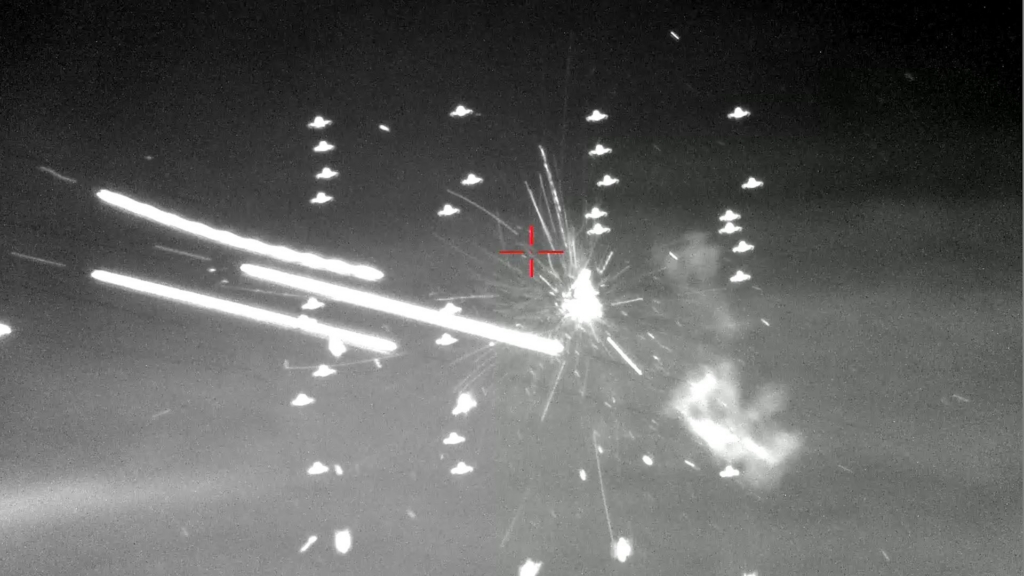
At short distances, the spread of pellets increases the chance of striking a manoeuvring drone. They are inexpensive, simple to operate and well-suited to protecting checkpoints, ammunition depots and other fixed positions where drones may appear with little warning.
The weapon’s inclusion illustrated another reality of modern counter-drone warfare. Technology alone is rarely enough. Sometimes the simplest solution remains the most practical.
Militaries are discovering that drone swarms demand a layered response
Drone swarms present a challenge unlike traditional air threats.
Small unmanned aircraft can fly low, change direction quickly and approach from several directions at once. Even when individual drones are relatively inexpensive, they can overwhelm conventional air defence systems if deployed in sufficient numbers.
Using costly surface-to-air missiles against such targets is rarely sustainable, prompting militaries to explore alternative approaches.
How Israel, the UK, Germany and the US are countering drone swarms
South Korea is far from alone in searching for an answer.
Rather than converging on a single solution, different countries are pursuing different combinations of technologies, reflecting the complexity of defeating large numbers of inexpensive drones.
Israel is developing the Iron Beam directed-energy system to complement its missile-based air defence network, providing a lower-cost option against rockets, mortars and drones.

The United Kingdom has successfully demonstrated its Radio Frequency Directed Energy Weapon (RF DEW), which disables drones by disrupting or damaging their electronic systems without firing a conventional projectile.
Germany has tested the Skynex air defence system, which uses programmable 35 mm ammunition designed to create a cloud of sub-projectiles in the path of incoming drones, increasing the probability of destroying small aerial targets.
The United States continues to field a layered approach of its own, combining Coyote interceptor drones, high-energy laser systems, electronic warfare and high-power microwave technologies to defeat unmanned aircraft at different ranges.
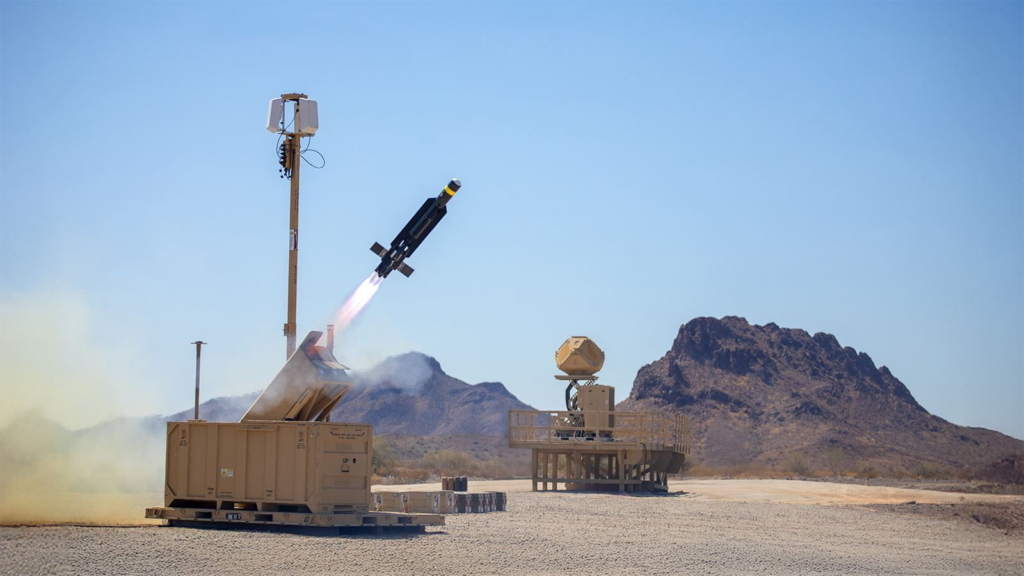
Meanwhile, the war in Ukraine has demonstrated that simpler solutions still have value. Both Ukrainian and Russian forces have relied extensively on electronic warfare, heavy machine guns, automatic cannon, shotguns and even first-person-view interceptor drones to counter the constant threat posed by small unmanned aircraft.
South Korea’s latest exercise fits squarely within that wider trend. Rather than searching for a single breakthrough weapon, it tested how several different systems could work together, with each covering the limitations of the others.
Counter-drone warfare is becoming a mix of old and new weapons
The exercise offered a reminder that innovation is not always about replacing older equipment.
Sometimes it is about finding new ways to use it.
Featured image: ROKAF
Sign up for our newsletter and get our latest content in your inbox.


More from


October 17, 20264 min read