Aeroberm moves from concept to commercial as Skyportz targets eVTOL infrastructure gap

4 min read
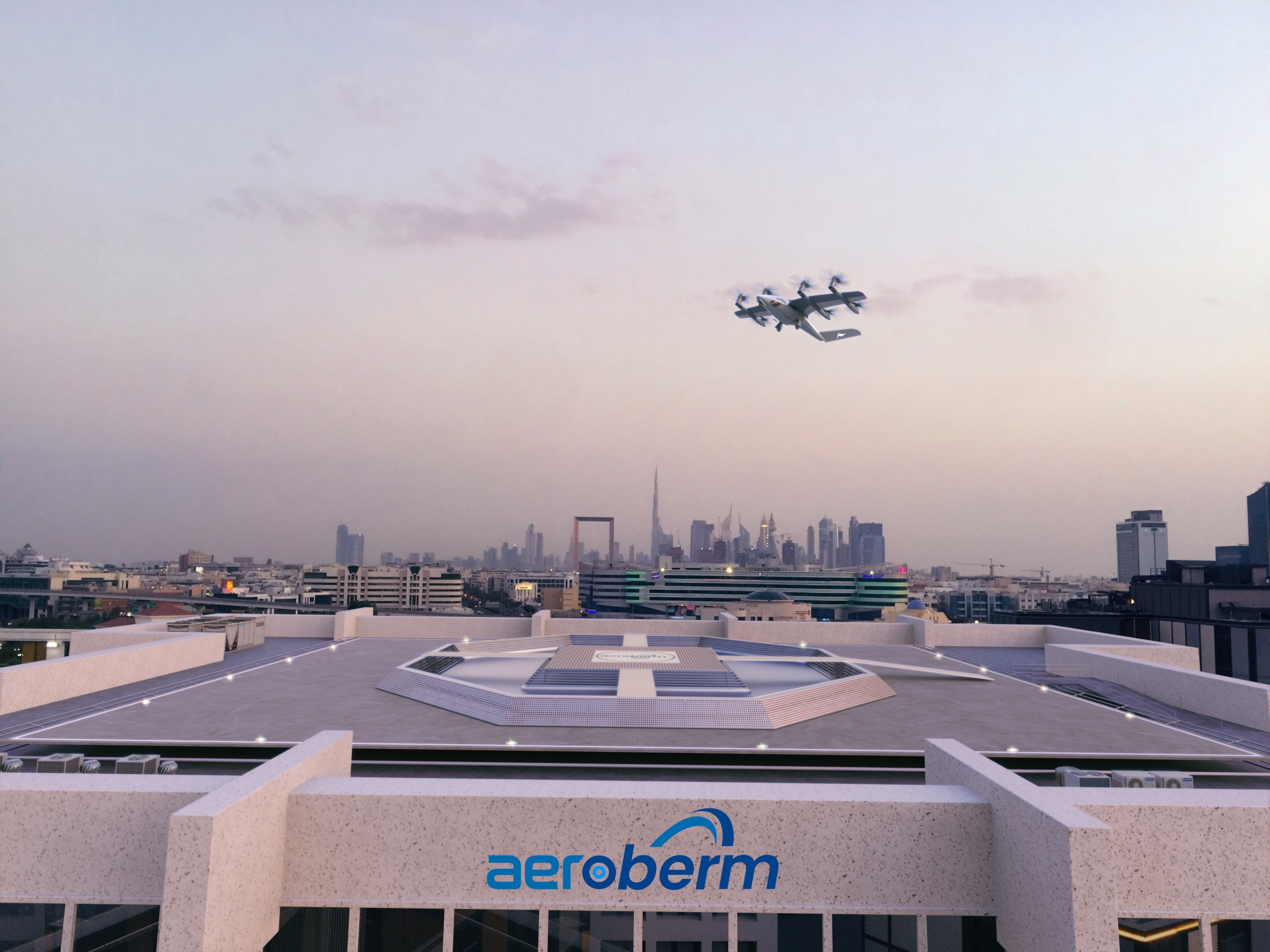
SkyPortz Australia has launched its Aeroberm vertipad system as a commercially available product, marking a shift from concept to deployable infrastructure. The technology attempts to solve one of the biggest challenges in advanced air mobility: where eVTOLs can safely land.
Simultaneously unveiled at Rotortech 2026 on the Gold Coast and at the Vertical Flight Society’s Forum 82 in Florida on 5 May, the system aims to provide a modular, low-cost alternative to traditional vertipad construction.
“You can’t build an aviation network without places to land. Right now, we don’t have them,” says Skyportz founder Clem Newton-Brown.
With billions being invested in eVTOL aircraft development, Skyportz is pitching Aeroberm as the solution to a major industry bottleneck – the absence of safe, scalable landing infrastructure.
Aeroberm targets the eVTOL landing challenge
Much of the talk around eVTOLs is focused on certification, battery technology and flight milestones. But infrastructure remains an unsolved challenge, with early vertiports typically utilising existing heliports.
The problem with that is that eVTOLs risk being limited to places already in helicopter networks. This leads to a rather niche market rather than the flexible air taxi dream we’ve been sold. Skyportz maintains that for the air taxi concept to really flourish, it needs to have takeoff and landing spots at a similar density to bus stops.
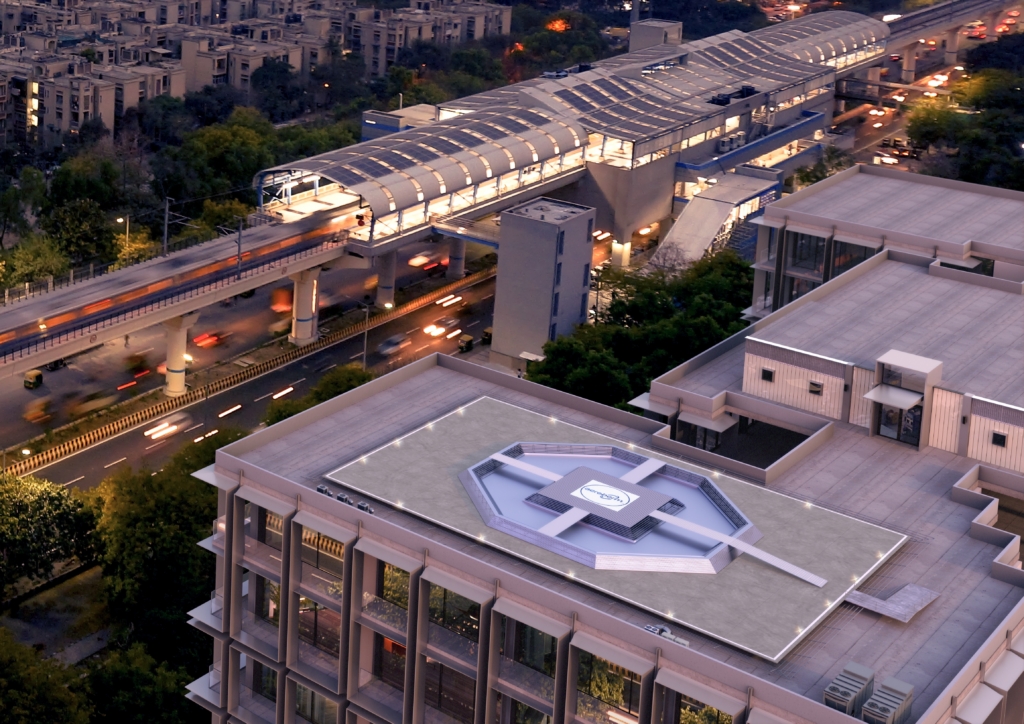
But eVTOLs can’t land just anywhere. Like helicopters, they produce downwash and outwash. Downwash is the air pushed downward by the rotors, while outwash is the high-speed airflow that spreads across the ground and defines the safety footprint of a landing site.
In addition to the usual helicopter challenges, eVTOLs also come with the risk of fire from thermal runaway in the lithium-ion battery. And then there’s the noise; while eVTOLs may be quiet at altitude, they’re likely to create local noise disturbance when landing and taking off.
“Noise, fire, outwash, cost — these aren’t engineering curiosities. They’re the reason vertiports aren’t being built,” says Newton-Brown. “Aeroberm addresses all four.”
How Aeroberm could make eVTOLs safer and more practical
Aeroberm tackles these key issues by making the landing surfaces do the hard work.
Outwash is reduced using Aeroberm’s fractal, angled surfaces to break up and dissipate airflow from the rotors. This turns a strong, organised blast into weak, fragmented turbulence that dies out faster.
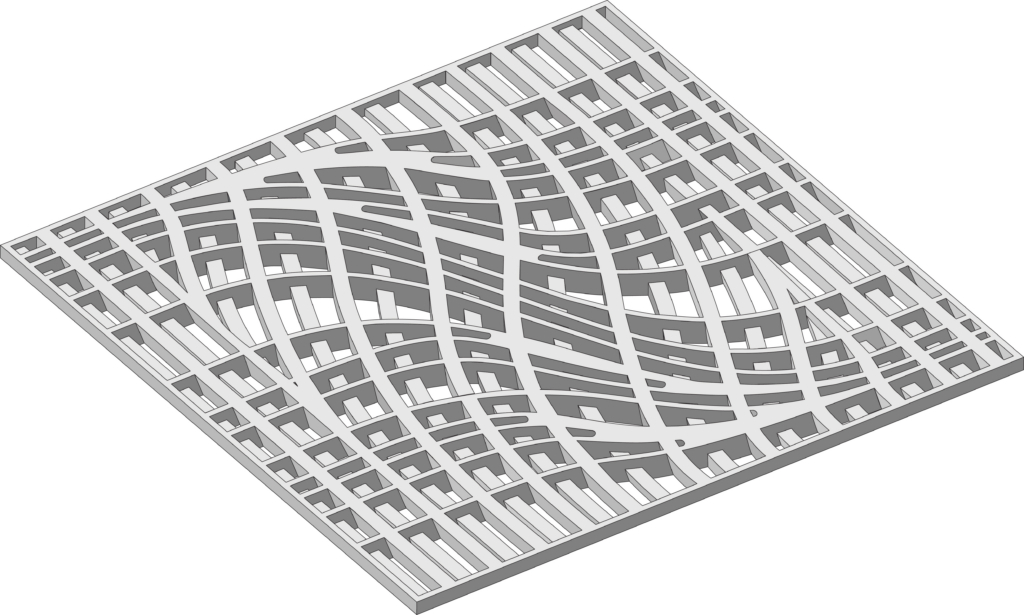
That same irregular surface scatters sound and reduces pressure waves. This reduces the reflection of noise and drives down intensity during landing and take-off.
Inbuilt to the system is an integrated immersion-style fire suppression system, a bit like a dunk tank. In the worst-case scenario, the landing area can be rapidly flooded to immerse and cool the aircraft’s battery system, rather than relying on conventional extinguishing methods.
The Aeroberm vertipad has been independently tested by Swinburne University using computational fluid dynamics (CFD) to model the system. The results showed that the design of the Aeroberm surface does indeed significantly reduce outwash strength.
Central to this is Aeroberm’s fractal panel, which outperforms other surfaces tested. In the CFD study, it dissipated airflow energy 30% faster than grated panels, and 90% better than flat surfaces.
The Swinburne modelling focuses on airflow behaviour rather than acoustics, although the reduction in coherent vortex structures could have secondary benefits for noise.
What’s next for Aeroberm and the future of vertipad infrastructure
While Aeroberm is now being positioned as a commercially available product, the next phase will be defined by how quickly it can move from modelling to real-world deployment.
The Swinburne study provides early technical validation of the concept, but full-scale testing under operational conditions will be key. That includes how the system performs with different aircraft types, in complex urban environments and under varying weather conditions, all factors that are difficult to fully capture in simulation.
There are also practical considerations. The integration of fire suppression systems, water management, structural loading for rooftop installations and turnaround times between operations will all need to be addressed as part of any large-scale rollout.

The regulatory framework for vertipad infrastructure is still evolving. Authorities such as the FAA and EASA have begun issuing interim guidance for vertiport design, but a fully standardised, globally aligned framework for eVTOL landing infrastructure has yet to emerge.
For now, many early eVTOL operations are expected to rely on existing heliports, simply because they are already certified and available. But these locations come with limitations, particularly in dense urban environments where space, noise and safety constraints are most acute.
That is where concepts like Aeroberm could find their role. If systems like this can demonstrate real-world performance and gain regulatory acceptance, they could enable a much denser network of landing sites, bringing the industry closer to its vision of scalable, on-demand urban air mobility.
The aircraft may be close to ready. The infrastructure they depend on is only just beginning to catch up.
Featured image: Skyportz