Global aviation remains extremely safe, despite rise in fatalities: IATA 2025 Safety Report

March 10, 2026

Global commercial aviation maintained a strong safety performance in 2025, with accident rates improving year-on-year, despite high-profile crashes which pushed fatalities higher last year.
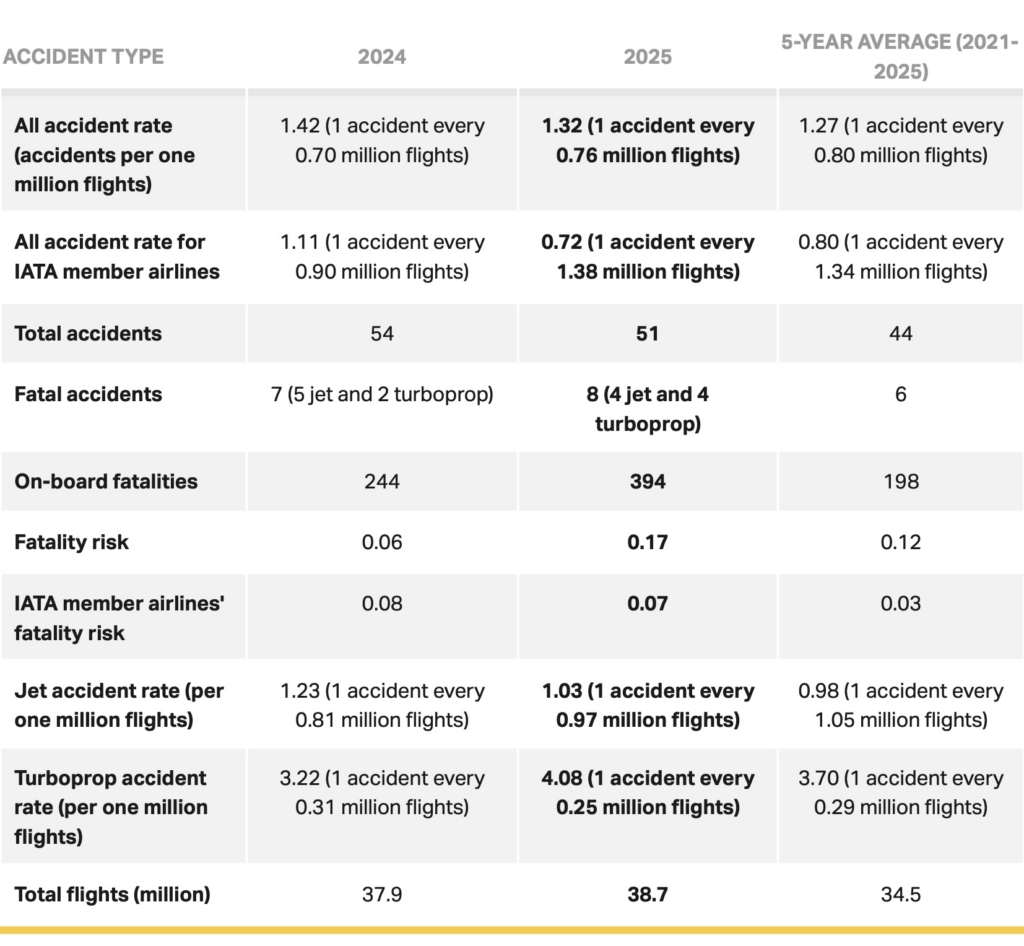
The International Air Transport Association’s (IATA) 2025 Annual Safety Report, released on 9 March, shows that airlines operated 38.7 million flights worldwide, recording 51 accidents, slightly fewer than the 54 accidents reported in 2024.
Despite improvements in accident rates, fatal accidents and total fatalities increased, with a small number of major incidents affecting global aviation safety statistics.
Accident rate improves despite more fatal crashes
According to IATA, the global all-accident rate was 1.32 accidents per million flights in 2025, equivalent to one accident for roughly every 759,646 flights. It was an improvement from 1.42 accidents per million flights in 2024, although slightly above the five-year average of 1.27.
The report recorded eight fatal accidents in 2025, compared with seven in 2024 and a five-year average of six.
Those accidents resulted in 394 fatalities, a sharp increase from 244 deaths in 2024 and significantly above the five-year average of 198.
IATA emphasised that, despite the increase in fatalities, commercial aviation remains a safe form of transport.
“Flying is the safest form of long-distance travel,” Willie Walsh, IATA’s Director General, said in the association’s announcement of the report.
“Accidents are extremely rare and each one reminds us to be even more focused on continuous improvement through global standards and collaboration guided by safety data. The result of that effort is clear in how the five-year rolling average rate for fatal accidents has improved.
“A decade ago, the rate stood at one fatal accident for every 3.5 million flights (2012-2016). Today, it is one fatal accident for every 5.6 million flights (2021-2025). Flying is so safe that even one accident among the nearly 40 million flights operated annually moves the global data. Every accident is, of course, one too many. The goal for aviation remains zero accidents and zero fatalities.”
Commercial aviation’s long-term safety trend is positive
The broader trend in aviation safety remains positive. Over the past decade, the probability of a fatal accident has fallen significantly.
IATA noted that during 2012–2016, the industry experienced one fatal accident for every 3.5 million flights. Between 2021 and 2025, that improved to one fatal accident for every 5.6 million flights. The association attributes these improved statistics to better safety management, technology, and data-driven oversight.
The most common airline accidents in 2025
IATA identified the most common accidents in 2025 as:
- Tail strikes
- Landing gear events
- Runway excursions
- Ground damage
For the second time (since 2020), there were no loss of control in-flight (LOC-I) accidents recorded in 2025. According to the association, LOC-I is “a leading cause of fatalities.”
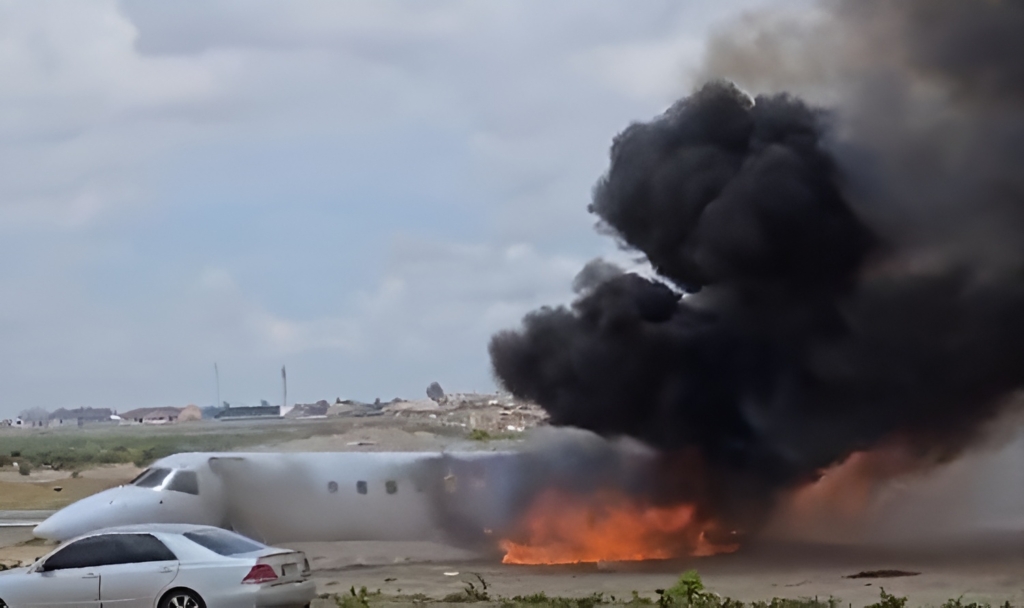
Last year, the fatality risk, a measure of the potential for loss of life, increased to 0.17 per million flights. That is significantly higher than in 2024 (0.06 per million) and above the five-year average of 0.12 per million flights. IATA attributes the rise in fatality risk to “a small number of fatal accidents”, including Air India 171 (241 fatalities) and PSA Airlines flight 5342 (64 fatalities). These two accidents alone “accounted for over 77% of all loss of life on board aircraft in 2025,” according to the association.
Airport infrastructure is critical to airline safety
According to IATA, airport infrastructure remains critical to aviation safety, with airport facilities contributing to 16% of accidents last year. The association highlights a “need to fully respect global standards for runway safety areas” and “frangible installations within safety zones.”
The crash of Jeju Air Flight 2216 at Muan International Airport in South Korea in December of 2024, which killed 179 out of 181 people on board, has been attributed to a non-frangible, solid concrete barrier located at the end of the runway.

IATA also calls for:
- Effective mitigation of hazards like runway surface contaminants
- Adequate markings and lighting
- Removal of obstacles within protected areas or near runways
“Airport infrastructure and runway environments play a critical role in accident outcomes. In several events, rigid obstacles near runways increased accident severity, likely turning otherwise survivable occurrences into fatal ones. All airports and regulators should continuously review runway safety areas and the structures near runways for compliance with global safety standards,” said Walsh.
Regional safety performance varies
While global safety metrics remain strong, IATA’s 2025 safety report shows continued regional disparities.
Africa has the highest accident rate globally
In 2025, Africa had the highest accident rate globally, with seven accidents. There was an improvement in the region’s all-accident rate from 12.13 per million sectors in 2024 to 7.86 in 2025, below the five-year average of 9.37. Africa’s fatality risk increased from zero in 2024 to 2.19 in 2025.

The most common accident types in Africa last year were runway excursions and ‘other end state’(where the accident is not categorised for various reasons, including insufficient information). Africa has accounted for the majority of ‘other end state’ cases since 2018. IATA says this reflects a “need for improved compliance with state investigation obligations under Annex 13 of the Chicago Convention.”
Most accidents (71%) recorded in Africa last year involved turboprop aircraft.
North Asia has the lowest accident rate globally
By contrast, North Asia has the lowest accident rate, with only one non-fatal tail strike recorded last year. The region’s all-accident rate remained unchanged at 0.16 per million sectors in 2025, the same as in 2024.
It was also better than the region’s five-year average of 0.18 accidents per million sectors. Fatality risk in North Asia has remained zero since 2023.
The Middle East and North Africa also had a low accident rate, with only one accident recorded in 2025—a runway excursion. The region’s all-accident rate improved from 1.09 accidents per million sectors in 2024 to 0.53 in 2025.
Last year, the accident rate was also better than the region’s five-year average of 1.01 accidents per million flight sectors. Fatality risk in the Middle East and North Africa has remained zero since 2019.
The Commonwealth of Independent States had the highest increase in the all-accident rate
The Commonwealth of Independent States recorded four accidents in 2025; the all-accident rate increased significantly from 1.44 accidents per million sectors in 2024 to 2.74 in 2025, exceeding the region’s five-year average of 2.26.
The fatality risk also increased from zero in 2024 to 0.69 in 2025. All accidents recorded in the region occurred with turboprop aircraft, including one fatal controlled flight into terrain (CFIT) accident, which caused 48 fatalities.
North America also saw the all-accident rate rise
North America reported 16 accidents in 2025; the all-accident rate rose from 1.49 per million sectors in 2024 to 1.68 in 2025, above the region’s five-year average of 1.33.

The fatality risk rate increased from zero in 2024 to 0.21 in 2025. The most common accidents in the region last year were ground damage and tail strikes.
Other large air traffic regions saw an improvement in the all-accident rate
Across the Asia-Pacific region, there were six accidents in 2025. The region’s all-accident rate improved to 0.91 in 2025, down from 1.08 per million sectors in 2024 and below the five-year average of 0.99. Fatality risk was unchanged at 0.15. Ground damage and tail strikes were the most common accident types.
In 2025, Europe recorded 11 accidents; the all-accident rate improved from 1.48 per million sectors in 2024 to 1.30 per million sectors last year. It was above the region’s five-year average accident rate of 1.11 per million flight sectors. The fatality risk rate in Europe was zero in 2025, compared to 0.03 in 2024. Most accidents were in-flight damage and tail strikes.

Latin America and the Caribbean saw five accidents in 2025; the all-accident rate improved from 1.84 accidents per million sectors in 2024 to 1.77 in 2025. It was also better than the five-year average of 2.02. The fatality risk in the region dropped from 0.37 in 2024 to 0.26 in 2025. Most accidents involved runway excursions.
IATA said addressing regional differences remains a priority through initiatives such as its Operational Safety Audit (IOSA) programme and expanded safety data sharing among airlines and regulators.
IATA draws attention to conflict zone risks
In its announcement of the 2025 safety report, IATA highlighted the “proliferation of conflict zones” that force airlines to reroute flight paths as military activity along flight corridors endangers commercial aircraft.
The latest example is the significant flight disruptions caused by the conflict between the US, Israel and Iran. The association called for “close coordination between military and civil authorities is essential to ensure the safe operations of civil aircraft,” adding: “When conflict zones present risks that cannot be mitigated, states are responsible for restricting or closing airspace in a timely, transparent, and coordinated manner.” IATA said the closing and re-opening of airspace should be governed by “safety and security parameters” and “not politicised.”
IATA also called for “clear, consistent, and professionally communicated Notice to Airmen (NOTAM) and risk advisories” to inform airlines’ risk assessments better.
“Civil aircraft must never be placed at risk from military activity—deliberately or accidentally,” said Walsh. “When tensions rise, governments must share timely risk information, ensure effective civil–military coordination, restrict airspace where needed, and provide airlines with sufficient information for their own risk assessments. Whether closing or re-opening airspace, safety depends on transparency, facts, and coordination.”
Spike in GNSS interference is “deeply concerning”
IATA also reported a sharp increase in Global Navigation Satellite System (GNSS) interference incidents impacting aircraft navigational systems. IATA’s Incident Data eXchange shows that jamming events in 2025 increased by 67% compared to 2023, while GPS spoofing incidents rose by 193%.

“GNSS interference events are deeply concerning,” Walsh said. “Airlines rely on GNSS for safe and efficient flight operations. While system redundancies support safe operations in the face of these deliberate acts, immediate steps by governments and air navigation service providers are needed to improve situational awareness and enhance mitigation tools for pilots. Ultimately, the practice of GNSS interference must be stopped. Anything less is both unacceptable and irresponsible.”
Data and collaboration remain key to aviation safety
The association emphasised that improving safety requires continued collaboration across airlines, manufacturers, regulators and safety bodies.
The IATA Annual Safety Report—now in its 62nd edition—collects accident data from scheduled passenger and cargo flights worldwide and serves as one of the aviation industry’s primary benchmarking tools for safety performance.
Despite the rise in fatalities last year, IATA reports continued long-term safety improvement, supported by global standards, modern aircraft technology and increasingly sophisticated safety analytics.
Featured Image: Indian Government