


Remote control: Saudi sets benchmark with Middle East’s first virtual ATC tower

4 min read

AIUla International Airport in Saudi Arabia is the region’s first airport to manage its airspace using a virtual control tower, approved by the General Authority of Civil Aviation (GACA).
AIUla’s remote tower receives operating license from GACA
The move to manage air traffic remotely at AIUla is in line with the Kingdom’s efforts to adopt the latest technologies across Saudi’s aviation sector. Implemented by the Saudi Air Navigation Services (SANS) company, the tower has now received its operating license from GACA after meeting all safety and security requirements.
AIUla’s virtual control tower uses cutting-edge digital technologies. It features 360-degree high-definition cameras, advanced sensors and artificial-intelligence (AI) systems. Images are fed back to SANS controllers who oversee air traffic at AIUla remotely from a virtual tower centre located at King Abdulaziz International Airport in Jeddah.
GACA’s approval marks a milestone for AIUla. The airport is officially the first in the region to be managed remotely.
Indra tasked with developing and operating AIUla’s virtual tower
SANS tasked Indra, the technological engineering company, with implementing the virtual control tower at AIUla. Indra signed a Memorandum of Understanding (MoU) with SANS in 2022 to develop and operate the virtual tower at AIUla.
Speaking at the time, SANS CEO Abdulaziz bin Salem AI Zaid, said he was confident the project will “constitute a qualitative leap for the navigation services provided by SANS.” AI Zaid also said the tower will enhance SANS’ position as “one of the operators that manages its airspace in accordance with the most demanding international safety and quality standards.”
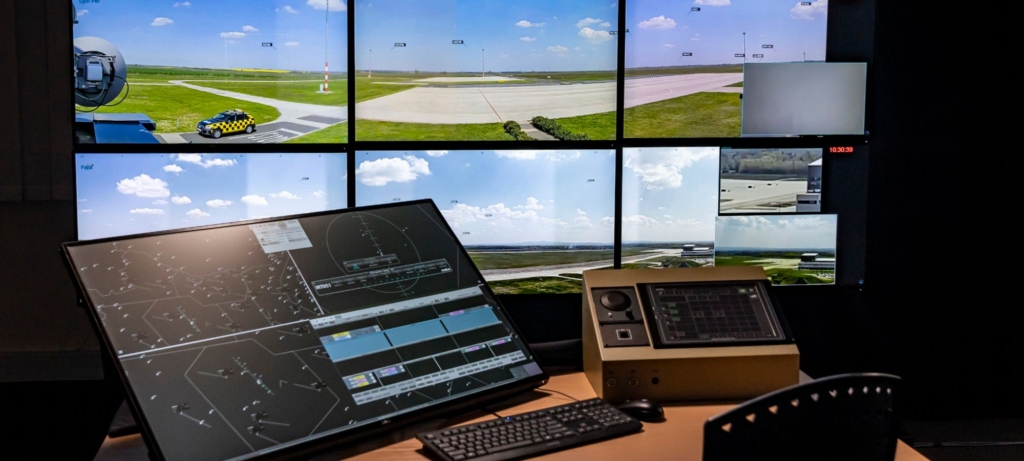
The collaboration between the two companies represents a first step in their future plans to expand their current cooperation in the area of air traffic management systems. It also signals a move to deploy virtual towers in airports elsewhere across the Kingdom.
With Indra’s technology multiple airports in the Kingdom could be operated from a single remote location. This would help reduce operating costs and increase the frequency of flights.
Indra was the first company in the world to receive authorisation to operate its virtual tower without any restrictions on capacity. It incorporates AI to support the work of the controllers and enable them to detect risks more rapidly and effectively.

Remote towers around the world
While AIUla is the first airport in the region to manage air traffic remotely, it follows in the footsteps of other airports around the world to do so.
Sweden launched the world’s first remote tower at Örnsköldsvik Airport in 2015 and and has built centres in Sundsvall and Stockholm that control eight airports.
When it opened in 2019, Scandinavian Mountains becane the world’s first airport built without an Air Traffic Control tower. Instead controllers in a facility some 220 miles away in Sundsvall manage the airport’s traffic. Provided by Saab Digital Air Traffic Solutions, the tower at the airport features 17 wide-angled cameras.
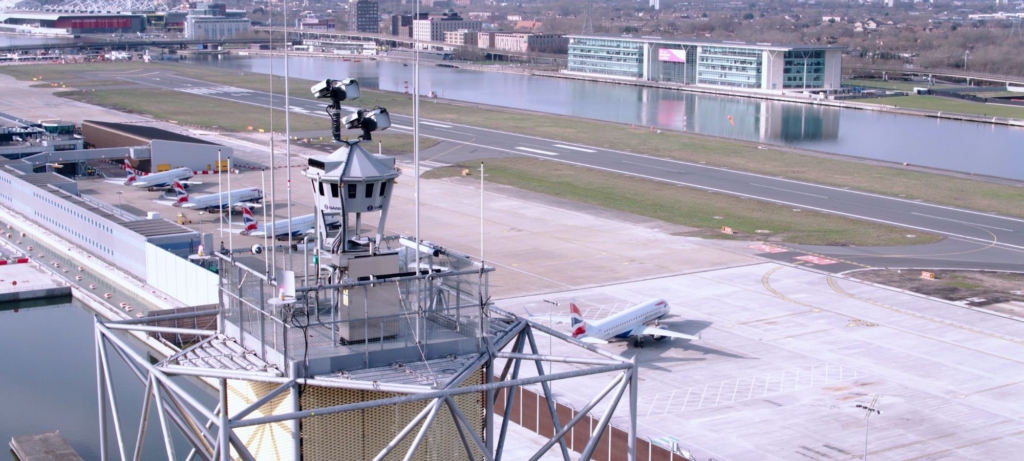
In 2021, London City Airport became the first major international airport fully controlled by remote air traffic control towers.
London city’s 50-metre-tall tower features multiple pan-tilt-zoom cameras, which feed images back to controllers at NATS’ air traffic control centre in Swanick in Hampshire. Fourteen high-definition screens form a panoramic moving image offering a view of the whole airport.
Elsewhere, Munich Airport in Germany trialled a virtual control tower in collaboration with Frequentis DFS earlier this year. Singapore’s Changi Airport is developing a digital tower concept and Dubai’s Al Maktoum International Airport (DWC) is planning remote tower capabilities.
There are over 40 remote towers in operation or in advanced development across 11 countries and 10 remote tower centres that each multiple airports.
The FAA has not approved remote towers in the US
However, the Federal Aviation Administration (FAA) has not approved remote tower systems for use in the US’ National Airspace System (NAS).
According to the FAA’s website, remote tower manufacturers must submit their proposed RT system design to the FAA. If the design is eligible for review the FAA will evaluate it at the William J. Hughes Technical Center in Atlantic City, New Jersey. This evaluation will enable the FAA to provide an independent assessment of the system’s capabilities in a robust operational environment, prior to deciding on whether to issue an FAA System Design Approval.
Sign up for our newsletter and get our latest content in your inbox.


More from

October 4, 20264 min read


