


China’s B-2-sized stealth drones spotted at Malan test base in satellite imagery

5 min read
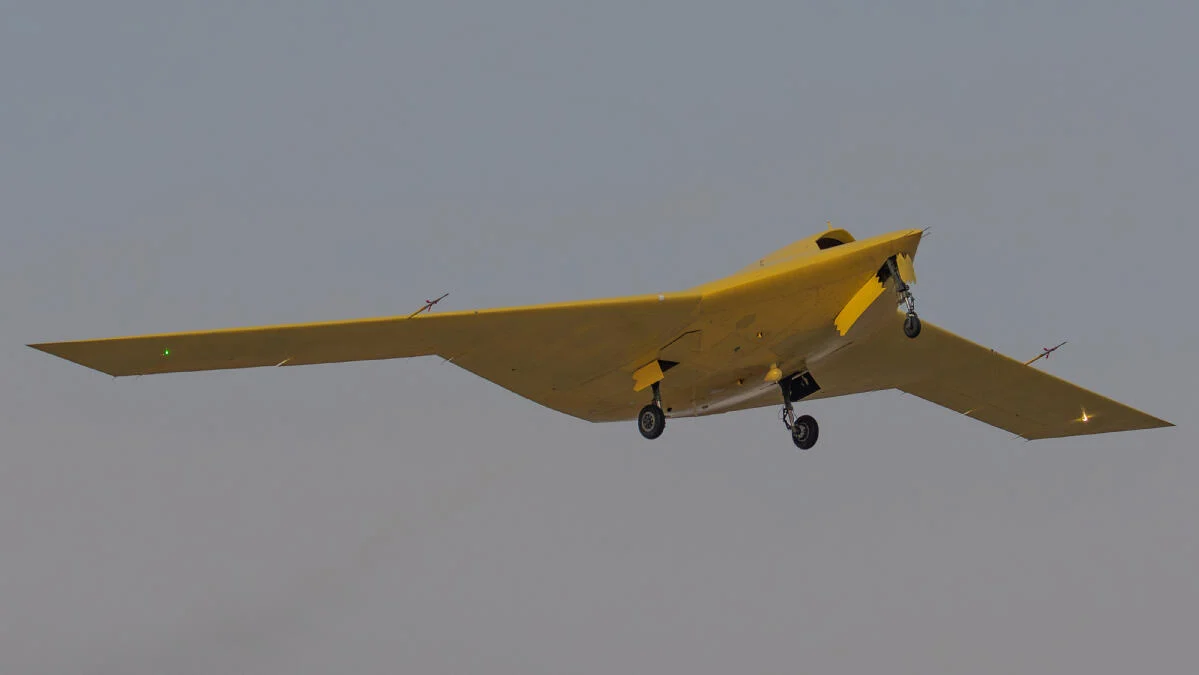
Satellite imagery has revealed two massive stealth flying-wing drones at a secretive Chinese test base, highlighting a significant acceleration in the country’s unmanned combat aircraft development.
The development was first reported by The War Zone (TWZ).
Images dated March 26, 2026, show the aircraft parked at the Malan test facility in Xinjiang, a site long associated with advanced aerospace testing.
This is the first time both aircraft have been observed together outside their hangars, suggesting a structured and active test programme rather than isolated prototypes.
Satellite imagery reveals B-2-sized Chinese stealth drones
One of the aircraft has an estimated wingspan of around 173 feet, comparable to the U.S. B-2 Spirit stealth bomber.
The second platform, slightly smaller, is parked near a newly built high-security hangar complex. Analysts say both aircraft feature flying-wing designs optimised for low observability and long endurance.
Çin’in devasa gizli “uçan kanat” insansız hava araçları gizli bir test üssünde birlikte görüntülendi.
— TRHaber (@trhaber_com) May 1, 2026
▪️Çin’in çok büyük uçan kanat tasarımlarının testleri hız kazanıyor; bunlar arasında savaş uçağına benzer insansız bir model de bulunuyor. pic.twitter.com/pF8Ru8WuOs
Such configurations are typically associated with high-altitude, long-endurance (HALE) missions. These include intelligence, surveillance and reconnaissance, as well as potential strike roles.
Additional imagery shows a stealth fighter-like drone and a Xi’an Y-20 transport aircraft at the same base, pointing to a wider ecosystem of platforms under development.
China’s Malan test base emerges as key hub for stealth drone development
The Malan facility has become a focal point for China’s most sensitive aerospace programmes.
Originally linked to nuclear weapons testing, the base has evolved into a major drone development centre. Its remote desert location provides both operational security and a large airspace for experimental flights.
Satellite imagery shows expanding infrastructure, including new hangars and restricted compounds, suggesting sustained investment in advanced unmanned systems.
🇨🇳 China’s skies just got more mysterious. A massive new “Cranked Kite” flying wing drone has surfaced at a secretive test base, sparking speculation about its true mission. Its unusual stealth-focused design hints at long-range reconnaissance or even strike roles. Whatever… pic.twitter.com/zJycKfZQQR
— Defense Intelligence (@DI313_) September 19, 2025
The presence of multiple large flying-wing drones at the same time indicates that testing is moving beyond prototype stages.
China expands flying-wing stealth drone programme
The aircraft observed at Malan appear to be part of a wider Chinese effort to develop stealthy unmanned aircraft, particularly flying-wing designs. These platforms are most often compared with US systems such as the B-2 Spirit and the B-21 Raider, given their shape and intended role.
🇨🇳 BREAKING: China unveils a new stealth flying wing bomber drone — nearly the size of the U.S. B-2 and even larger than the B-21.
— Defence Index (@Defence_Index) September 21, 2025
Powered by 2× WS-15 engines
Range: 4,000+ km
Max takeoff weight: ~80 tons.
~ Chinese media reports pic.twitter.com/YD5sAju04f
China has already fielded or tested several similar designs. The GJ-11 “Sharp Sword,” a stealth flying-wing unmanned combat aircraft, has been displayed in what analysts describe as near-operational configurations. The CH-7, another flying-wing drone, is designed for high-altitude missions with low observable features.
🇨🇳China’s Rainbow 7 stealth drone, also known as the CH 7, has successfully completed its first flight, marking a major milestone in unmanned aviation.
— Defense Intelligence (@DI313_) December 15, 2025
Built around an advanced flying wing design, the platform is optimized for low observability and high end reconnaissance,… pic.twitter.com/qyfTKnPvBI
Alongside these are smaller unmanned systems designed to operate with crewed aircraft. These “loyal wingman” concepts are intended to fly alongside fighters, extending sensor coverage and adding strike capability.
The approach mirrors developments in the United States, where unmanned aircraft are being integrated into future combat formations alongside fifth- and sixth-generation fighters.
China has also signalled this direction publicly. Multiple drone concepts were displayed during the country’s September 2025 military parade, underlining the growing role of unmanned systems in its future force structure.
China’s growing unmanned capability reflects wider military industrial expansion
The development comes as China continues to expand its defence industrial base and invest in advanced aerospace systems.
Over the past two decades, the country has built capabilities across aircraft, missiles and unmanned platforms, supported by advances in sensors, autonomy and networked operations.
Satellite imagery confirms that China has deployed GJ-11 “Sharp Sword” Stealth Unmanned Combat Aerial Vehicles (UCAVs) to Shigatse Air Base in Tibet, near the Indian border.
— OSINTWarfare (@OSINTWarfare) October 11, 2025
The flying-wing GJ-11s, designed for stealth strike, reconnaissance, and electronic warfare missions,… pic.twitter.com/YYyRkvr0ZM
Unmanned systems have become a key focus area, both for operational use and export markets.
Large stealth drones could expand China’s long-range surveillance and strike capability
The size and design of the aircraft suggest missions that go beyond traditional drone roles.
High-altitude endurance would allow persistent surveillance over large areas. Stealth shaping would enable operations in contested airspace.
🇨🇳 BREAKING: China confirms the CH-7 high-altitude stealth UAV has completed its first flight.
— Defence Index (@Defence_Index) December 15, 2025
The flying-wing drone was previously displayed at AirShow China 2024 in Zhuhai. pic.twitter.com/6NBZ450dsF
At the same time, the scale of the platforms indicates the potential to carry larger payloads, including advanced sensors or weapons.
While official details remain limited, the appearance of multiple large stealth drones at Malan suggests China is moving toward operational capability in this segment.
For now, satellite imagery provides only a partial view. But it points to a programme that is progressing steadily and at scale.
Featured image: Chinese State Media
Sign up for our newsletter and get our latest content in your inbox.


More from


September 6, 20264 min read


