US reportedly withholding GE F110 engines for Turkey’s 5th gen KAAN fighter jet

September 30, 2025

Turkey’s foreign minister, Hakan Fidan, said licenses for the US F110 turbofan engines needed for its domestic KAAN fighter jet are stalled in Congress. The development further calls into question Turkey’s ambitious 2028 in-service date.
US CAASTA Act blocking sale of engines for Turkey’s KAAN fighter
Turkey has a rapidly growing defence industry and is now one of the dominant players in medium and higher-level drones. The country is developing a trainer jet, attack helicopters, various levels of drones, but the flagship project is the stealthy TAI KAAN fighter jet.
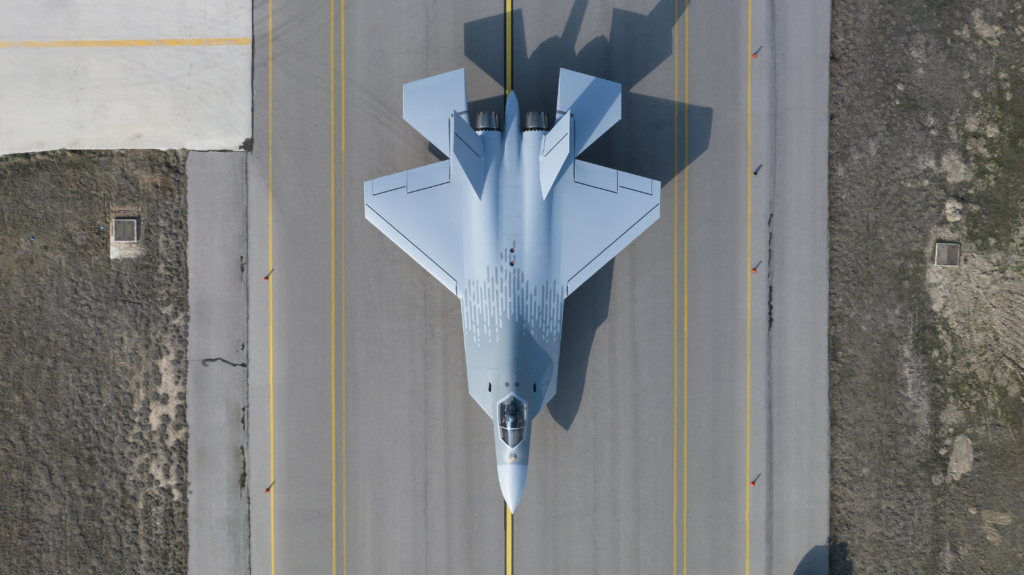
According to Turkish Minute, initial units of the KAAN are to be powered by the General Electric F110, the same family of engines that powers the F-15EX and F-16 fighter jets.
The Turkish defence minister says the issues are rooted in the 2019 sanctions imposed on Turkey when it purchased Russia’s S-400 SAMs despite American warnings. The act has all but cut off Russian fighter jets and helicopters from the international market.
Under the CAASTA Act, the US kicked Turkey out of the F-35 program. Turkey said it would develop its own fifth-generation fighter jet, but now the same act is threatening to stall that program. Turkey has continuously sought to be readmitted to the F-35 program, but no agreement has been reached about its S-400s sitting gathering dust in a warehouse.
The U.S. Congress has blocked the sale of engines to Turkey for its 5th Gen TAI KAAN Stealth Multirole Fighter.
— OSINTWarfare (@OSINTWarfare) September 28, 2025
While Turkey is developing an indigenous powerplant, the TF35000 turbofan, it may also consider China’s WS-series engines as a backup option. pic.twitter.com/3SvRFHK2Ju
Shunned by the US, Turkey has turned to purchasing 40 Typhoon Eurofighters from the United Kingdom, only for that to stall due to a German veto. Germany has lifted its veto, allowing the transaction to proceed.
Turkey’s Presidency of Defense Industry says there is no delay
Haluk Görgün, who leads Turkey’s Presidency of Defense Industry, seemingly contradicted the foreign minister, saying there is “no delay” in KAAN’s scheduled delivery for 2028. He added that the project is not dependent on the engine of a single country.

Görgün went on to say that all the prototype engines have been delivered. Squaring these opposing statements, it seems the issue is with licensing disputes for the engines for the first block of KAAN aircraft.
He added it’s technically possible to switch engines if required. Turkey had previously partnered with Rolls-Royce to develop an engine for the jet.
Integration of the TEI TF-35000 engine into the KAAN combat aircraft is planned for 2032, according to Turkish Aerospace Industries (TAI). pic.twitter.com/eTs8M9hxbt
— International Defence Analysis (@Defence_IDA) July 28, 2025
Turkey’s engine development is still nascent, although it has the long-term goal of fitting a future domestic TF-35000 engine to the KAAN around 2032. Ground testing is expected to begin in 2026. Critics claim that the timetable is unrealistically optimistic.
Indonesia has ordered 48 examples of Turkey’s upcoming KAAN, although much uncertainty surrounds that contract.
The handful of countries able to make fighter jet engines
For many countries, the bane of developing frontline fighter jets is finding engines. This also applies to the commercial sector, to aircraft like China’s COMAC C919 airliner.
Outside of the United States, only the United Kingdom, France, Russia, and China are able to produce fighter jet engines from start to finish. Additionally, Ukraine makes engines suitable for trainers and high-end UCAVs.

A Ukrainian engine powers Turkey’s new high-end Kızılelma combat drone. In 2023, Ukraine’s news outlet Militarnyi even suggested Turkey’s KAAN fighter could get a Ukrainian engine.
Unexpected news.⬇️
— Junsupreme (@RyszardJonski) July 26, 2025
Turkish Aerospace Industries (TAI) has signed an agreement to export 48 KAAN fighters to Indonesia during the IDEF 2025 exhibition.
What about the KF21 Boramae? Will Indonesia also buy this Korean fighter? https://t.co/CCdxEihfcq pic.twitter.com/3ZkjnPavaK
All other countries are unable to make a truly sovereign fighter jet. The Swedish Gripen, Indian HAL Tajas, and upcoming South Korean KF-21 Bromae all use General Electric F404 or F414 engines. The Gripen’s Volvo RM12 is a licensed version of the F404.