Operation Epic Fury: How the US and Israel’s coordinated attack on Iran unfolded

March 2, 2026
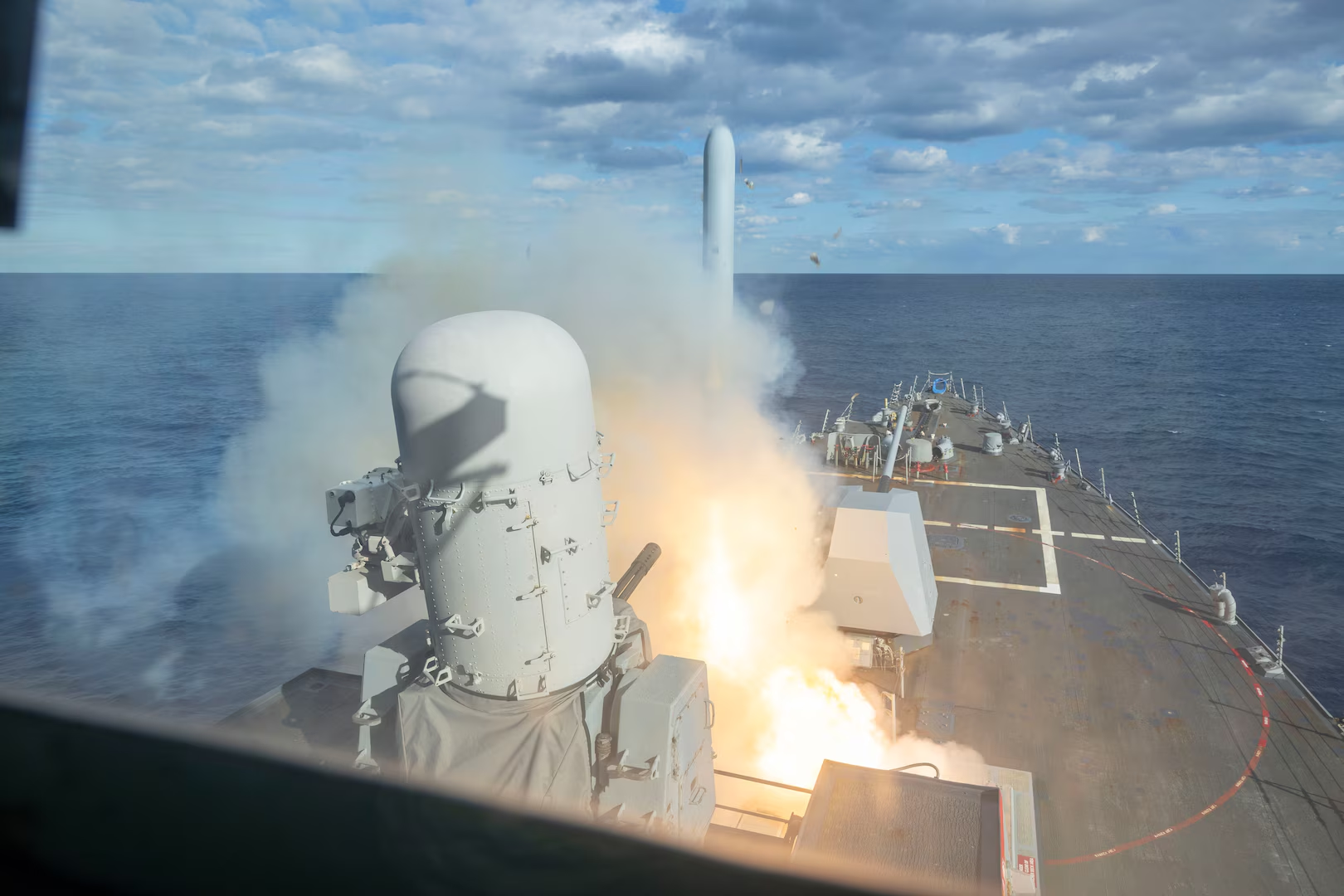
US Central Command (CENTCOM) began Operation Epic Fury on February 28, 2026, at 01:15 ET, describing a joint effort with partner forces to “dismantle the Iranian regime’s security apparatus” by striking Islamic Revolutionary Guard Corps command and control facilities, Iranian air defence capabilities, missile and drone launch sites, and military airfields.
“The President ordered bold action, and our brave Soldiers, Sailors, Airmen, Marines, Guardians, and Coast Guardsmen are answering the call,” said Adm. Brad Cooper, commander of CENTCOM, in the announcement of the campaign.
Israel simultaneously launched its own campaign—dubbed Operation Roaring Lion—which Israeli officials described as the largest operational strike sortie in Israeli Air Force history, involving around 200 warplanes and roughly 500 objectives, including Iran’s air defences and ballistic-missile infrastructure.
Phase 1: shaping the battlespace (air defences, C2, missile nodes)
CENTCOM applied a “kick-the-door” air campaign: degrading integrated air defences and command networks first, then widening the targets. The opening hours included precision munitions launched from air, land, and sea, with CENTCOM’s first combat use of its low-cost one-way attack drones by Task Force Scorpion Strike.
CENTCOM described Operation Epic Fury as “the largest regional concentration of American military firepower in a generation.”
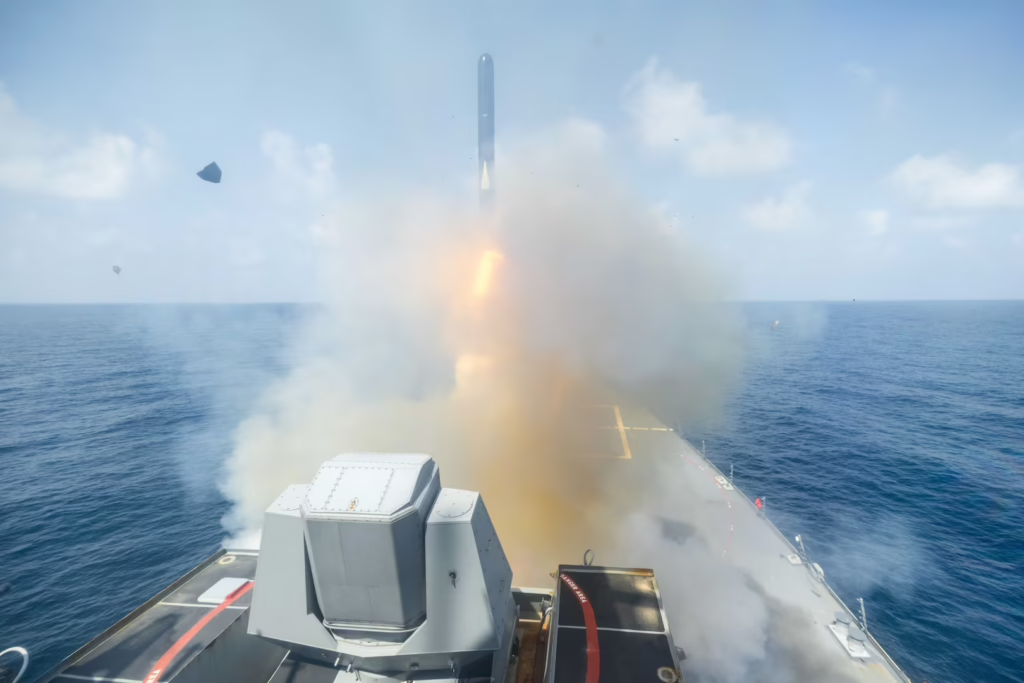
Aviation Week reported that the combined plan leaned heavily on intelligence efforts designed to strike senior regime targets “when those officials convene.” The US and Israel reportedly executed the attack in the morning rather than at night to preserve an element of surprise.
Phase 2: massed strike packages (Israel’s ~200-jet effort)
As reported by Breaking Defense, Israel’s fighter force dropped hundreds of munitions in near-simultaneous attacks across multiple locations, targeting air defence systems and missile launchers among other objectives.

While Israel has not provided a complete aircraft-type order of battle, IDF imagery cited by Aviation Week showed Israel employed F-35s and F-15s in the operation.
Phase 3: the US strike mix (fighters, carriers, drones, and B-2s)
The US used a combination of aerial capabilities on the first day:
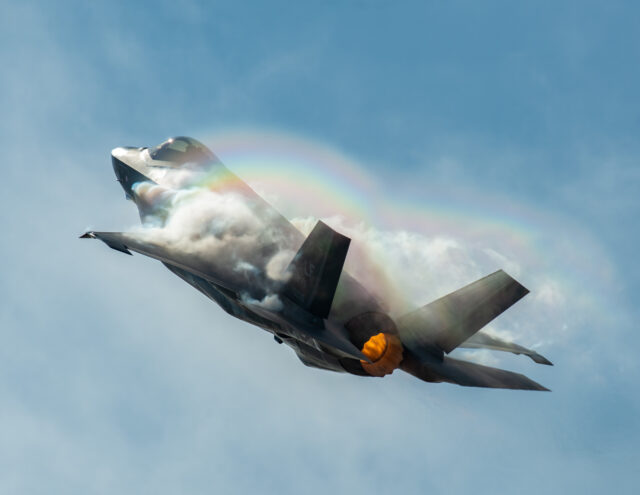
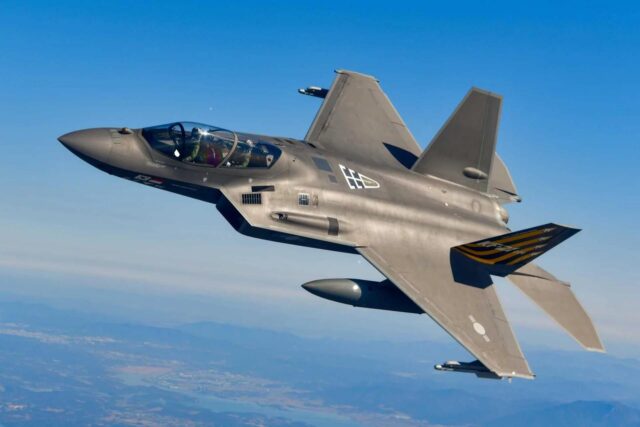
- Fifth-generation fighters (including F-22 and F-35) featured in US operations.
- Carrier airpower, including F/A-18 operations alongside sea-launched Tomahawk strikes.
- The US Air Force assets in-theatre included F-22s forward-deployed to Ovda Airbase (Israel), plus F-35As, F-15E Strike Eagles, A-10s, and F-16s, supported by a large tanker and ISR backbone.
- CENTCOM highlighted the debut combat use of Shahed-derived “one-way attack drones” as a new asset deployed for the campaign.
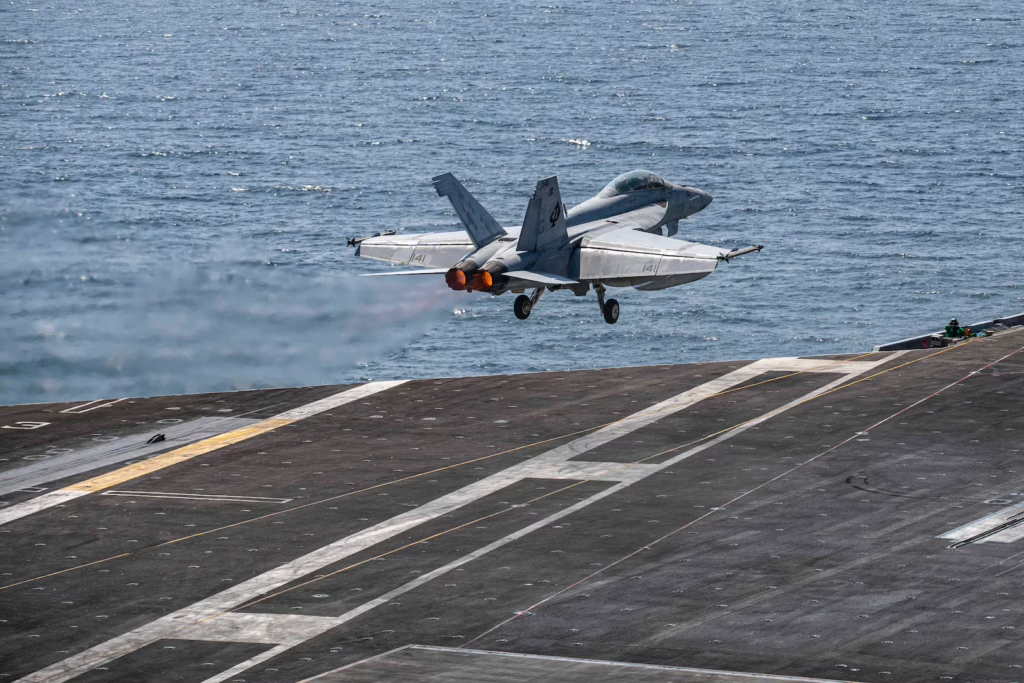
As AGN previously reported, the US forward-deployed assets for the strike, as the regional build-up peaked, with the arrival of F-22s and a carrier presence, including the USS Gerald R. Ford. The USS Abraham Lincoln was already positioned in the Sea of Aden, redeployed from the Pacific.
Iran’s drone technology is turned on itself: The US’ Shahed-derived strike drones
CENTCOM’s Task Force Scorpion Strike employed low-cost one-way attack drones, modelled after Iran’s Shahed family, for the first time in combat. AGN previously reported on the US development of the Low-Cost Uncrewed Combat Attack System (LUCAS) FLM 136 developed by SpektreWorks and the MQM-172 Arrowhead.

The provenance of the drones used by the US in this strike is not entirely Iranian, as the Shahed drone was not an original Iranian design. Germany’s Dornier first developed the drone in the 1980s and dubbed it the DAR (Die Drohne Antiradar).
The Israelis adopted the DAR’s design for the IAI Harpy anti-radar loitering munition, which Iran then reverse-engineered as the Shahed-136. So the drone came full circle from a Western asset to an Iranian asset and back to a Western asset again in time to strike at Iran.
B-2 bombers deployed, but no confirmation of “bunker busters” used
Air & Space Forces Magazine reported that USAF B-2 Spirit bombers conducted airstrikes during Operation Epic Fury against Iranian ballistic missile sites. The B-2 bombers departed from Whiteman Air Force Base in Missouri on a round-trip mission to strike Iran, targeting what CENTCOM described as “hardened ballistic missile facilities.”
Last night, U.S. B-2 stealth bombers, armed with 2,000 lb. bombs, struck Iran’s hardened ballistic missile facilities. No nation should ever doubt America's resolve. pic.twitter.com/6JpG73lHYW
— U.S. Central Command (@CENTCOM) March 1, 2026
The B-2 bombers were refuelled enroute by US Air Force aerial tankers. They were captured on camera by a spotter as they returned to Dyess Air Force Base in Texas, due to a weather diversion.
US Air Force B-2A Spirit long range strategic bombers from Whiteman AFB, MO have just touched down at Dyess AFB, TX after diverting following their mission over Iran due to weather at Whiteman.
— TheIntelFrog (@TheIntelFrog) March 1, 2026
📹 https://t.co/mfeThUOgLC https://t.co/P6a2V5soFN pic.twitter.com/q7iLy97vus
Air & Space Forces Magazine, relying on information derived from Air traffic control communications, open-source data, and aircraft spotters, suggests that four US B-2s took part in the campaign (callsigns Petro 41–44). However, CENTCOM did not confirm the number used.
“Bunker busters” evidently not deployed for Epic Fury
The US does not appear to have used its GBU-57 Massive Ordnance Penetrator (MOP) “bunker busters” in this offensive, though the B-2 can carry these bombs.

Air & Space Forces Magazine reports that the Epic Fury B-2 strikes instead used 2,000-pound guided bombs (GBU-31 class). Reuters likewise described B-2s hitting Iran’s hardened underground missile sites with 2,000-pound bombs (not 30,000-pound MOPs).
What fighter jets were involved in the strike on Iran (US & Israel combined)
Although CENTCOM has not provided a detailed list, reports suggest that the US and Israel deployed the following fighter jets during Epic Fury and Operation Roaring Lion.
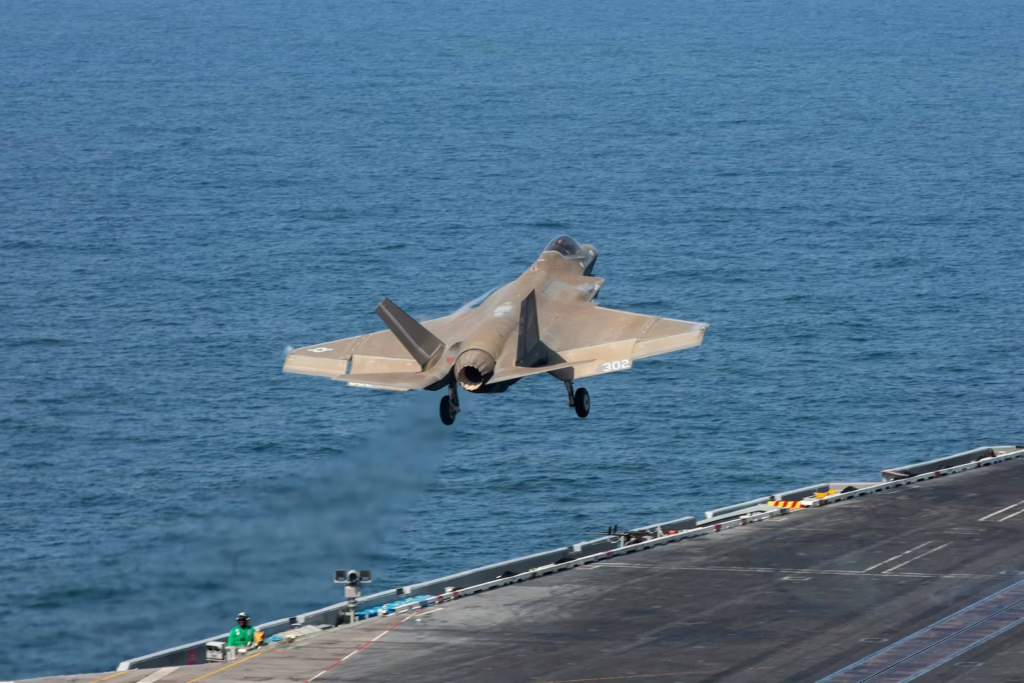
United States
- F-22 (including those forward-deployed to Israel)
- F-35
- F/A-18
- EA-18G
- F-15E
- FlightGlobal also reports A-10s and F-16s as present in-theatre
Israel
- F-35 (Israeli F-35I “Adir” variant)
- F-15
- Total force size reported by Israel: ~200 warplanes
Additional aircraft supporting the mission
US aircraft deployed also included approximately 86 KC-135 and KC-46A tankers, as well as E-3 Sentry AEW&C aircraft for support, according to FlightGlobal.
Additionally, the two US aircraft carriers present in the region carry Northrop Grumman E-2D Advanced Hawkeye airborne early warning and control (AEW&C) aircraft, MH-60R Seahawk anti-submarine/anti-surface warfare helicopters and MH-60S utility helicopters.
Epic Fury leads to commercial airspace disruption with injuries on the ground at two UAE airports
The operation also impacted civil aviation, as Iran struck at its Gulf neighbours, leading to commercial flight disruption. As AGN reported, the United Arab Emirates, Qatar, Bahrain, Iraq, Israel and Iran closed their airspaces.
Qatar Airways suspended all its flights “to, and from, Doha due to the closure of Qatari airspace” with the suspension expected to last through Monday. Abu Dhabi’s Etihad Airways and Dubai’s Emirates and flydubai also suspended flights through Monday. However, Emirates also recommended that passengers with bookings before 5 March either rebook their flights or request a refund.
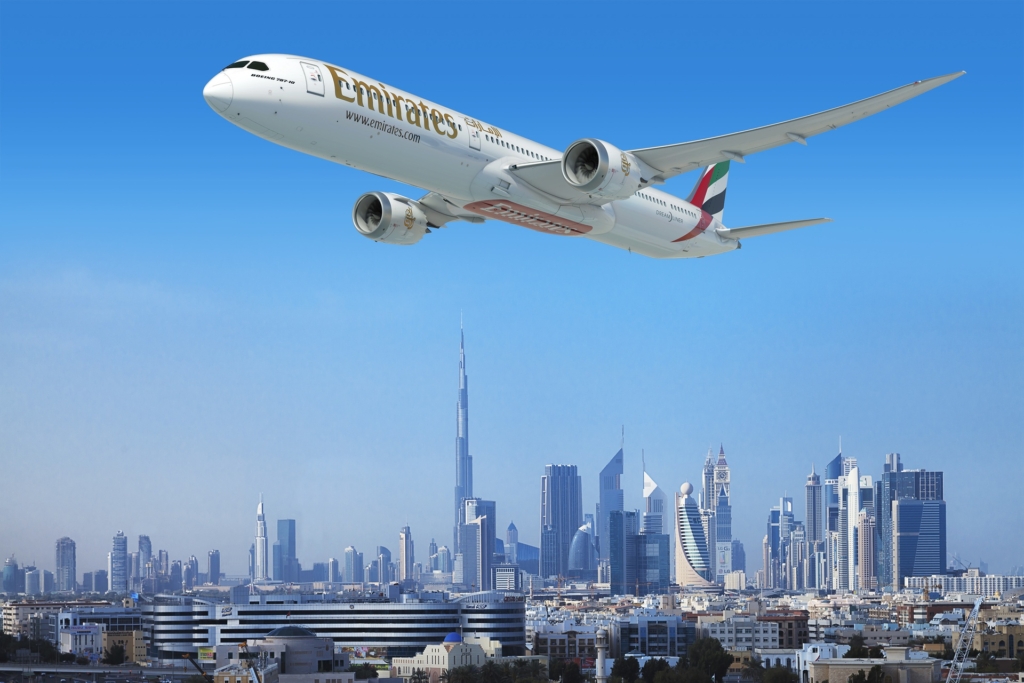
The airspace closure impacted thousands of travellers to the region as other global carriers also suspended flights. Airlines have already been limiting their service to the Middle East and rerouting flights to avoid Iranian airspace, following guidance from regulators and their governments.
Iran attempted to strike both Abu Dhabi and Dubai airports. Abu Dhabi reported that an Iranian drone targeting its facility was intercepted. However, falling debris killed one person on the ground and injured seven others. Dubai reported “an incident” which injured four people and damaged some of its facilities. The airport reported it had only “sustained minor damage,” which “was quickly contained” by emergency response teams.
Featured Image: CENTCOM