Honeywell leads ESA project to take quantum sensing into orbit

5 min read
A Honeywell Aerospace-led consortium has been selected by the European Space Agency (ESA) to develop a compact quantum magnetometer capable of measuring Earth’s magnetic field from orbit, in a project that could help pave the way for a new generation of lighter, more sensitive scientific instruments for future space missions.
The consortium, comprising Honeywell Aerospace, Quantum Brilliance and Poland’s Jagiellonian University, will develop, test and deliver the instrument by 2027 under an ESA-funded contract.
Designed to provide full-vector magnetic field measurements from space, the compact sensor is expected to support Earth science, geophysics and space domain awareness while meeting the strict size, weight and power requirements of modern satellites.
Although magnetometers have flown aboard spacecraft for decades, the new project reflects growing interest in applying quantum technologies to space missions.
Researchers believe quantum sensors can provide greater sensitivity while reducing the size and complexity of payloads, making them better suited to the next generation of smaller satellites.
Earth’s magnetic field remains one of the planet’s most important invisible shields
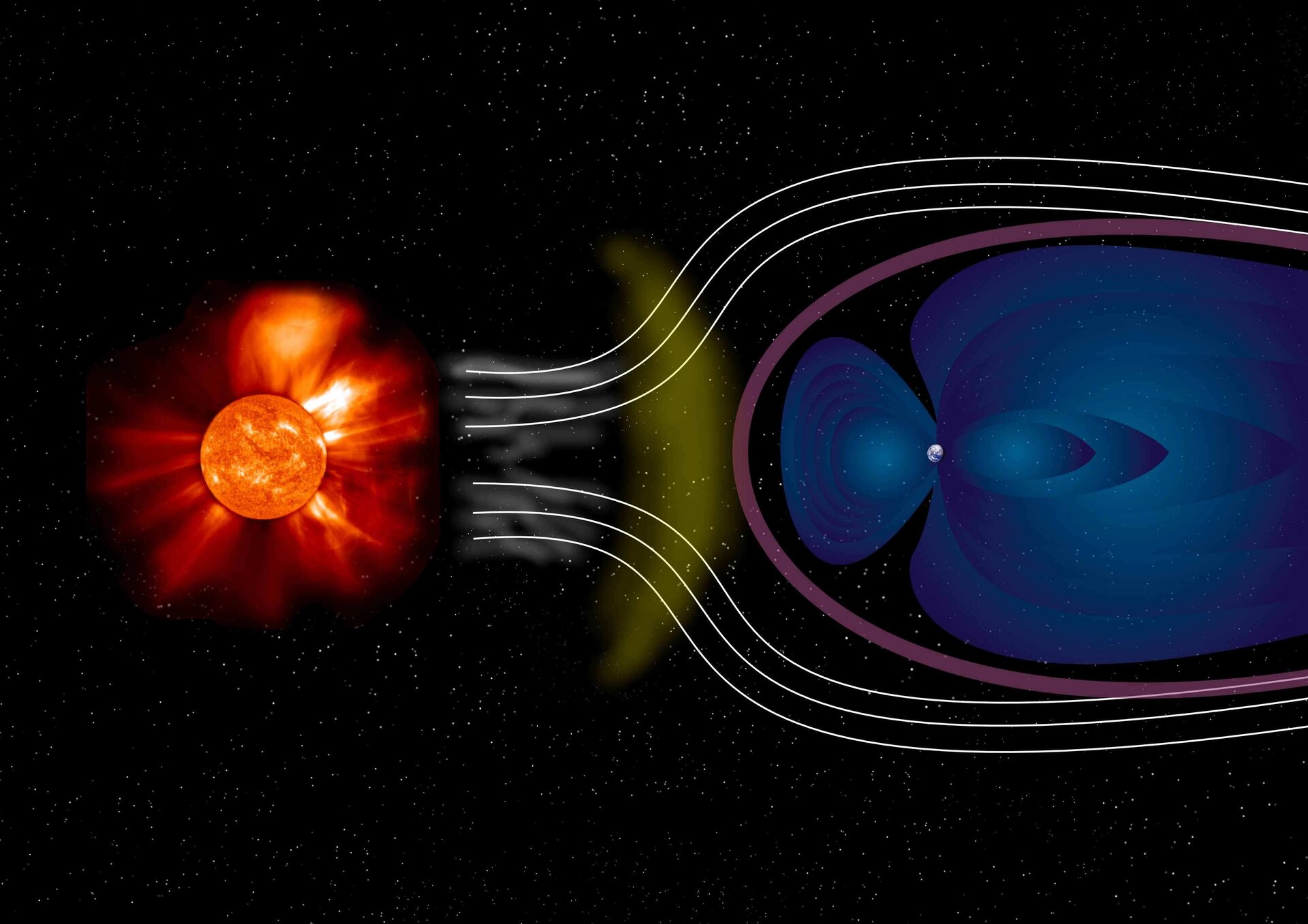
Earth’s magnetic field is generated deep within the planet by the movement of molten iron in its outer core. It extends thousands of kilometres into space, forming a protective barrier that deflects much of the charged solar radiation that constantly streams from the Sun.
Understanding how that magnetic field changes is important for far more than scientific research.
Variations in the geomagnetic field influence space weather, which can disrupt satellite operations, communications and navigation systems. Long-term measurements also help scientists study the Earth’s interior, monitor changes in the planet’s magnetic environment and improve models used to understand interactions between Earth and the space environment.
ESA has invested heavily in magnetic field research through missions such as Swarm. The new instrument is intended to build on that work by providing detailed measurements from a sensor that occupies far less space aboard a satellite.
Quantum sensing is beginning to leave the laboratory
Quantum sensing has long been regarded as one of the most promising technologies for precision measurement, but much of its development has remained confined to research laboratories. That is beginning to change.
“Quantum sensors are a breakthrough technology and their development is gaining traction globally,” said Jan Lukáš, quantum sensing technical lead at Honeywell Aerospace. “As the race to lead in this technology’s development intensifies, this new alliance will help Honeywell Aerospace push the technology forward.”
Unlike conventional sensors, quantum sensors exploit the behaviour of atoms and other quantum-scale phenomena to detect extremely small changes in magnetic, electric and gravitational fields.
Because measurements are made at the atomic level, they can achieve levels of precision that are difficult to match using traditional sensing technologies. Researchers believe the technology could improve everything from medical imaging and autonomous navigation to geological surveys and spacecraft guidance.
In space, quantum sensors are also expected to be less vulnerable to electromagnetic interference than many conventional sensing systems. The ESA project represents one of the latest efforts to demonstrate that quantum sensing can operate reliably in the demanding conditions of space.
Diamond technology offers a compact alternative
At the heart of the new magnetometer is quantum sensing technology developed by Quantum Brilliance.
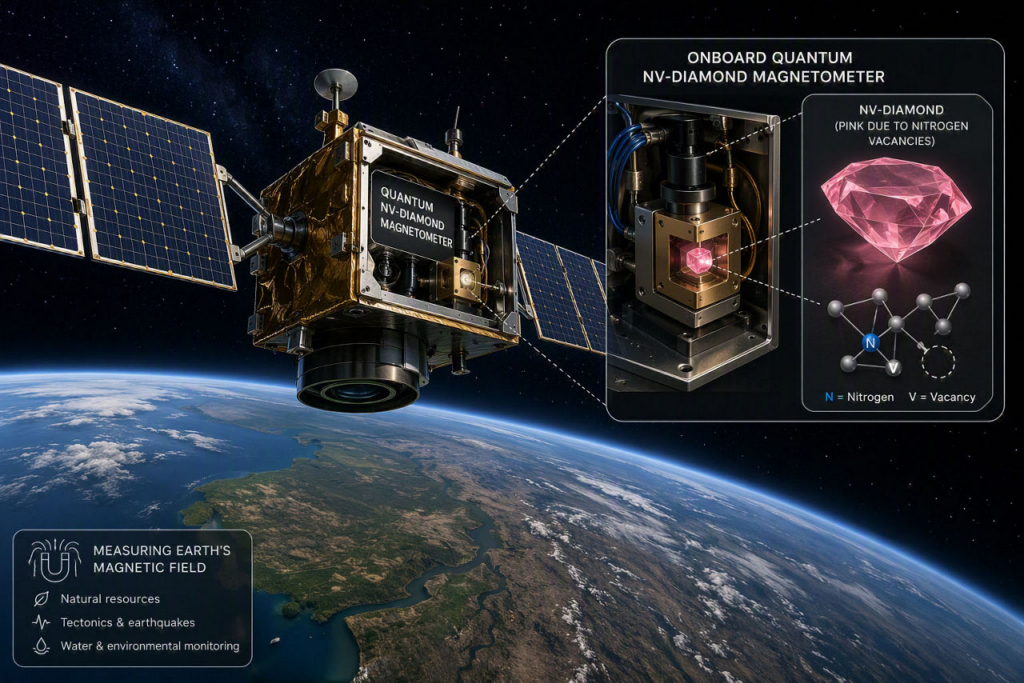
The instrument uses synthetic diamonds containing nitrogen-vacancy (NV) centres, tiny defects within the crystal structure that respond to magnetic fields. Those defects allow the sensor to measure both the strength and direction of magnetic fields using a single sensing element.
Unlike many laboratory-based quantum systems, the diamond sensor operates at room temperature. It also combines several measurement functions within a compact device, reducing alignment requirements and overall system complexity.
According to the consortium, those characteristics make the technology well-suited to satellites where every kilogram of payload and every watt of power matter.
“Our collaboration with Honeywell Aerospace and Quantum Brilliance is an important step toward demonstrating a low-SWaP quantum sensor,” said John Liobe, Technical Director of European Quantum Sensing Programs at Quantum Brilliance. “This project unlocks a pathway to scalable manufacturing for the benefit of future satellite constellations for Earth science and space domain awareness.”
The partners expect the instrument to deliver higher-resolution geomagnetic measurements while offering improved radiation tolerance for long-duration missions and lower power consumption than larger conventional systems.
Smaller payloads could broaden future scientific missions
Reducing the size, weight and power demands of scientific instruments has become increasingly important as satellites continue to shrink.
Many Earth observation missions now rely on compact spacecraft carrying multiple payloads. Every reduction in mass creates opportunities to accommodate additional instruments, extend mission life or lower launch costs.
The consortium believes compact quantum sensors could help meet those demands without sacrificing measurement performance. If successful, the technology could eventually be deployed across constellations supporting Earth observation, environmental monitoring and space domain awareness.
The project also reflects a broader trend within the space sector, where advances in quantum technologies are moving beyond computing and communications into sensing and navigation applications.
While ESA’s immediate interest is scientific research, quantum sensing is attracting increasing attention across the aerospace and defence sectors.
Researchers believe future quantum magnetometers, gravimeters and inertial sensors could support navigation in environments where Global Navigation Satellite System (GNSS) signals are weak, unavailable or deliberately disrupted.
Other potential applications include planetary exploration, underground mapping, climate monitoring and autonomous navigation for aircraft, ships and spacecraft.
The technology is still at an early stage of adoption, but investment is accelerating as governments and industry explore practical uses for quantum-enabled sensors that can deliver greater precision in increasingly demanding environments.