Europe urged to act on winter contrails as aviation’s quickest climate win

January 21, 2026

A new analysis from Transport & Environment (T&E) of Europe’s commercial aviation sector shows that a concentrated segment of flights — specifically those operating at night, in late autumn and winter — is responsible for a disproportionately large share of contrail-related climate warming.
The study highlights that adjusting a relatively small number of flights could deliver one of aviation’s most effective short-term climate wins.
Contrails — the thin, cloud-like trails left behind jets at cruise altitude — can trap heat in the atmosphere and contribute to warming. They are an environmental factor in aviation’s non-CO₂ emissions. While most contrails are short-lived, those formed in cold, humid atmospheric layers can persist and spread, creating a blanket of cirrus-like clouds that trap heat and increase atmospheric warming.
Europe’s seasonal and temporal contrail hotspots
According to the T&E study, contrail formation and its climate impact in Europe are highly seasonal and time-dependent:
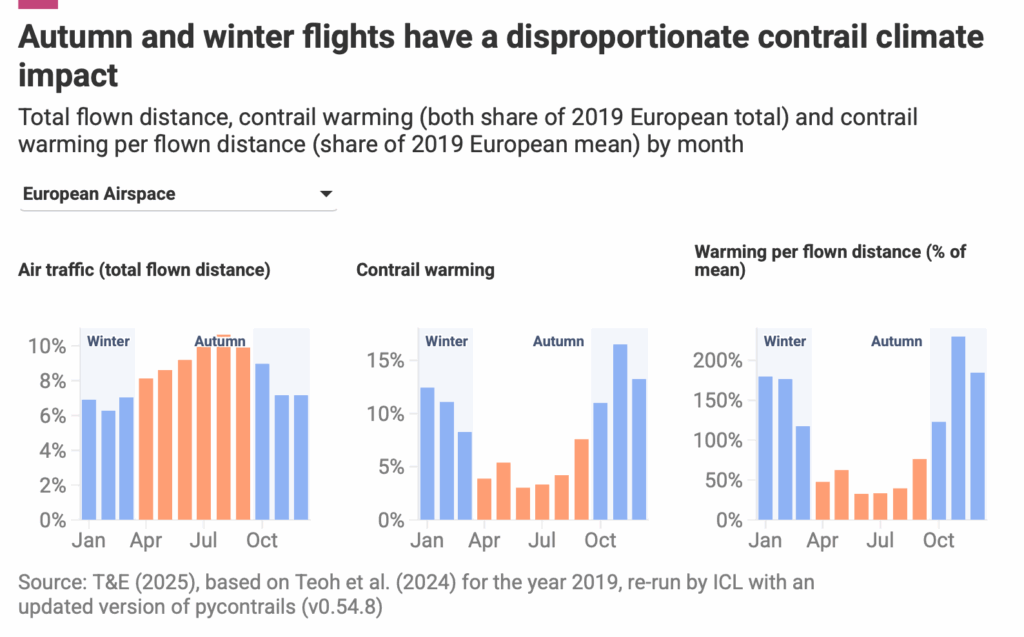
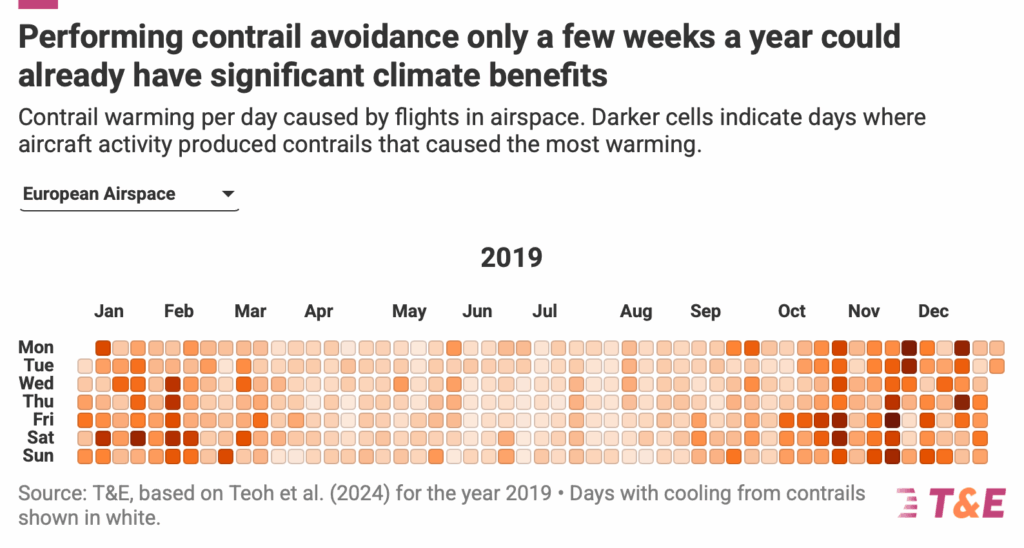
- 75% of contrail warming in 2019 occurred during January–March and October–December, even though these months represent less than half of annual flights.
- 40% of that warming occurred during evenings and nighttime operations.
- Flights at night during late autumn and winter — just 10% of European air traffic — contributed 25% of contrail-induced warming.
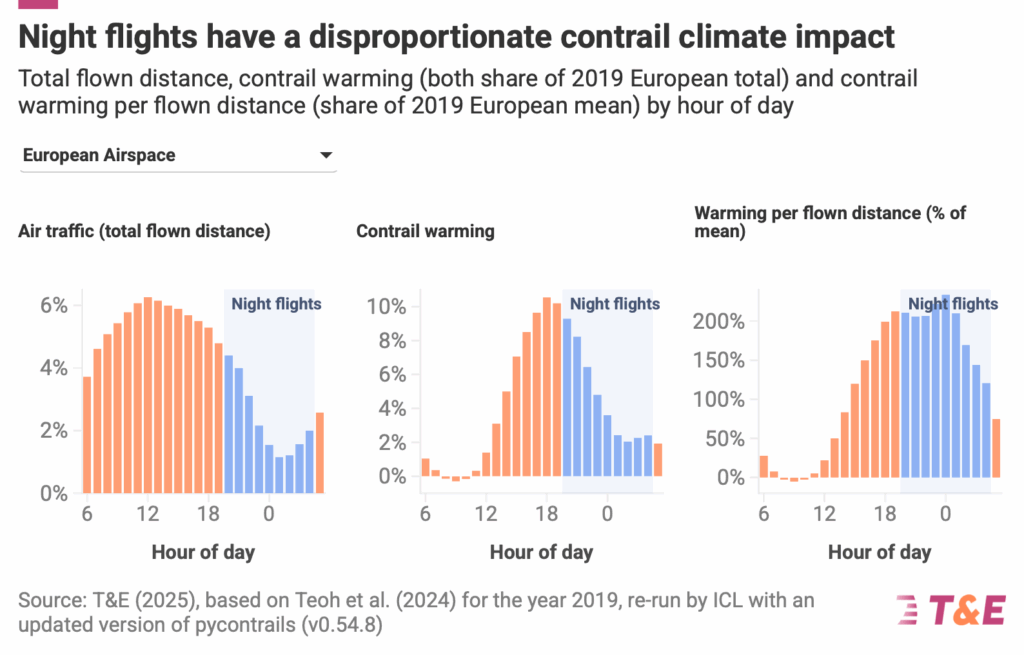
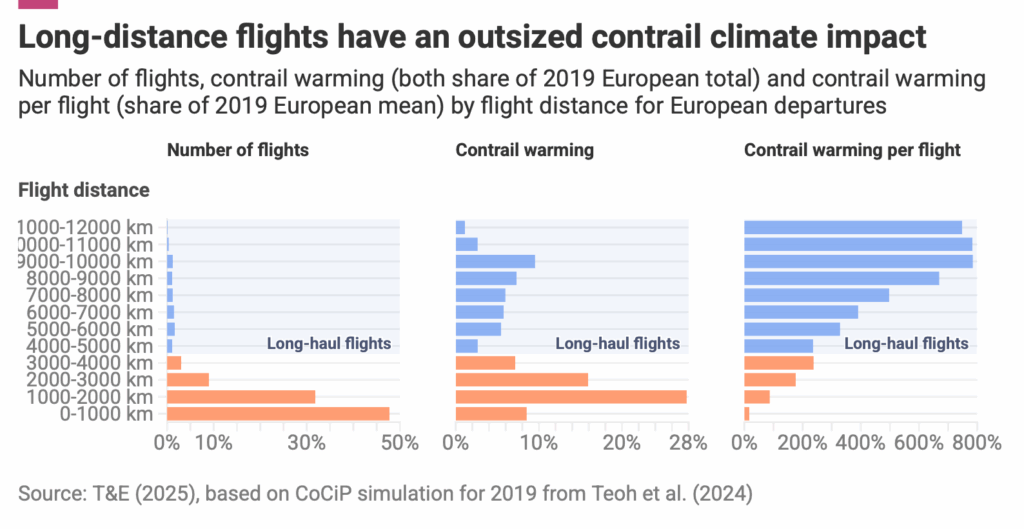
The data underscore that not all flights contribute equally to warming: only about 3% of flights accounted for roughly 80% of the contrail warming in the dataset analysed.
For airlines, focusing the contrail mitigation strategy on a narrow set of flights—nighttime and autumn/winter operations—could generate significant climate benefits.
What can be done: contrail avoidance flight planning
The report identifies contrail avoidance—planning flight trajectories to avoid the cold, humid air layers that lead to persistent contrails — as a key mitigation strategy. Small route adjustments, minor altitude changes or slightly modified departure times could dramatically reduce the formation of warming contrails.

Contrail avoidance involves adjusting flight paths to reduce the distance aircraft spend in atmospheric layers where persistent, warming contrails form.
The principal tactics include:
- Lateral deviations (slightly altering the route horizontally)
- Vertical deviations (small climbs or descents out of contrail-prone layers)
- Hybrid manoeuvres combining both adjustments
Because contrail-sensitive layers are often relatively thin, even modest vertical or lateral changes can avoid contrails without significant extra fuel burn.
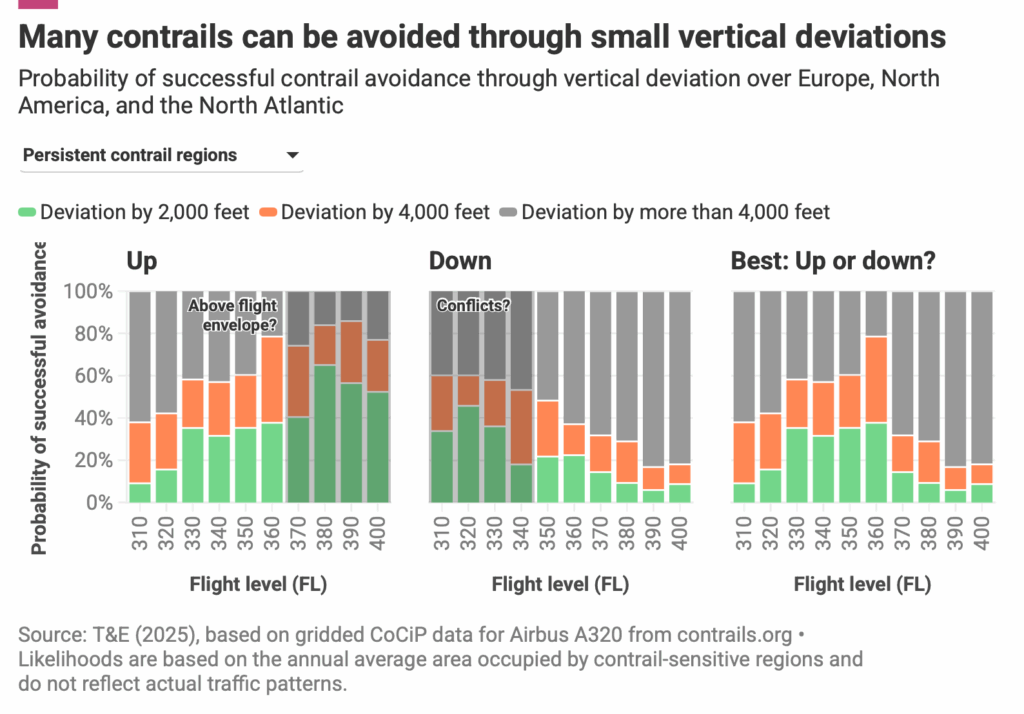
Simulation studies and real-world trials show contrail avoidance can substantially cut warming with little downside, making it one of aviation’s most cost-effective climate measures.
North Atlantic routes could benefit from contrail avoidance measures
Airspace over the North Atlantic—dominated by long-haul flights that generate significant contrail warming but have lower overall traffic density—presents an ideal starting point for contrail avoidance measures.
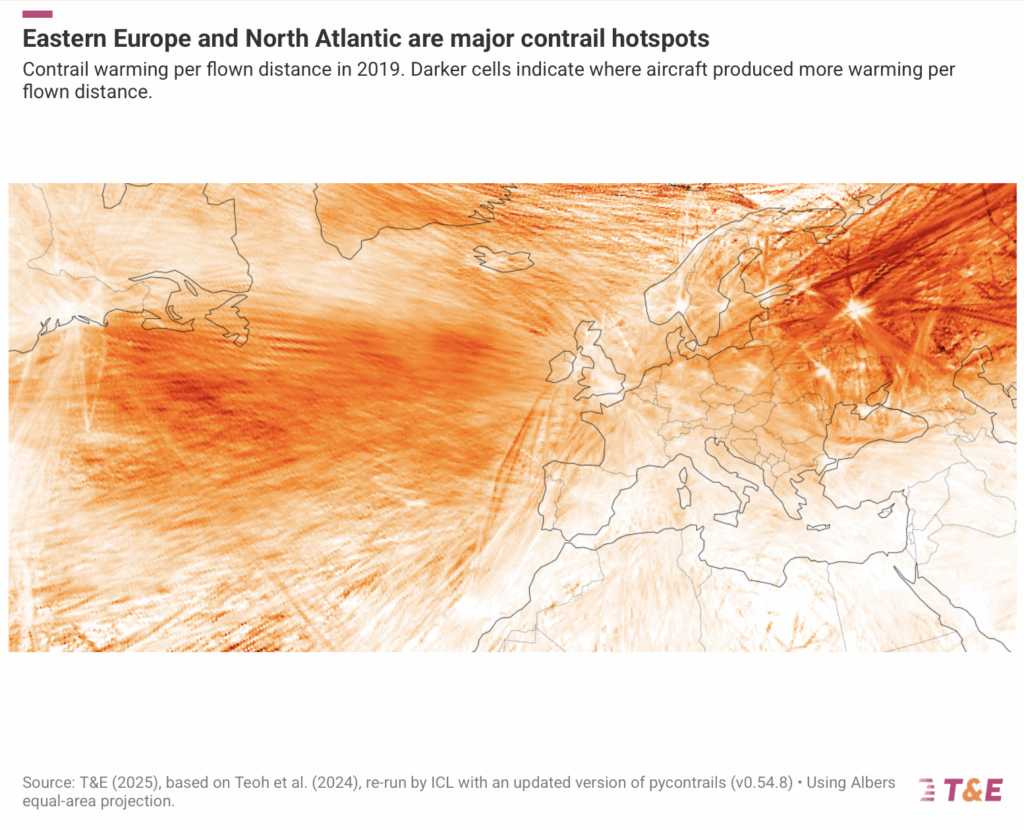
Scaling up contrail avoidance from theory to practice
While contrail avoidance is operationally feasible, scaling it across Europe’s dense airspace network requires policy support, research, and coordination among airlines, ATM stakeholders, and meteorologists.
The T&E report lays out a roadmap for implementation:
- Large-Scale Operational Trials — Conduct live airspace trials embedded within SESAR and funded via the EU Innovation Fund and Horizon Europe to study network-wide impacts and refine best practices.
- Policy Integration — Introduce a dedicated climate key performance indicator (KPI) for non-CO₂ effects, including contrails, into the Single European Sky (SES) performance framework and national ATM performance schemes.
- Monitoring and Reporting — Maintain and expand the EU non-CO₂ monitoring, reporting and verification (MRV) scheme, including flights outside the EEA and UK departures, to build robust datasets for contrail climate impacts.
- Financial Incentives — Develop mechanisms within the EU Emissions Trading System (ETS) to encourage airlines to adopt contrail-reducing flight planning.
- Airspace Modernisation — Accelerate ATM modernisation to support dynamic, climate-optimised routing and reduce controller workload.
- Training and Awareness — Embed contrail-aware planning tools and training into ATC and airline dispatch operations to ensure effective contrail management becomes standard practice.
- Strategic Planning — Incorporate contrail mitigation into Europe’s broader ATM masterplan with measurable action steps through 2035.
Reducing aviation’s climate impact by leaving fewer contrails behind
Contrails are among the most potent non-CO₂ climate effects from aviation, and reducing them offers an immediate way to curb warming while longer-term decarbonisation efforts — such as sustainable aviation fuels and hydrogen electric propulsion — mature.
Aviation’s overall climate footprint is a combination of CO₂ and other effects; targeting contrails leverages existing meteorological forecasting and flight-planning tools to achieve near-term impact.
“Contrails are a very concentrated problem,” said Alexander Kunkel, Senior Analyst at T&E. “By adjusting the paths of just a handful of flights, Europe could prevent years of avoidable warming.”
Integrating contrail avoidance into European aviation’s climate strategy could help deliver measurable reductions in warming well before 2035, complementing decarbonisation efforts and reinforcing the European Union’s global leadership on aviation climate action.

“The time to shift into the next gear on contrail action is now,” Kunkel concluded. “Boosting research, supporting large-scale trials, and designing a policy framework could pave the way for contrail avoidance deployment in the next five to ten years.”
The T&E contrail study suggests that, given the concentrated nature of the problem, the ready availability of weather forecasts to guide flight planning, and the operational flexibility of flight planning systems, contrail avoidance is a climate mitigation pathway where science, policy and the airline industry can align.
Contrail avoidance isn’t a silver bullet. The decarbonisation of aviation will also require sustainable aviation fuels, aircraft efficiency improvements, and new propulsion technologies, but it represents a low-hanging fruit with measurable near-term climate benefits.
Featured Image: Philippe | stock.adobe.com