Emirates to convert high-density Airbus A380s to three-class layout with premium economy

February 14, 2026
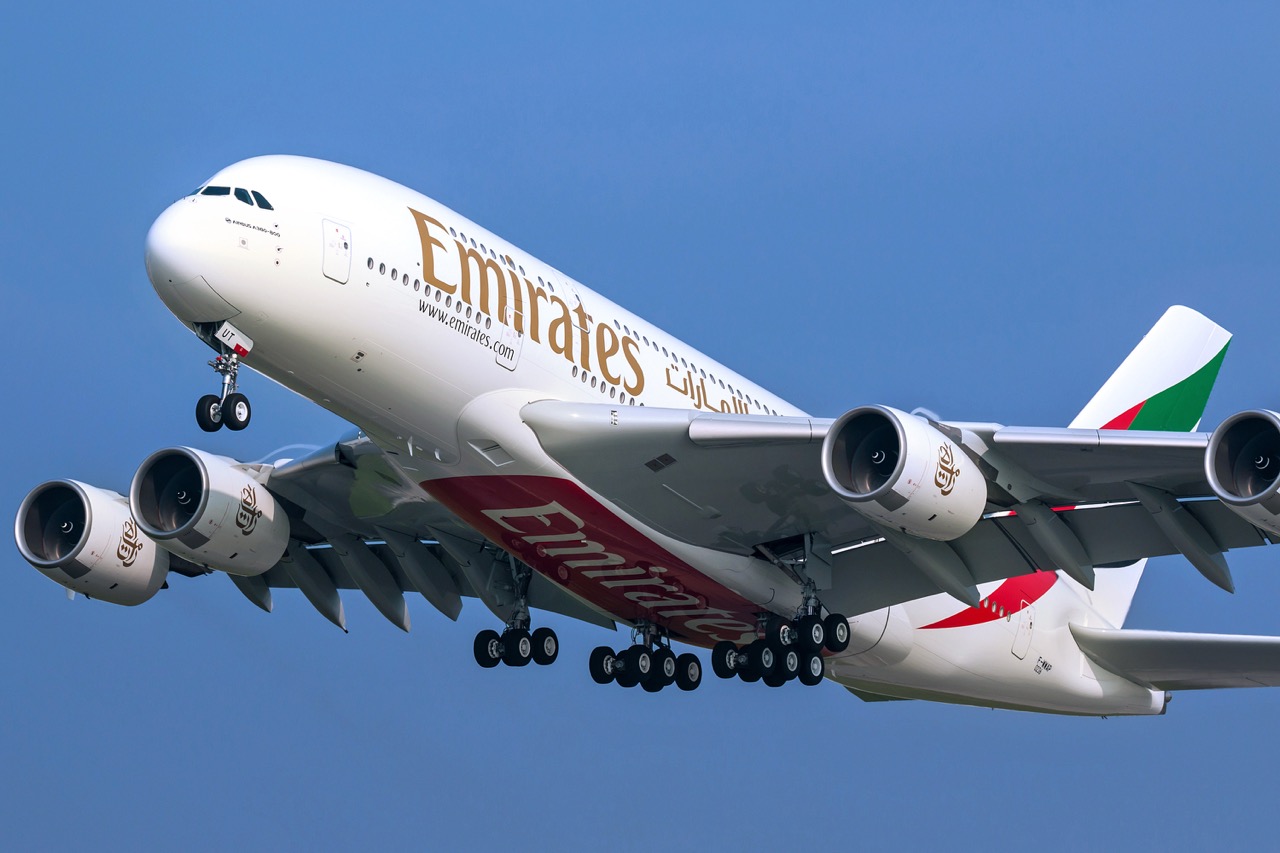
Emirates is upgrading its Airbus A380 passenger experience, announcing it will retrofit its high-density, two-class superjumbos into three classes, adding a premium economy cabin.
The Dubai-based airline said the first upgraded aircraft will enter service on 14 April 2026. The decision to add premium economy seats to the high-density aircraft is another step in the rapid expansion of a cabin product that Emirates introduced later than many competitors.
Emirates’ high-density A380s gain a third cabin
As part of its ongoing multibillion-dollar widebody retrofit programme, Emirates will complete the reconfiguration of its first two-class A380 by mid-April.
The aircraft—previously configured in a dense Business- and Economy-only layout—will emerge with:
- 76 Business Class seats
- 56 Premium Economy seats
- 437 Economy Class seats
This brings the total to 569 seats, maintaining the A380’s role as a high-capacity aircraft while adding a mid-tier product that appeals to long-haul leisure travellers.
The first retrofitted aircraft will operate Dubai–Amman (EK903/904) from 14 April to 31 May, then transfer to Dubai–Prague (EK139/140) from 1 June.
Emirates expects to convert all 15 of its two-class A380s to the new three-class layout by November 2026.
How Emirates’ premium economy cabin product compares to economy class
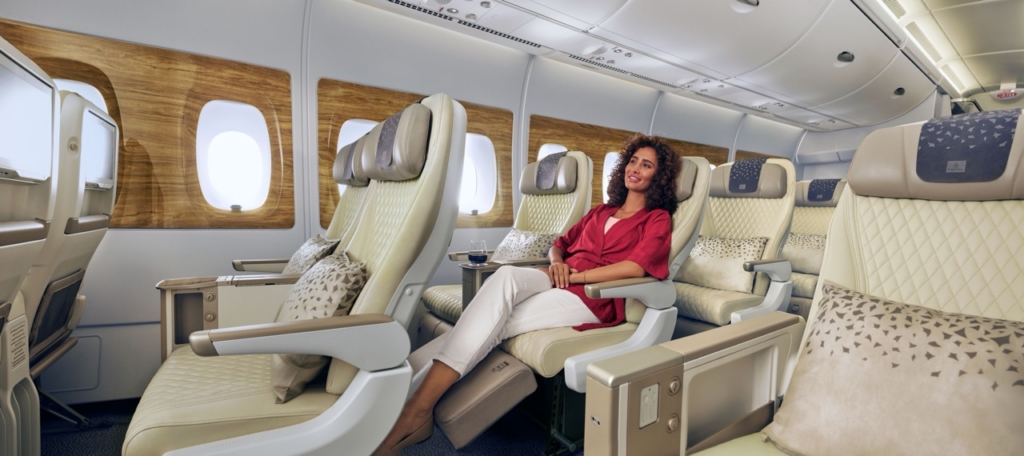
Emirates’ premium economy is more comfortable than its economy class and aligns with the luxurious standards of its other premium cabins.
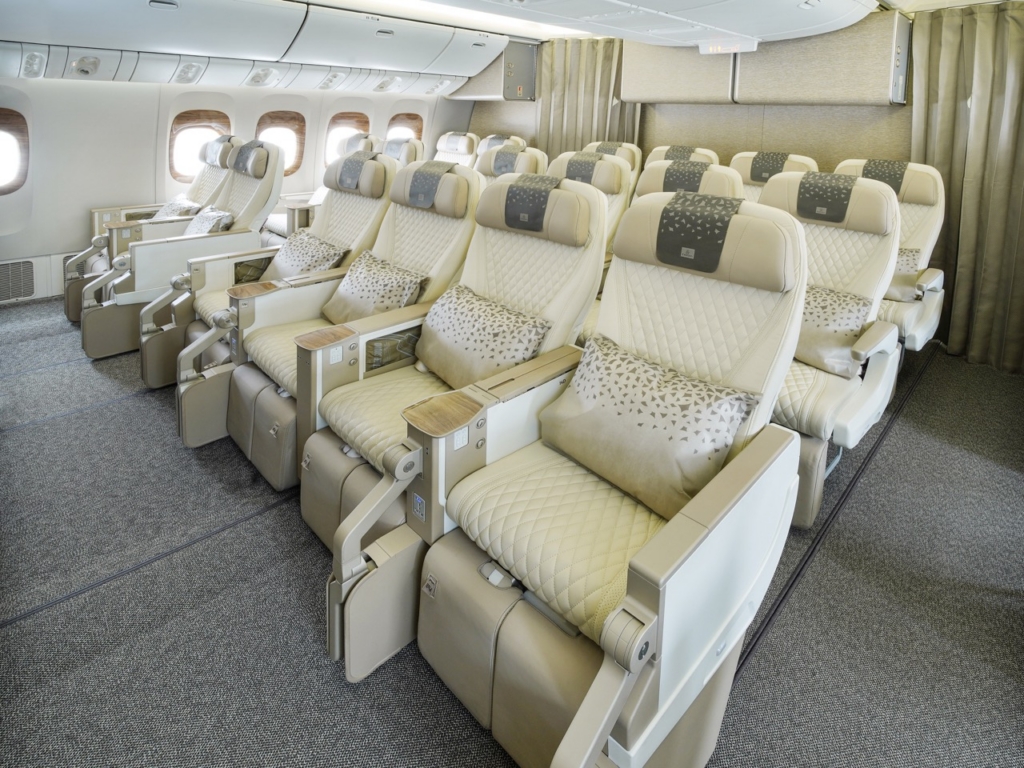
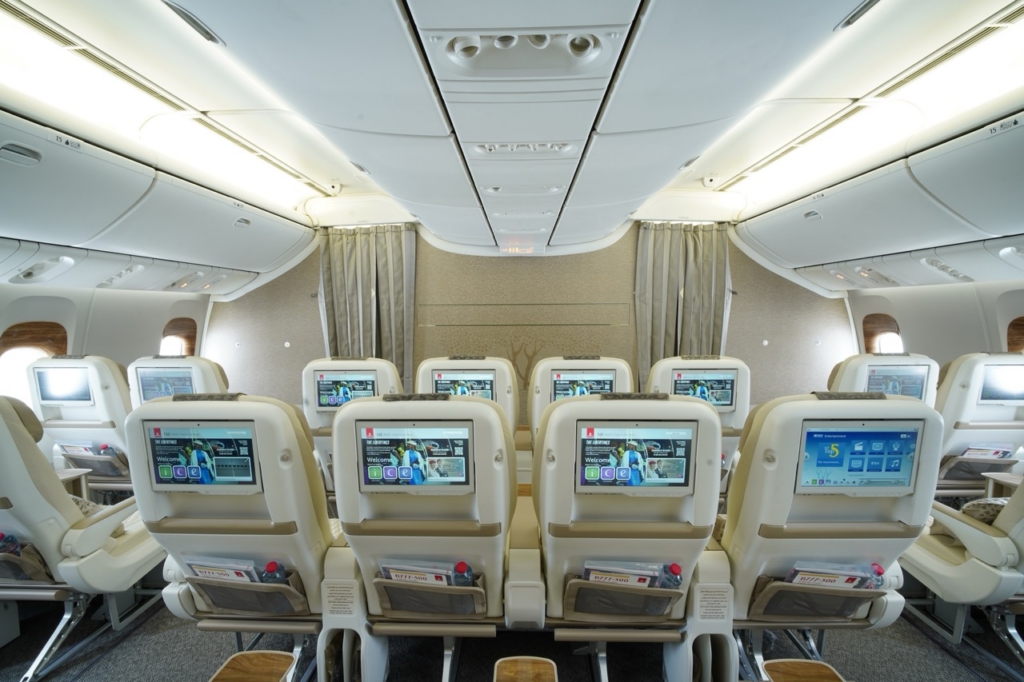
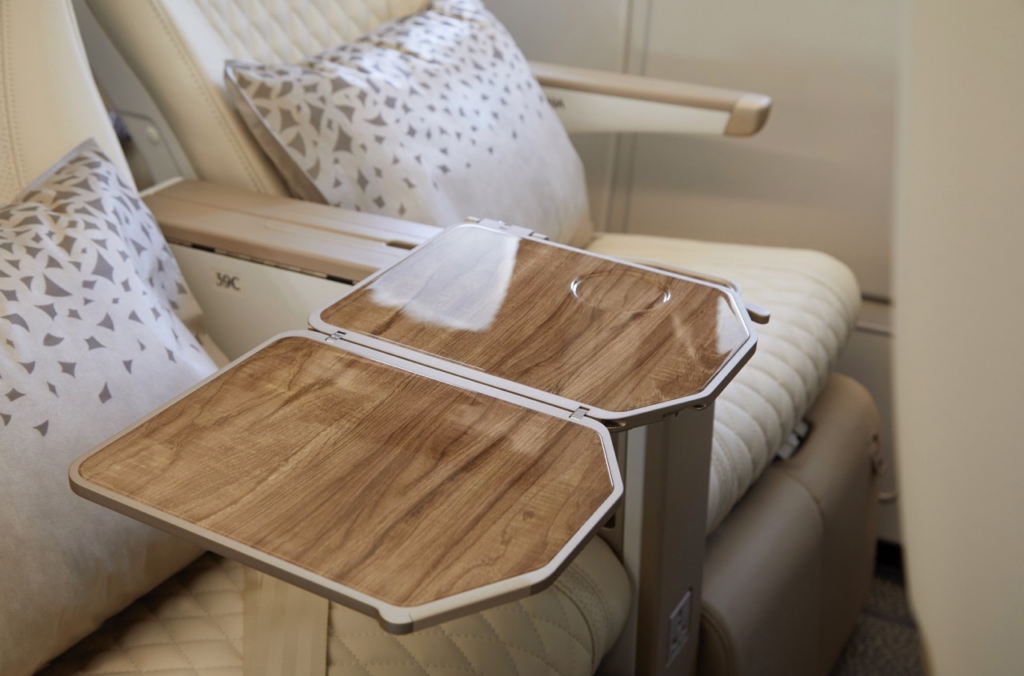
It features 19.5”-wide Recaro PL3530 seats, in a 2-4-2 configuration with 8” recline and 40” pitch (separation). Each seat is dressed in quilted leather and includes a six-way adjustable headrest, calf rest, footrest, and a retractable woodgrain bi-folding table, as well as a shared small cocktail table in the joint armrests.
Seats are also equipped with pivoting 13.3″ HD touch screen displays for in-flight entertainment and offer a shared 110V universal AC power outlet as well as USB-A and USB-C power sockets.
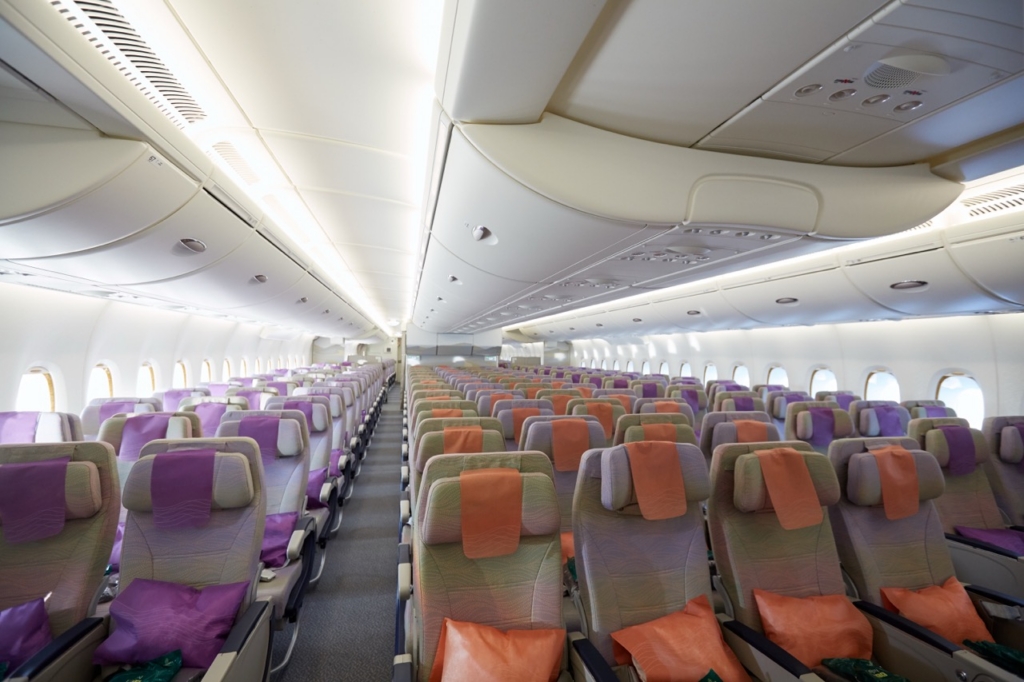
Economy seats are 17.9”-wide Safran Z400 seats in a 3-4-3 configuration set 32” apart with a 4” recline. Seats are equipped with four-way adjustable headrests, pivoting 13.3″ HD touch screen displays, and USB-A and USB-C power sockets.
Emirates also offers special menus to premium economy passengers (updated monthly) and serves meals on Royal Doulton china tableware with stainless steel cutlery wrapped in linen. Passengers can select from a wider range of beverages, including Chandon sparkling wine and extra-vintage wines from the business-class wine list, and receive treats like chocolates and liqueurs.
How the high-density layout compares with other Emirates A380s
According to aeroLOPA cabin data, Emirates operates multiple distinct A380 configurations, reflecting different fleet applications and retrofit stages:
Four-class retrofit A380
- 14 first class suites in a 1-2-1 configuration on the upper deck
- 76 business class lie-flat seats in a 1-2-1 configuration behind first class and lounge
- 56 premium economy seats in a 2-4-2 configuration on the main deck
- 341 (338 on ultra long range variant) standard economy seats behind premium economy
- 484-487 seats total
Original four-class A380 (pre-retrofit)
- First and business class unchanged
- No premium economy
- Higher economy cabin density
- 489–517 seats total, depending on aircraft version
High-density two-class A380 (pre-retrofit)
- No first class
- Larger business cabin with 58 lie-flat seats
- Very high economy cabin density with 557 seats distributed along both decks
- Onboard lounge behind business class
- 615 seats total
New three-class retrofit of high-density A380
- Removes extreme economy cabin density
- Introduces a 56-seat premium economy cabin
- 569 seats total
With the conversion reducing overall seat count, Emirates is trading volume for yield on its high-density routes.
Emirates’ premium economy rollout accelerates
Emirates was notably late to adopt premium economy, holding off for years as rivals positioned the happy middle cabin as a core long-haul product. Its hesitation to adopt the cabin was understandable.
Emirates has positioned itself as a luxury air carrier, with its product focus on providing a superior first and business class and a reasonably comfortable economy class.
Developing a premium economy experience that would not take away from that design standard while still meeting the needs of passengers who would like something better than economy class took some time.
The airline finally introduced the class in 2021, initially on a small number of Airbus A380s, before committing to a fleet-wide retrofit spanning its A380s and Boeing 777s.
That rollout is now accelerating:
- Emirates’ premium economy network will reach 99 destinations by the end of 2026
- The airline’s retrofit programme is expanding across A380 and 777 fleets
- Emirates is increasing the deployment of its reconfigured aircraft with premium economy seating on high-demand leisure and corporate routes
The airline’s new Airbus A350-900s are delivered with a three-class configuration including business, premium economy and economy cabins. On the A350, the airline’s premium economy cabin is configured in a 2-3-2 layout but otherwise matches the product on its other aircraft, ensuring a consistent passenger experience regardless of the aircraft flown.
Emirates makes strategic shift toward higher yield cabin segmentation
The retrofit of Emirates’ high-density A380s reflects the airline’s strategy to optimise revenue per square metre rather than maximising seat count.
Emirates is responding to strong global demand for mid-tier long-haul comfort as leisure demand for more comfortable seats remains stable and corporate travel policies increasingly allow premium economy bookings.
The premium economy fare remains significantly lower than business or first class, making it appealing for those who want to arrive at their long-haul destination more refreshed without breaking the budget.
Importantly, the airline’s plush premium economy experience remains substantially different from business class and does not encourage higher-premium passengers to downgrade.
Emirates announces more premium cabin routes
While announcing the high-density A380 reconfiguration, Emirates also shared new premium economy cabin deployments starting this March through the end of the year, including New York JFK, Zurich, Milan, Dublin, Ho Chi Minh City, Hong Kong, Entebbe, Basra and Mauritius.
The airline is deploying a combination of retrofitted A380s, retrofitted 777-200LRs and new Airbus A350s to meet increased premium economy demand.
The conversion of Emirates’ densest A380s into three-class aircraft is the airline’s latest advance in its premium economy transformation. After years of consideration, Emirates has evidently found the happy middle cabin suits its luxury airline business model well.
Rather than relying solely on aircraft capacity, the world’s largest A380 operator is reshaping its flagship fleet around yield, segmentation, and a consistent passenger experience, ensuring its superjumbo meets air traveller expectations for the long-haul.
Featured Image: Emirates