ASKY weighing Boeing 737 MAX and 787 for long-haul flights to Europe

December 7, 2025

ASKY is one of West Africa’s few successful privately-owned airlines. Some airlines in the region – that continue to exist today – operate a plethora of routes with a sometimes odd mix of aircraft, hoping to make it work. But few do.
A mix of regulatory challenges, high costs, politically-motivated growth strategies and what the region’s aviation expert Sean Mendis describes as a “30% Africa tax” make it a tough market indeed. Cost-control, therefore, is key.
That has been core to ASKY’s entire operation, including future expansion. In an interview with Aerospace Global News, the airline’s Commercial Director Martial Daté Dovéné Tevi-Bénissan talks all-things long-haul flights.

This includes its latest timeline for the launch of long-haul flights, the planes it plans to use, the destinations it is considering, and the importance of efficiency, connectivity and caution. “Because for us it is not just flying out of Africa; it is flying to the right market at the right moment, with the right aircraft,” he underlines.
ASKY currently connects its Lomé (Togo) hub to destinations across Central, West and East Africa. It operates a fleet an ever-growing fleet of 15 Boeing 737 aircraft, consisting of 9 NG variants and 6 MAX’s. The latest factory-fresh example arrived just last week.
Boeing 737 MAX 8s, 10s and 787s
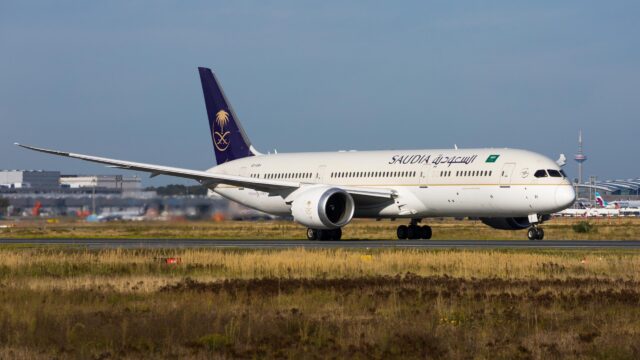
The airline’s preferred option for long-haul flights is the Boeing 787-8 for the launch of flights to Paris as soon as next year, the airline’s Chief Executive told Aviation Week earlier this month. As Tevi-Bénissan tells us, the 737 remains a possibility.
“We are looking of all the possible aircraft that can fly and feed within our airport, being the 787 or MAX versions 8 or 10. We are exploring all the possibilities. A choice is not yet made because financing the aircraft also needs to be taken into consideration, as well as availability, economics….so we are doing the studies right now and we want to be sure.”
The airline is in discussions with lessors – together with 25% stakeholder Ethiopian Airlines – to secure widebodies.
“We are still working and we are hopeful. Maybe by next year or early-2027, we expect to have good news for our passengers,” the carrier’s Commercial Director told us.
Leveraging the 737 MAX’s range
When asked whether the 737 MAX could reach the kind of destinations ASKY is looking at, Tevi-Bénissan said: “It is possible. The MAX 8 is a really nice aircraft that can fly for a very long time. When it is empty it can fly up to 9 hours. With loads, it can go up to 7h 30, or even possibly 8 hours, based on the conditions of the route and airport locations and others.”
He also noted that Lomé’s position at sea-level means that “performance is even greater.”
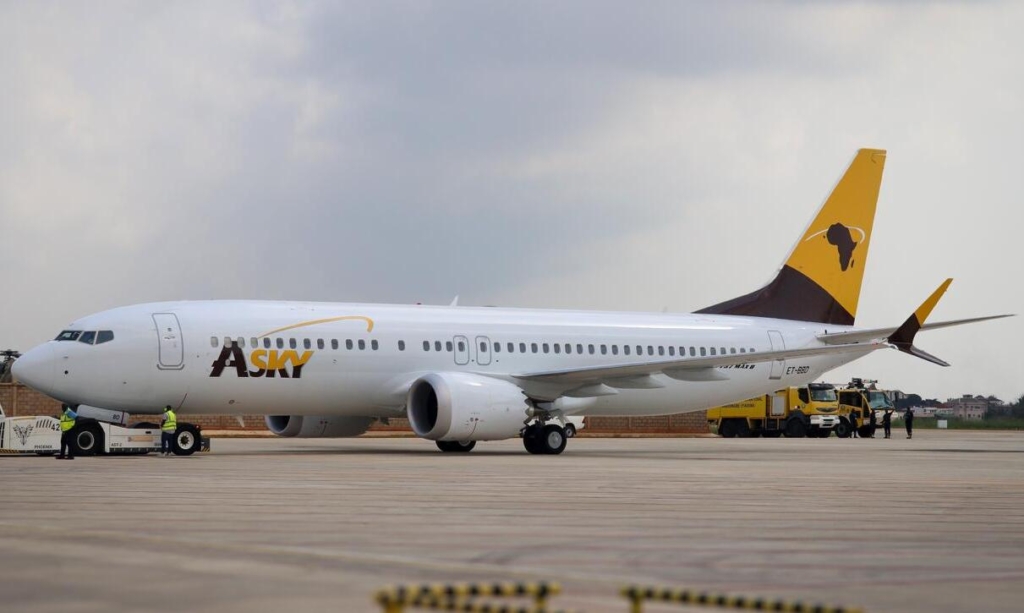
“It is an aircraft that can fly from Lomé to Paris for example,” he continued. “It is an aircraft that can also fly to Madrid and other places in Europe and the Middle East. So it is also something that we can consider as fit for long-haul. But the most important for us is not the aircraft: it is the product, the frequency, the capacity, the service on board, the departure/arrival time and the possible connectivity we can offer.”
ASKY is not the only airline newly interested in the 737 MAX’s range capabilities. Last week, Air Canada and WestJet unveiled a slew of new routes, some of which topped the list for their longest MAX flights yet.
ASKY “scrutinising” every aspect of its possible new destinations
The executive revealed that it is studying several different markets for its new long-haul network. “There are a lot of destinations. We aim to connect as much as possible. If we take Europe, you have Paris, Brussels, Madrid, Barcelona, Milan….all of these are under our radar. We are scrutinising them. We are just looking for the right one in terms of capacity and if they fit.”
He also highlighted that the airline has to be careful with its choice, balancing competition and cost-control.
Connections will also be essential. The carrier’s existing network is based on a strong hub-and-spoke model. Currently it offers just under 500 different Origin-and-Destination points.
In other words, each of its new destinations also need to be considered in the context of the connections possible beyond Lomé. “If we take Lisbon for example, it is highly connected with other lusophone cities like São Tome, Luanda…so we need to consider the competition also on these routes and what we can take if it is a satisfactory new route.”

“So we are studying each and every market and assessing the potential and from that perspective the financials will be made,” he concluded.