


Airbus CSO Farnborough reflections: Aviation sustainability is entering a new phase

Julie Kitcher is Chief Sustainability Officer and Communications at Airbus and a member of the company’s Executive Committee. She oversees Airbus’ sustainability roadmap and communications strategy, and also chairs the Airbus Foundation.
I felt a distinct shift at this year’s Farnborough International Airshow. Against a backdrop of high global fuel prices and geopolitical instability, conversations that once centred predominantly on decarbonisation and net zero are increasingly being framed through the lens of pragmatism, resilience and competitiveness.
In the industry, we call this the ‘Energy Trilemma’, which is the challenge of balancing emissions reduction with energy security and affordability.
Across the week, I saw this playing out in discussions ranging from climate adaptation and Sustainable Aviation Fuel (SAF) to the role of energy efficiency across the aviation sector. What struck me was not a retreat from sustainability ambitions, but a growing recognition that achieving them requires solutions that work in a complex global reality.
In many ways, Farnborough reflected an industry entering a new phase. One that’s focused less on ambitions and more on creating the conditions to deliver them.
Here are some of my key takeaways:
As climate change confronts Europe, adaptation is moving up the agenda
For much of my time as CSO, conversations at major industry events have centred on climate mitigation and the actions we’re taking to reduce greenhouse gas emissions.
At this year’s Farnborough, however, adaptation featured much more prominently. Specifically, how our industry, and society more broadly, can strengthen resilience to the effects of climate change.
To me, this reflects an important evolution in the industry’s thinking. Climate change is no longer being discussed solely as an environmental challenge, but a resilience challenge that has direct implications for infrastructure, operations, and competitiveness.
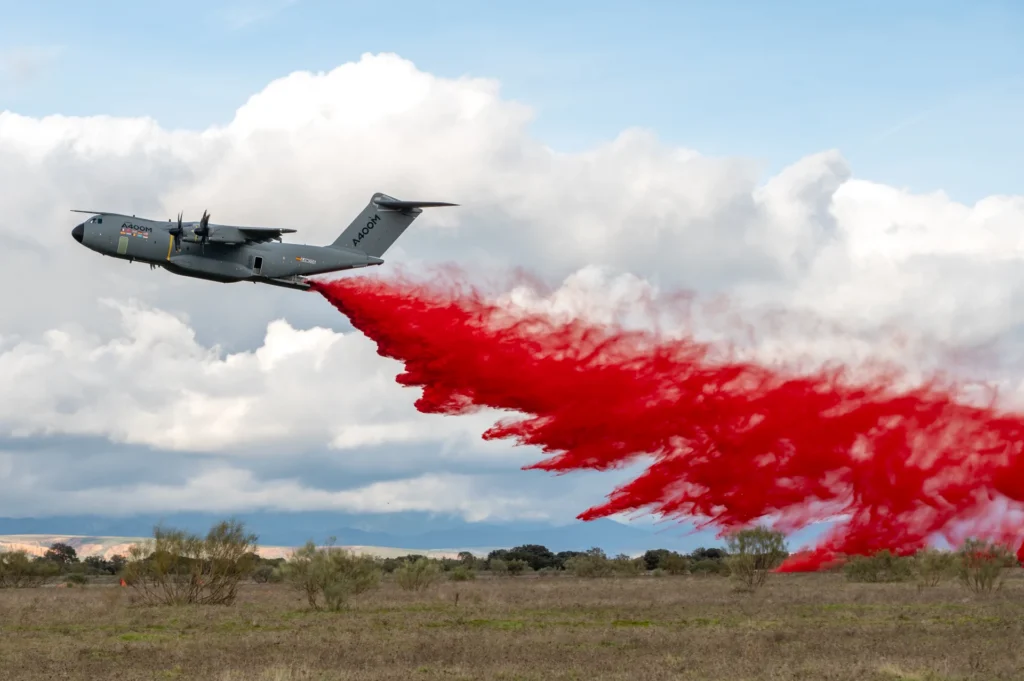
That shift is unsurprising given the extreme weather Europe is experiencing, including record-breaking heatwaves and wildfires. President Emmanuel Macron’s description of the fires in France as the country’s biggest challenge since the Second World War underlined the scale of the threat.
As extreme weather events become more frequent and severe, I expect adaptation to become an increasingly important part of the sustainability conversation. The aerospace sector will be judged not only on its contribution to reducing emissions, but also on its ability to help societies anticipate, respond to, and recover from climate-related disruption.
Wildfires are one example. Aerospace technologies already play a critical role across the response ecosystem, from satellites that can detect hotspots and monitor the spread of fires, to aircraft and helicopters that support firefighting and emergency services on the ground.
SAF is shifting from promise to progress
While adaptation featured more prominently than in previous years, the energy transition remained firmly on the agenda.
SAF is now an established part of the aviation sustainability conversation. What was encouraging at Farnborough was the shift from discussing its potential to confronting the practical challenge of scaling production and accelerating adoption.
Investment will be central to making that happen. Across discussions with aviation leaders, airport operators and SAF producers, there was a clear recognition that scaling SAF will require significant financial commitment, disciplined capital allocation and long-term policy certainty.

It will also require deeper collaboration across the value chain. Our partnership with Air Canada to help strengthen the Canadian SAF ecosystem, announced at Farnborough, is one example of what this can look like in practice. Progress ultimately depends on building tangible, local ecosystems in which OEMs, airlines, fuel suppliers and airports work together.
Despite a challenging macro-economic environment, I came away encouraged by the level of collaboration on display. There was a clear collective focus on moving from ambition to implementation and that gives me reason for optimism.
The industry’s most immediate opportunity is often overlooked
There was one opportunity I felt deserved more attention.
While much of the industry’s focus is rightly on future fuels and technologies, there is also a significant opportunity to improve the energy efficiency of aviation today. Replacing older aircraft with the latest-generation models can reduce fuel consumption by 20-25%, lowering emissions while helping airlines manage costs in an increasingly challenging operating environment.
Aviation’s transition will unfold over decades, but that makes near-term action more important, not less. As we develop the next generation of aircraft and scale lower-carbon fuels, we should also make full use of the solutions already available to reduce emissions today.
As climate targets draw closer, I expect energy efficiency will move higher up the agenda as organisations look for practical ways to deliver measurable reductions.
What Farnborough revealed about the road ahead
More than anything, Farnborough reinforced how interconnected the industry’s biggest challenges have become. Decarbonisation, climate resilience and energy security can no longer be addressed in isolation.
Making progress will require a sustainability transition that works across all these dimensions. Reducing emissions while ensuring that aviation’s infrastructure, operations and supply chains remain resilient and competitive.
I left Farnborough feeling optimistic. Not because the challenges have become smaller, but because there is growing alignment across the industry on what practical progress requires.
The task is now to turn that alignment into action.


