“Profitable and disciplined growth”: LATAM Airlines talks recent European expansion and oneworld departure

5 min read
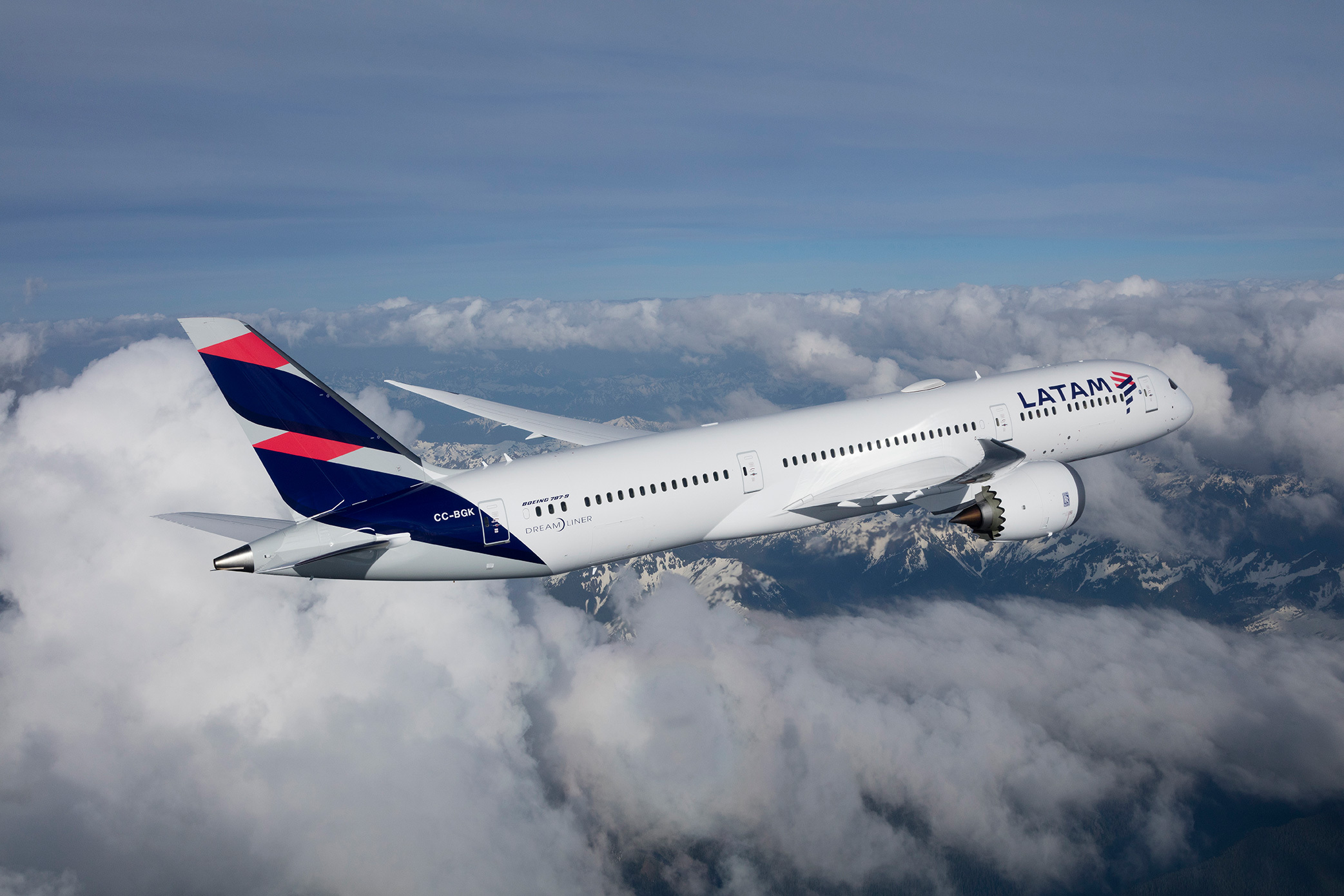
LATAM Airlines recently announced two new European routes beginning in summer 2026. Three-weekly flights each to Amsterdam and Brussels launch in April and June 2026, marking an expansion to the carrier’s already reasonably strong network in Europe.
Though primarily concentrated in the Iberian peninsula – with which it maintains linguistic and diasporic ties – its flights to the likes of Frankfurt, London Heathrow and Paris Charles de Gaulle. Northwestern Europe will continue to play an important role for the carrier as it bolsters its network with the new routes to Belgium and the Netherlands.
In an interview with Aerospace Global News, the carrier’s General Manager for EMEA, Asia and the South Pacific, Thibaud Morand, discusses LATAM’s recent expansion announcements and post-COVID strategy.
LATAM’s new Brussels and Amsterdam routes are all about connections
The new routes fit into the carrier’s intercontinental strategy, combining a mix of “point-to-point traffic and connectivity, with connections playing a very important role,” Morand explains.
“LATAM Airlines is the only airline group in the region that connects South America with four continents, and Europe plays a key role in this strategy,” he continued.
Indeed, Amsterdam and Brussels both have considerable point-to-point demand. Last year, roughly double the number of passengers travelled between São Paulo and the Dutch capital than to Brussels. That said, this was primarily driven by KLM’s existing non-stop connection from Amsterdam, whereas Belgium has no direct flights to the Brazilian city.
The connection to São Paulo is also Belgium’s only non-stop passenger service to South America. LATAM’s non-stop flight will stimulate the market.
“The new routes strengthen access to São Paulo as the group’s main hub,” Morand said, “from where more than 150 destinations in South America are connected, allowing us to offer more options and a better travel experience to European passengers.”

Onward flights to Buenos Aires and Rio de Janeiro are expected to be key for both the new European connections.
Europe’s airlines are increasingly interested in South America
LATAM’s expansion in Europe also comes at a time of increased competition from airlines across the pond.
Lufthansa Group, Air France-KLM, and International Airlines Group have all submitted bids for TAP Air Portugal, of particular value given its South American network. Its links to Brazil and other former Portuguese colonies are valuable and would reinforce any buyer’s position in the South Atlantic.
Individually, airlines are also upping flights to the continent.
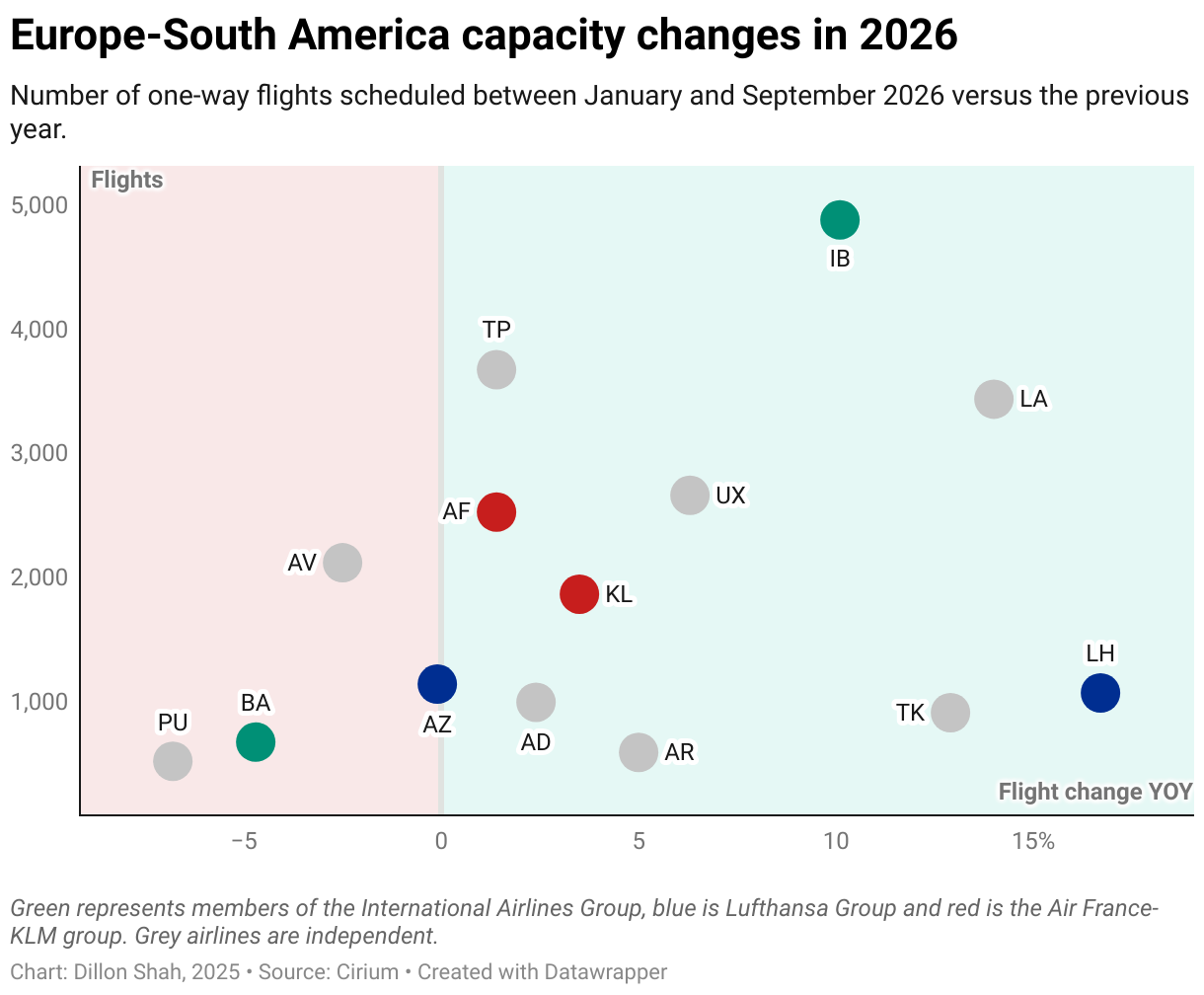
Iberia is both the largest airline flying between the two regions and is growing roughly 10% during the first nine months of 2026 compared to the previous year. TAP Air Portugal is the second largest player on the market and grew slightly as well.
LATAM follows shortly after with the second-strongest growth rate by number of flights.
Morand stresses that the carrier is not expanding in reaction to others. “LATAM Airlines has strengthened its presence in Europe as part of a profitable growth strategy, supported by an extensive network, a differentiated value proposition and constant improvements in product and service.”
He added: “The focus is on better connecting Europe with South America, rather than reacting to specific moves by other players. This is not a defensive strategy, but rather an investment where there is a clear opportunity for sustainable growth.”
As Azul makes cuts, LATAM bolsters its European position
As this publication reported in late November, Azul decided to withdraw from its Paris route in search of higher-yielding traffic to the United States and Mexico surrounding the 2026 World Cup.
LATAM, however, is holding strong. Aside from the new routes to Brussels and Amsterdam, many of its other European services will also see increases. Most of these have already been outlined in a weekly schedule update report in early November. This included the following entries:
- LATAM increases Barcelona to Sao Paulo from 4x weekly to daily in S26.
- LATAM increases Madrid to Sao Paulo from 10x weekly to double daily in S26.
- LATAM increases Rome Fiumicino to Sao Paulo from 5x weekly to daily in S26.
- LATAM increases Madrid to Santiago de Chile from 11x weekly to double daily in S26
Morand highlighted that despite Azul’s exit, transatlantic flights to Europe remain a successful market. It “has shown consistent and solid performance for LATAM Airlines, which is reflected in the group’s decision to maintain and expand its presence on the continent.”
He pointed to the carrier’s planned growth for summer 2026 and underlined its product offering, including its new Premium Business cabins and the introduction of Wi-Fi on long-haul flights. These measures indicate “confidence in the viability and potential of the European market” with LATAM’s network.
LATAM European routes in August 2026
| Region | Route | Frequency |
| Western Europe | GRU – AMS | 3 |
| GRU – BRU | 3 | |
| GRU – CDG | 7 | |
| GRU – FRA | 7 | |
| GRU – LHR | 7 | |
| Southern Europe | FOR – LIS | 2 |
| GRU – LIS | 7 | |
| GRU – BCN | 7 | |
| GRU – FCO | 7 | |
| GRU – MAD | 14 | |
| LIM – MAD | 7 | |
| SCL – MAD | 14 | |
| GRU – MXP | 7 | |
| Total weekly frequencies | 96 | |
Source: Cirium
It is not currently planning new destinations, though, as the focus remains strictly on “consolidating and strengthening the existing network, improving the travel experience and continuing to develop connectivity through the group’s hubs.”
It operates subsidiaries in Brazil, Chile, Colombia, Ecuador, Paraguay and Perú.
“LATAM Airlines is constantly evaluating growth opportunities in the markets where it operates and those where it does not,” Morand said. “However, the company has been clear that its strategy prioritises profitable and disciplined growth over rapid expansion.”
What does LATAM’s oneworld departure mean for its global airline partnerships?
LATAM left the oneworld alliance in May 2020. The decision coincided with its shift in partner in the North Atlantic, effectively ending its relationship with American Airlines. Instead, the carrier pivoted to Delta Air Lines.
It is worth noting that Delta Air Lines owns a 10% stake in the South American airline group. Qatar Airways also owns another 10%.
Morand described the airline’s departure from the alliance as having provided additional versatility in its operation that “generates direct value for customers.”
“The main example is the joint venture with Delta, which has enabled the airline to offer a highly integrated network between North and South America, with concrete benefits in terms of connectivity, travel experience and loyalty programmes.”
“This approach is in line with the group’s vision of building alliances based on clear commercial objectives, beyond membership of a traditional global alliance,” he concluded.
LATAM’s continued global expansion – particularly in Europe – will continue to turn heads. And as Europe’s airline groups vie for increased market share in the South Atlantic, LATAM’s experience and position will make that a tough challenge.
Featured image: LATAM Airlines
Sign up for our newsletter and get our latest content in your inbox.


More from


October 17, 20264 min read