ZIPAIR uses riblet coatings to cut aerodynamic drag on its Boeing 787s

February 2, 2026
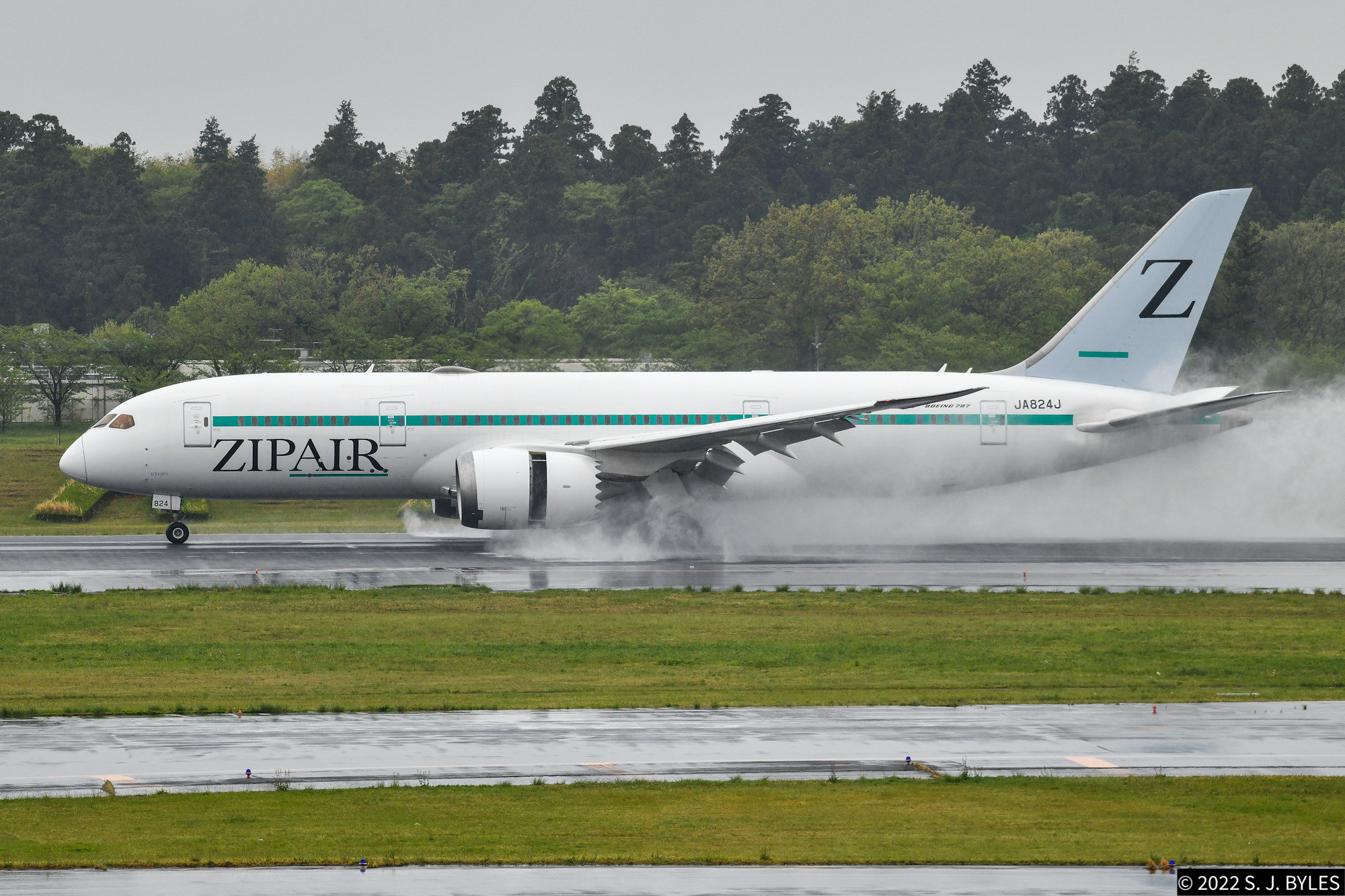
A Boeing 787-8 operated by Japanese carrier ZIPAIR has entered service with a sharkskin-inspired riblet paint coating, a drag-reduction technology that has already been shown to save more than 150 tonnes of fuel and nearly 500 tonnes of CO₂ per aircraft each year in long-haul operations.
The aircraft (JA851J) began flying with the coating on 27 January, becoming the second aircraft type within the Japan Airlines group to operate with riblet structures applied to its fuselage after Japan Airlines applied the same treatment to a Boeing 787-9.
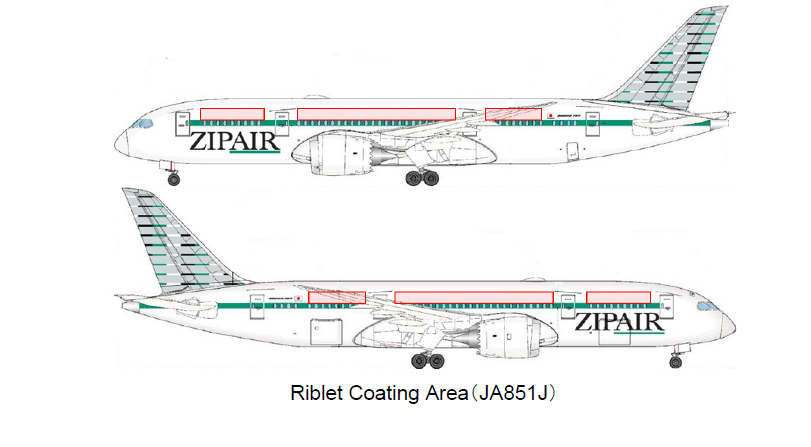
ZIPAIR applies riblet paint coating to Boeing 787-8 to cut aerodynamic drag
The application builds on earlier work by Japan Airlines (JAL) and represents the latest phase of a multi-year collaboration involving Japan Aerospace Exploration Agency and coatings specialist O-Well Corporation.
JAL’s Boeing 787-9 aircraft (JA868J) has been operating with large-scale riblet coating since 18 January 2025, and the application was expanded to the upper fuselage area in November 2025, with the aircraft continuing to operate on international routes.
Riblets are fine, groove-like surface structures inspired by shark skin, aligned with the airflow to reduce skin-friction drag during cruise.
While the concept has been studied for decades, durability, manufacturability and maintenance compatibility have historically limited large-scale adoption on commercial aircraft.
The Japanese programme aims to address those barriers through in-service demonstrations rather than purely experimental trials.
Riblet drag reduction technology enters airline service
For ZIPAIR, a medium- to long-haul low-cost carrier within the JAL group, the project aligns with its wider emissions-reduction strategy.
The airline achieved carbon-neutral certification under ISO 14068-1 in 2025 and has been seeking efficiency gains alongside fleet and operational measures.
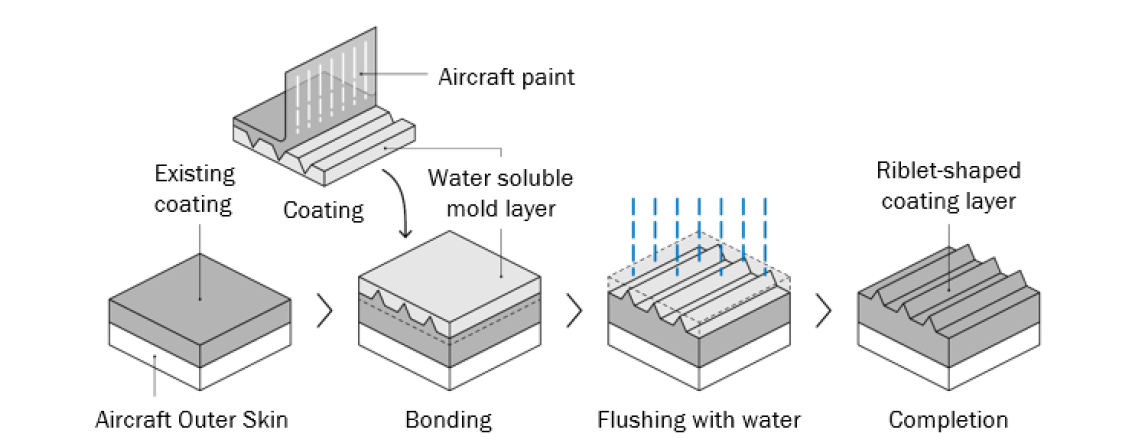
The riblet coating was applied using a so-called “paint-to-paint” process, in which a textured pattern is formed directly onto the aircraft’s existing paint layer using a water-soluble mould.
This avoids the need for additional structural films or panels and allows the coating to be integrated into standard maintenance workflows.
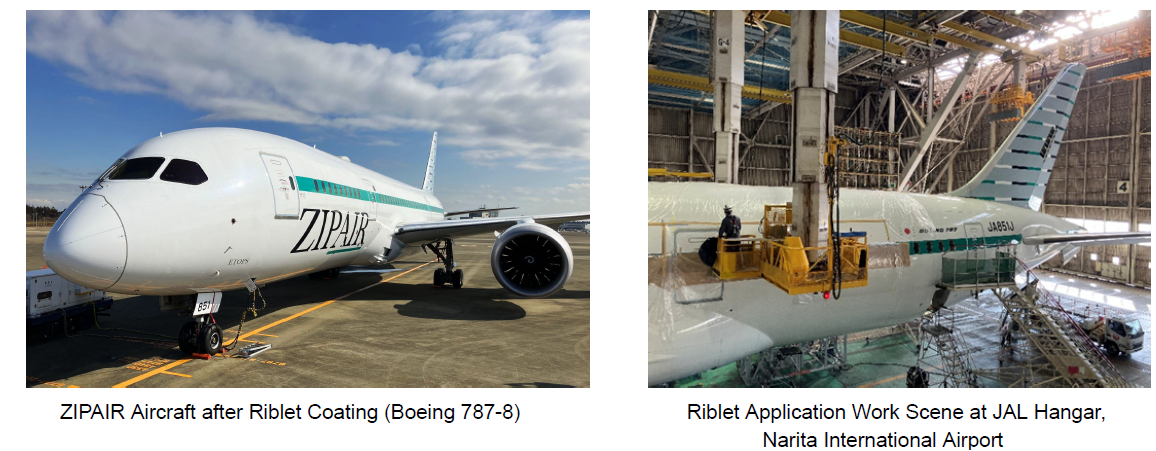
For the ZIPAIR aircraft, the application process was refined further with new positioning and crimping tools designed to improve consistency and reduce labour time.
Work was carried out at Narita airport, ZIPAIR’s primary maintenance base, as well as at Haneda, demonstrating that the technique can be deployed outside specialist facilities.
Building on earlier Japan Airlines widebody trials
The ZIPAIR aircraft follows an earlier, larger-scale demonstration on a JAL-operated Boeing 787-9, which entered international service in early 2025 with riblet coating applied to substantial areas of its fuselage.
That aircraft later received an expanded application covering additional upper fuselage sections.
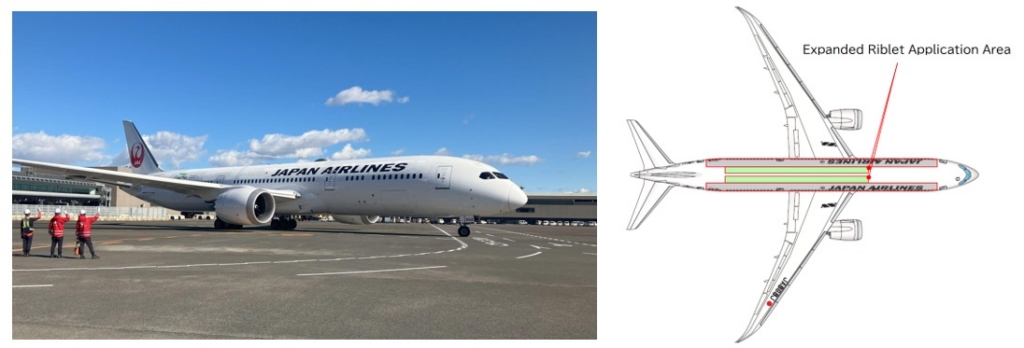
According to JAXA’s aerodynamic analysis, the expanded coating increased estimated cruise drag reduction from 0.24% to 0.31%.
While the absolute percentage appears modest, the cumulative effect over long-haul operations is significant: JAXA estimates annual savings on the Narita–Frankfurt route of around 154 tonnes of fuel and approximately 492 tonnes of carbon dioxide.
Such gains underline the appeal of surface-based efficiency technologies: unlike new propulsion systems or alternative fuels, riblet coatings can be retrofitted to existing aircraft and deliver benefits immediately.
JAXA research targets next-generation riblet designs for aircraft efficiency
JAXA and its partners are continuing development of a new riblet geometry known as a “sharp single-bevel” design, which resembles the cross-section of a single-edged blade.
Laboratory and wind-tunnel work suggests this shape could deliver higher skin-friction drag reduction than conventional riblets, with performance improvements of more than 6% in controlled conditions.
The key question now is whether those gains can be translated into real-world airline operations. Durability under repeated thermal cycling, exposure to weather, cleaning processes and minor surface damage remains a central focus of ongoing evaluation flights.
The riblet programme sits within JAXA’s Space Innovation through Partnership and Co-creation initiative, which aims to accelerate technology transfer from research into industrial use.
For JAL and ZIPAIR, assessing how the coatings perform over time, how they affect aircraft appearance, and whether the projected fuel savings persist across different routes and operating conditions will be key.
Featured image: S. J. Byles / Flickr