NTSB reveals how UPS MD-11 lost an engine seconds after liftoff

November 22, 2025
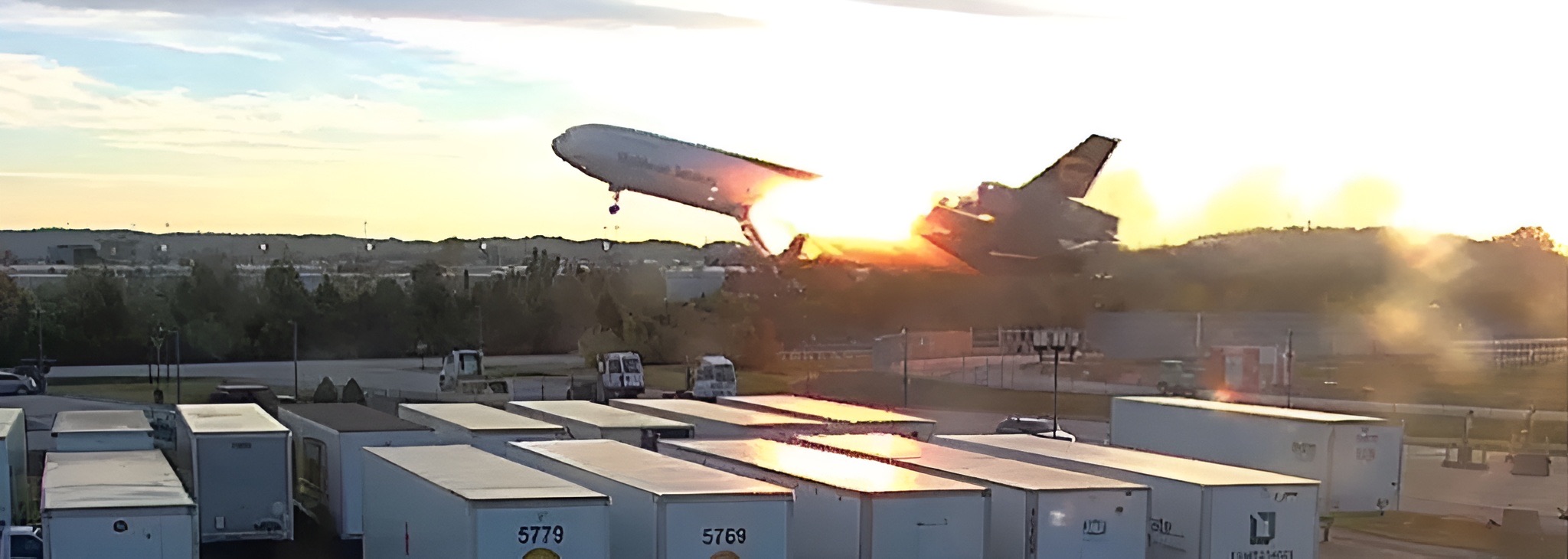
The first federal findings into the 4 November crash of United Parcel Service (UPS) Flight 2976, a Boeing (McDonnell-Douglas) MD-11F, strip away much of the early confusion that often surrounds a major air disaster.
What emerges from the Aviation Investigation Preliminary Report is both brutally simple and deeply alarming: the aircraft began breaking apart almost the moment it left the ground.
The MD-11F climbed for only a few seconds before its left engine tore free, fire trailing aft along the wing as the trijet staggered beyond the runway. It crashed moments later into an industrial area south of Louisville airport, leaving a debris trail nearly half a mile long.
The NTSB’s preliminary report, based on evidence gathered after investigators reached the scene on 5 November, now lays out the first coherent reconstruction of those last moments and the structural failures that preceded them.
How UPS Flight 2976 broke apart seconds after takeoff
UPS Flight 2976 was cleared for departure from runway 17R at 1711 local time. The taxi, take-off roll and rotation all appeared normal, and the aircraft lifted off in the way its experienced crew had done countless times before.
Airport surveillance cameras captured the moment the left engine and its pylon separated from the wing. The entire assembly rose upward, trailing fire, arced briefly above the fuselage, then fell to the ground.
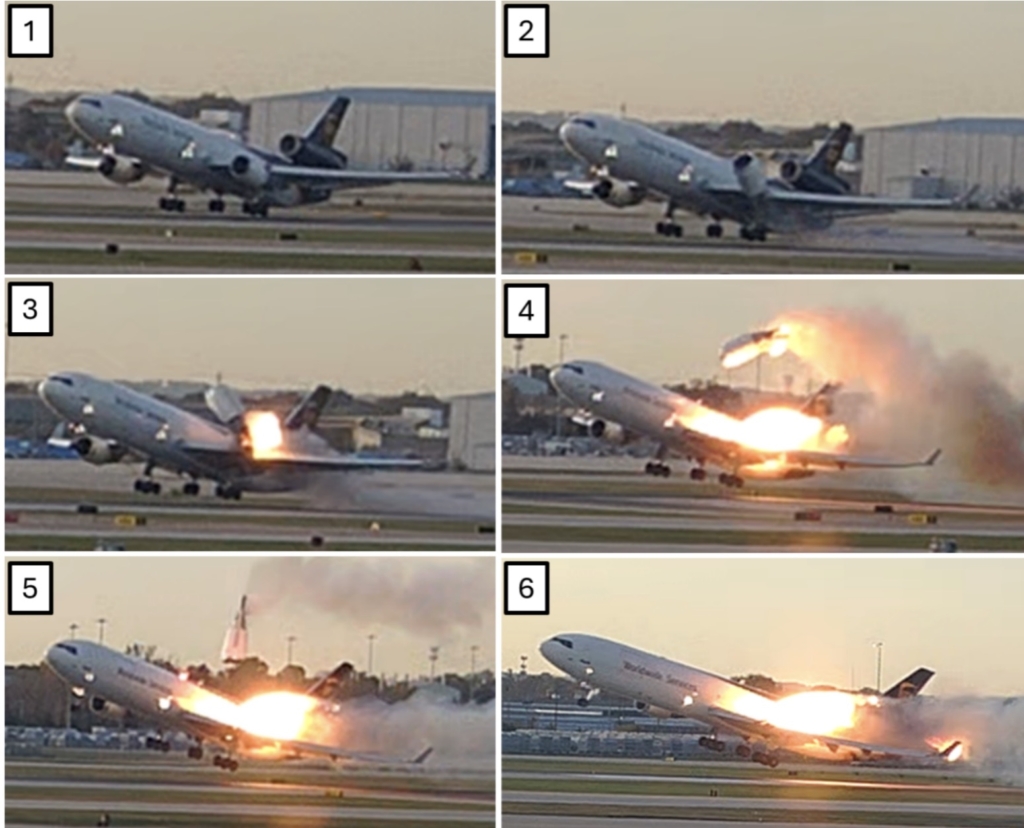
Flames immediately appeared where the pylon’s forward mounts had been carrying load. Flight-data recordings show the jet reached only about 30 feet above ground level, far lower than early assumptions. ADS-B data gave a final transmitted height of 100 feet AGL, confirming that the aircraft never achieved a stable climb.
Still, it cleared the blast fence at the runway’s end, a fleeting hint of hope for air traffic controllers. But with asymmetric thrust and growing drag, the aircraft could not sustain flight.
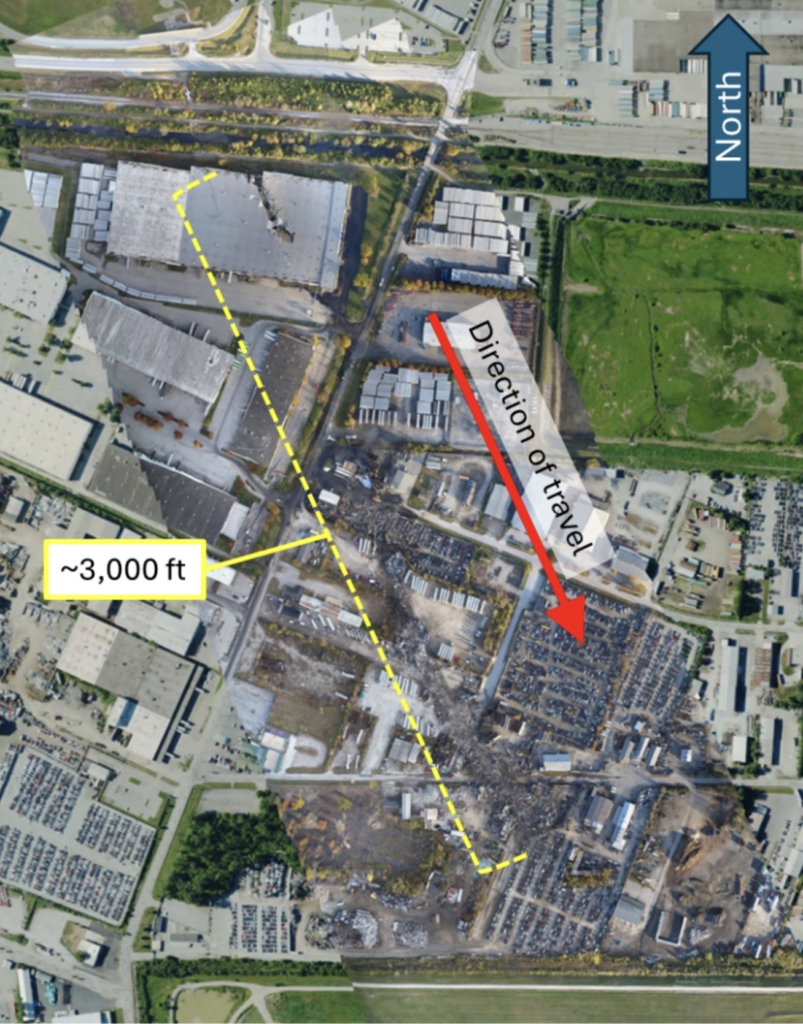
The left main landing gear clipped the roof of a UPS warehouse, marking the start of a debris field almost 3,000 feet long. The jet then tore through a storage yard and two more buildings, including a petroleum recycling facility, before a massive fire consumed most of the wreckage.
Surveillance and flight data reveal a climb that never stabilised
Controllers reported normal take-off speed but immediately sensed something wrong with the climb profile. The aircraft never rose above the tower’s height and appeared to hang level before descending.
Another witness said it stopped climbing altogether, banked slightly left and began to sink. All of this is consistent with an MD-11 losing an outboard engine seconds into flight at a height too low for recovery.
The flight deck carried a captain, first officer and relief officer, all with deep MD-11 experience:
- Captain: 8,613 total hours, 4,918 on type
- First Officer: 9,200 hours, 994 on type
- Relief Officer: 15,250 hours, 8,775 on type
Their experience rules out inexperience as a factor. Both the CVR and FDR were recovered and readable, capturing the entire flight from pushback to impact. The last FDR data point showed that the crash occurred less than a minute after becoming airborne.
What metallurgical evidence shows about the MD-11 engine mount failure
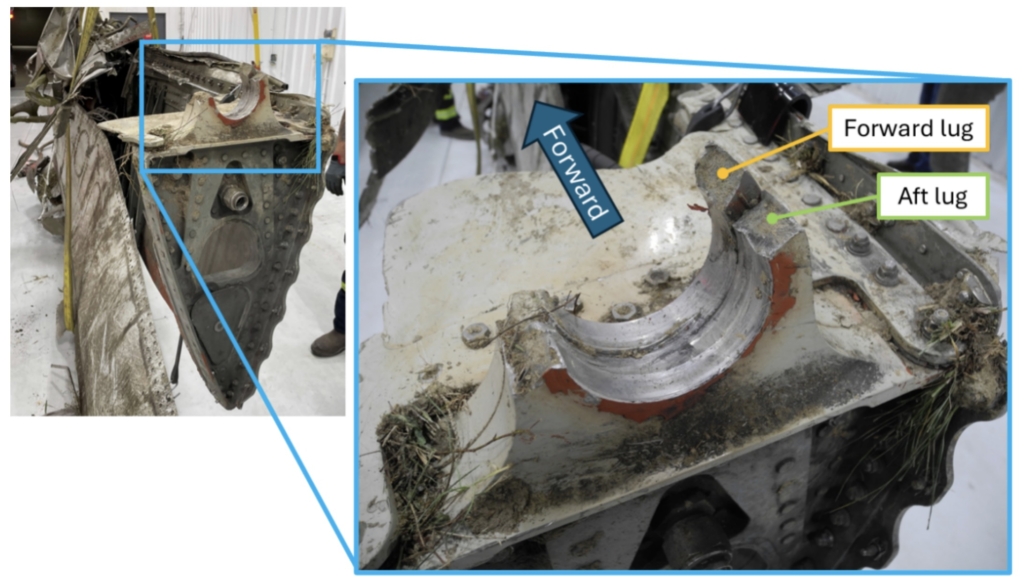
Early metallurgical findings are stark. The MD-11 mounts its engines beneath the wings via pylons tied into the wing through a forward mount, thrust link and aft mount. It was the aft mount that failed in flight.
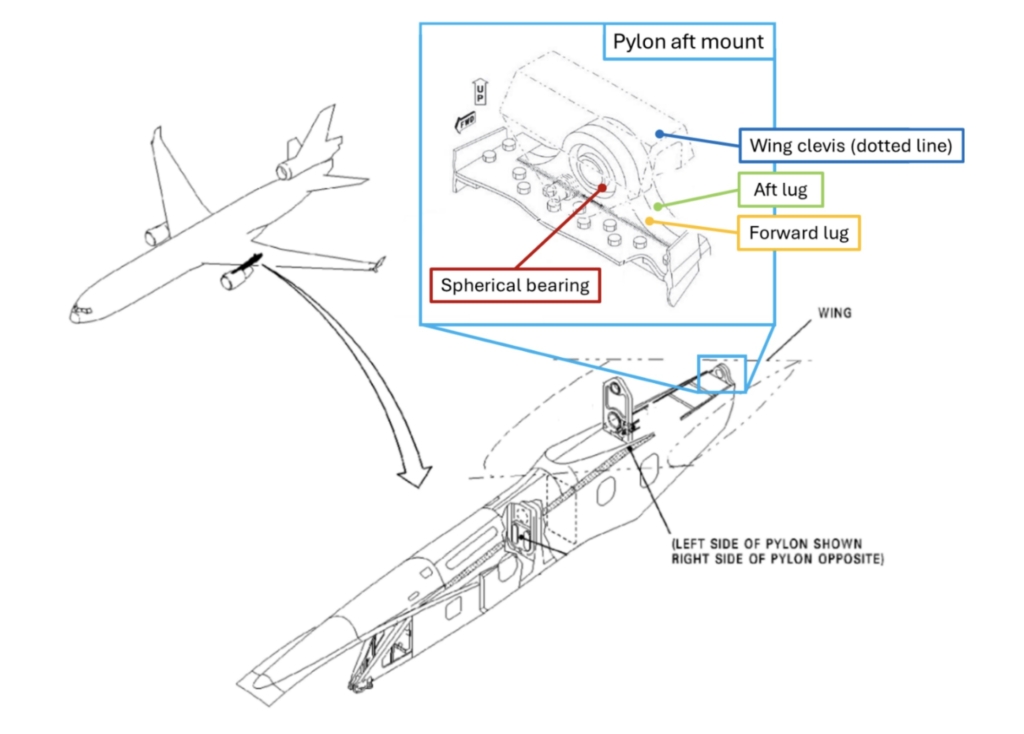
Investigators found:
- Both forward and aft lugs of the left pylon’s aft mount had fractured
- The spherical bearing’s outer race had sheared away
- Multiple fatigue cracks around the lug bores
- Additional overstress fractures mark the final break
In short, fatigue cracks had been growing inside the mount. Under heavy take-off loading, the weakened structure could no longer hold the engine.
The right engine’s mounts also fractured—but only on ground impact, not in flight.
Maintenance records show UPS MD-11 was compliant but cracks went undetected
The aircraft, N259UP, had accumulated 92,992 hours and 21,043 cycles. Records show:
- A detailed inspection of the left pylon aft mount in October 2021
- Lubrication of thrust links and spherical bearings in October 2025
- Two special detailed inspections linked to cycle thresholds had not yet come due
The critical inspection that might have revealed the cracks was still thousands of cycles away.
The NTSB notes the parallels with the 1979 crash of American 191, a DC-10 that lost its left engine and pylon on take-off from Chicago O’Hare. The MD-11 shares structural lineage with the DC-10, and although the failure mechanisms differ, the similarities are striking.
Groundings expand as FAA responds to MD-11 and DC-10 structural risks
The findings were serious enough that:
- UPS grounded its MD-11 fleet on 7 November
- The FAA issued an emergency airworthiness directive grounding all MD-11/MD-11F aircraft
- A second directive expanded the grounding to include DC-10 series aircraft
With only around 70 MD-11s still flying, mostly in freight service, the impact is concentrated on UPS, FedEx and Western Global. Operators have shifted cargo onto 747s, 767s and other fleets.
| Category | Details |
|---|---|
| Aircraft and Operator Information | |
| Aircraft make | McDonnell Douglas |
| Model / series | MD-11F |
| Registration | N259UP |
| Aircraft category | Airplane |
| Engines | GE CF-6 series |
| Operator | United Parcel Service Co (UPS) |
| Operating certificate | Flag carrier (Part 121) |
| Wreckage and Impact Information | |
| Aircraft damage | Destroyed |
| In-flight fire | Yes — both in-flight and on-ground |
| Aircraft explosion | None |
| Crew injuries | 3 fatal |
| Ground injuries | 11 fatal, 2 serious, 21 minor |
| Total injuries | 14 fatal, 2 serious, 21 minor |
| Impact location | Louisville, KY — 38.14718°, -85.734333° |
The crash killed 14 people—three UPS crew members and eleven people on the ground. Fires destroyed warehouses, a recycling facility and nearby structures, injuring 23. Louisville’s mayor called the aftermath “unlike anything the city has seen in decades”.
The preliminary report stops short of identifying the cause. For families, crews, operators and regulators, the next update cannot come soon enough.
Featured image: NTSB