Boeing–Saab–BAE team up to offer T-7 as successor to RAF Hawk and future Red Arrows platform

November 19, 2025

Boeing, Saab and BAE Systems have formalised a joint bid for the UK RAF’s future fast-jet trainer programme, signing a Letter of Intent that places the T-7 Red Hawk at the centre of their proposal.
The agreement, announced at Dubai Airshow as industry attention intensifies around the RAF’s looming Hawk replacement, brings together the aircraft’s original developers with Britain’s largest defence contractor in a coordinated effort to shape the next generation of pilot training.
Stay up to date with all the news from Dubai Airshow with AGN
A coordinated push for the T-7 as the RAF faces a ticking clock on Hawk retirement
The UK’s 2025 Strategic Defence Review confirmed what had long been expected: the RAF needs a new Advanced Jet Trainer to succeed the Hawk T2 fleet, which has suffered persistent availability issues and is due to retire in the next decade.
The older Hawk T1s, now largely flown by the Red Arrows, are expected to leave service around 2030.

A competitive process for a successor is imminent, attracting interest from established trainer manufacturers and newer entrants seeking a foothold in a growing global market.
Into this field comes the T-7, developed by Boeing and Saab for the US Air Force and now being tailored for international customers. By partnering with BAE Systems—the long-time steward of the Hawk and a central player in UK aerospace—the team presents itself as a serious contender well ahead of the competition formally opening.
A partnership built around a UK-assembled T-7
Under the proposal, BAE Systems would lead the UK effort, including establishing a British final-assembly line for the aircraft.
The partners say this approach would support domestic jobs, widen the UK supplier base and deliver a training system that blends a modern jet with an expanded mix of live flying and synthetic environments.
The vision is not only to meet RAF requirements but to field an export-ready platform appealing to traditional BAE customers, including those in the Gulf.

Simon Barnes, head of BAE’s Air business, said the collaboration enables the partners to present a unified, future-focused training solution. Saab’s aeronautics chief, Lars Tossman, described the T-7 as a logical successor to the Hawk, reflecting the longstanding Boeing–Saab partnership that shaped the jet’s development.
Why the RAF market is drawing global competitors
The RAF requirement comes at a time when global demand for trainer aircraft is rising. Analysts forecast the advanced trainer market to grow from just under USD 3 billion today to more than USD 3.7 billion by the end of the decade, excluding support and training systems.
Likely contenders include the Korean Aerospace Industries T-50, Leonardo’s M-346 and the Turkish Aerospace Hurjet. In the UK, start-up Aeralis is promoting a modular clean-sheet design, backed by RAF research funding but still at an early stage.
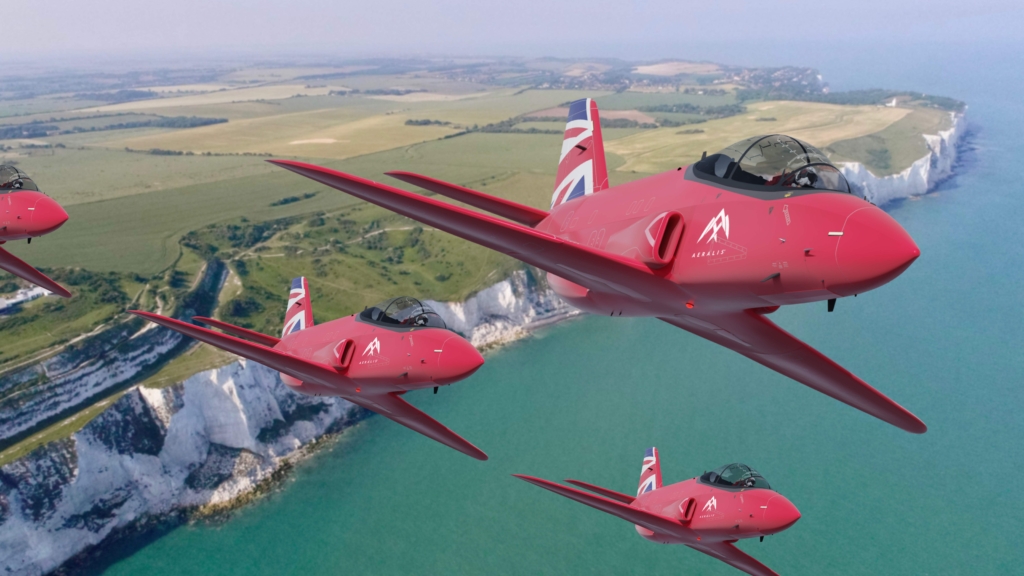
Operational pressures are sharpening the competition. Issues with the Hawk T2’s Adour engine have reduced availability, forcing the UK to buy training slots overseas in recent years.
The RAF’s training pipeline, which already blends contractor-delivered phases, synthetic instruction and international partnerships, is widely acknowledged to need modernisation.
T-7 progress and challenges in the US offer context for the UK bid
The T-7A Red Hawk was selected by the US Air Force in 2018 as its next advanced trainer and is edging closer to operational delivery.
Boeing executives said on the eve of the Dubai Airshow that the first aircraft is expected to reach Randolph Air Force Base in December, with ground-based training systems already installed. Flight-test activity at Edwards AFB has reached more than three-quarters of planned test points, including high-angle-of-attack work.
The programme has faced setbacks. Issues with the ejection seat and environmental testing triggered delays and programme adjustments, pushing full operational service entry to 2027. Both Boeing and the US Air Force say the concerns have been addressed, and flight-test results remain positive.

The aircraft has been designed with maintainability in mind, using accessible panels and simplified avionics bays to reduce downtime and boost training throughput.
US orders remain the priority, with 350 aircraft on contract, but international interest is growing. Boeing sees strong potential demand from air forces operating F-15s, F-16s or F-35s, particularly across the Middle East, Europe and Asia.
A training system built for new generations of combat aircraft
The T-7 proposition for the RAF focuses as much on its training architecture as on the aircraft itself.
The system integrates live flying with virtual and constructive elements, mirroring the complex mission environments pilots will face as they graduate to Typhoon, F-35 and eventually Tempest.
This blended approach is becoming central to modern fast-jet training, enabling higher-end scenarios to be practised without the cost of deploying live assets.

The partners argue that this approach makes the T-7 a future-proof platform, built to support evolving software, mission systems and synthetic upgrades.
With RAF flying training split across multiple phases—from basic instruction through to advanced jet training at RAF Valley—the proposed T-7 system aims to smooth bottlenecks and create a more efficient pathway to frontline aircraft.
A bid that sets the tone ahead of a major UK decision
The UK’s procurement timeline remains unclear and funding has yet to be allocated. But the Letter of Intent marks the first major public step in what is likely to be a closely contested and strategically significant competition.
With Hawk production long ended and the RAF’s need for a successor becoming more urgent, BAE’s decision to partner on the T-7 underscores its determination to remain central to the UK’s fast-jet trainer ecosystem.
Featured image: Saab