


Why does the F-35 have a flap on top?

3 min read
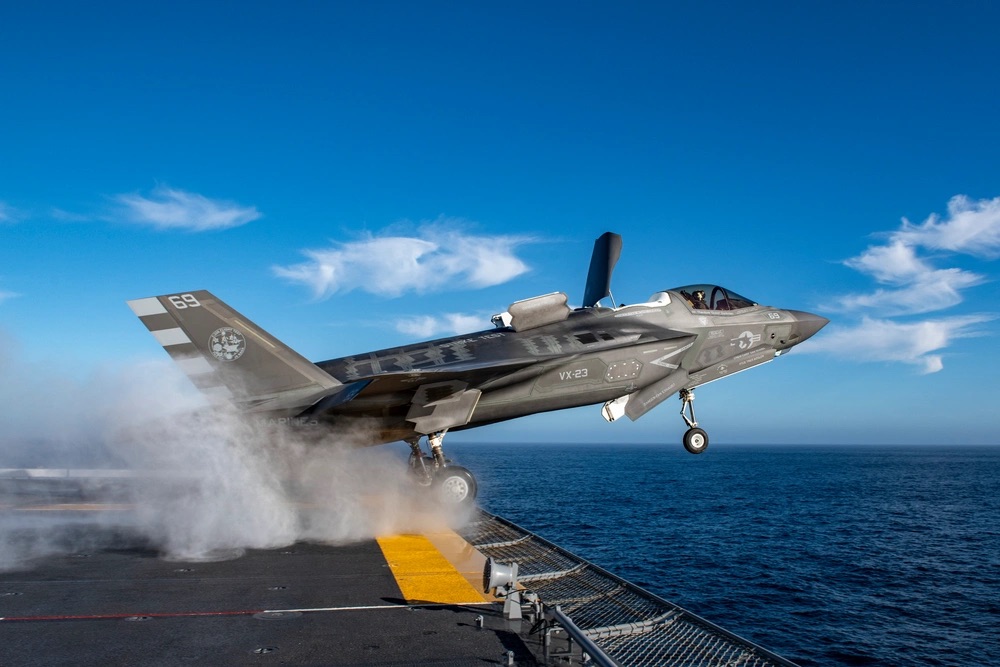
If you’ve ever spotted an F-35 with what looks like a hinged panel popped open just behind the cockpit, you’re probably looking at the short take-off and vertical landing variant. And that “flap” is the reason it can do something no other Western supersonic stealth fighter can: hover.
The feature belongs exclusively to the Lockheed Martin F-35B Lightning II, the STOVL version operated by the Royal Navy, the United States Marine Corps and others.
Unlike the conventional Lockheed Martin F-35A Lightning II or the carrier-optimised Lockheed Martin F-35C Lightning II, the B-model is designed to launch from short decks and land vertically at sea or on austere forward bases.
The F-35’s ‘flap’ is actually a door
Although it looks like a flap, what you’re seeing is actually a strategically designed door, known as the “upper lift fan door”.
Behind the cockpit sits a large, vertically mounted lift fan. In normal forward flight, the fan is disengaged and sealed within the fuselage. Everything sits flush to preserve the jet’s low observable profile.
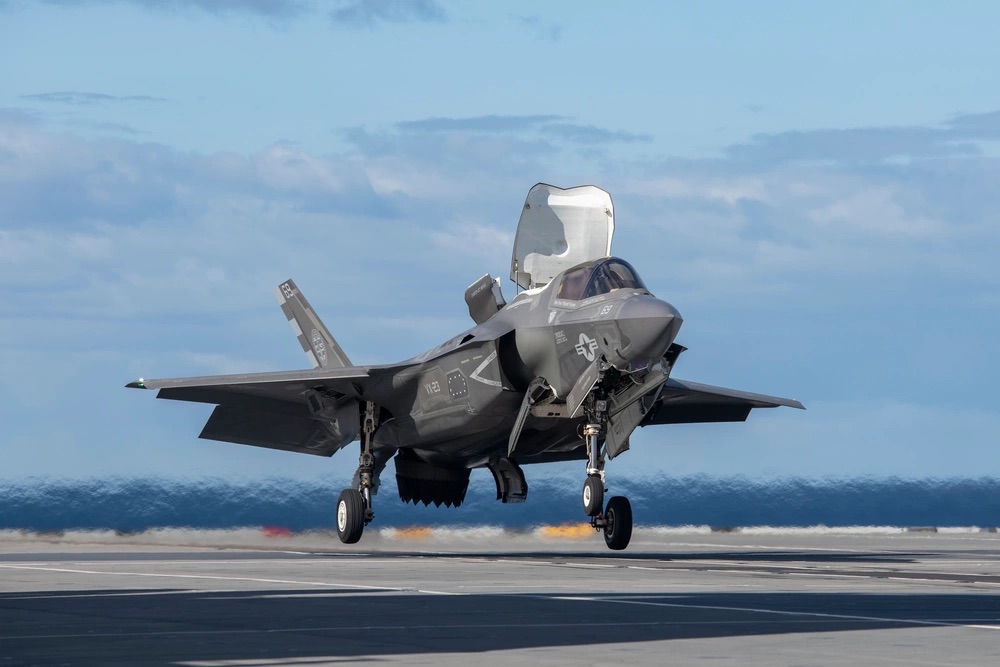
When the pilot selects STOVL mode, however, a clutch connects the lift fan to the main engine via a drive shaft. The upper door opens, allowing air to be drawn in from above the fuselage. The fan then forces that air downward through a nozzle underneath the aircraft, generating vertical lift.
In simple terms, if that door didn’t open, the lift fan would starve of air. No airflow, no vertical thrust. And no hovering.
How the F-35B hovers
The lift fan is only one part of a carefully balanced system.
When in STOVL mode:
- The rear exhaust nozzle rotates downward to vector engine thrust
- The lift fan provides cool vertical thrust at the front
- Roll control nozzles in the wings stabilise the aircraft
Together, these create a four-point lift system. The result is a stable hover, a vertical landing, or a rolling short take-off from a carrier deck.
The F-35B effectively replaced the Harrier as the West’s only operational supersonic jet capable of vertical flight. But unlike the Harrier, the F-35B combines that ability with fifth-generation stealth and sensor fusion.
Why is the F-35’s door ‘flap’ on the top?
Positioning the intake on the upper fuselage isn’t accidental.
To hover safely, the lift fan needs large volumes of relatively undisturbed air. Airflow over the top of the fuselage is smoother and less contaminated than airflow underneath, especially during vertical landings.
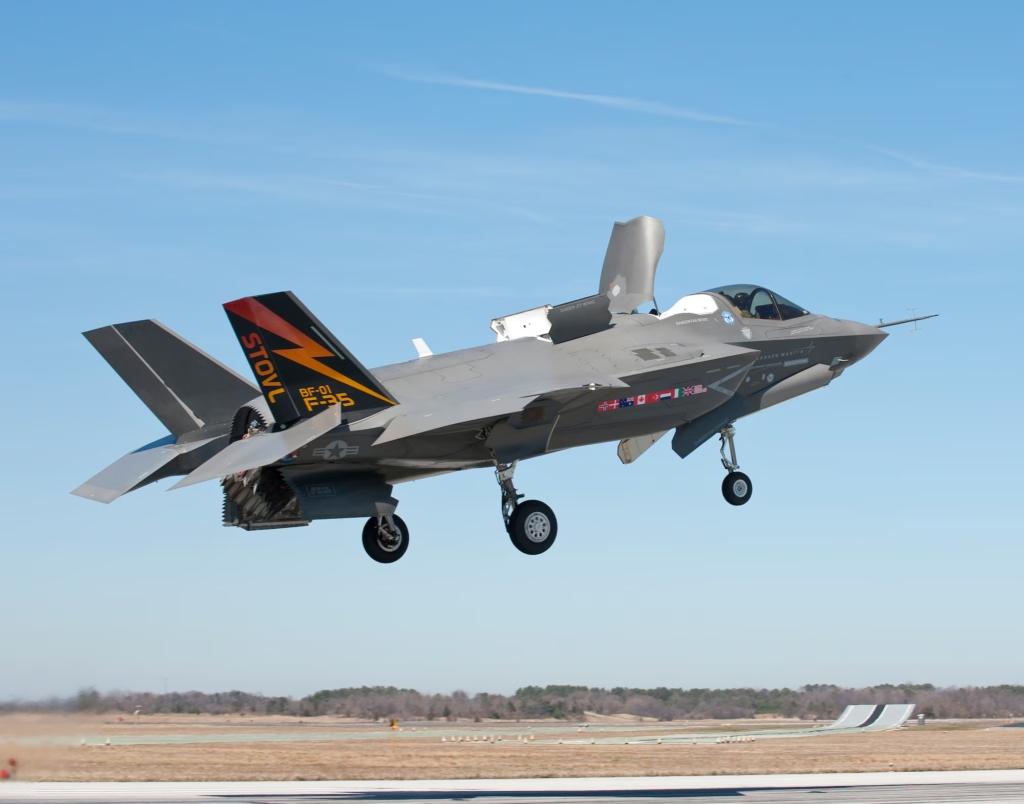
If the aircraft were to ingest hot exhaust gases from below, performance would degrade rapidly. Drawing air from above reduces the risk of hot gas recirculation and improves efficiency.
There’s also a balance consideration. The lift fan sits close to the aircraft’s centre of gravity, directly behind the cockpit, helping maintain stability during vertical operations.
Not all F-35s have a flap
Only the F-35B carries the lift fan system and its distinctive upper door.
The F-35A and F-35C variants are built purely for conventional take-off and landing or catapult launches and arrested recoveries. Without the need to hover, they don’t require a lift fan or the structural compromises that come with it.
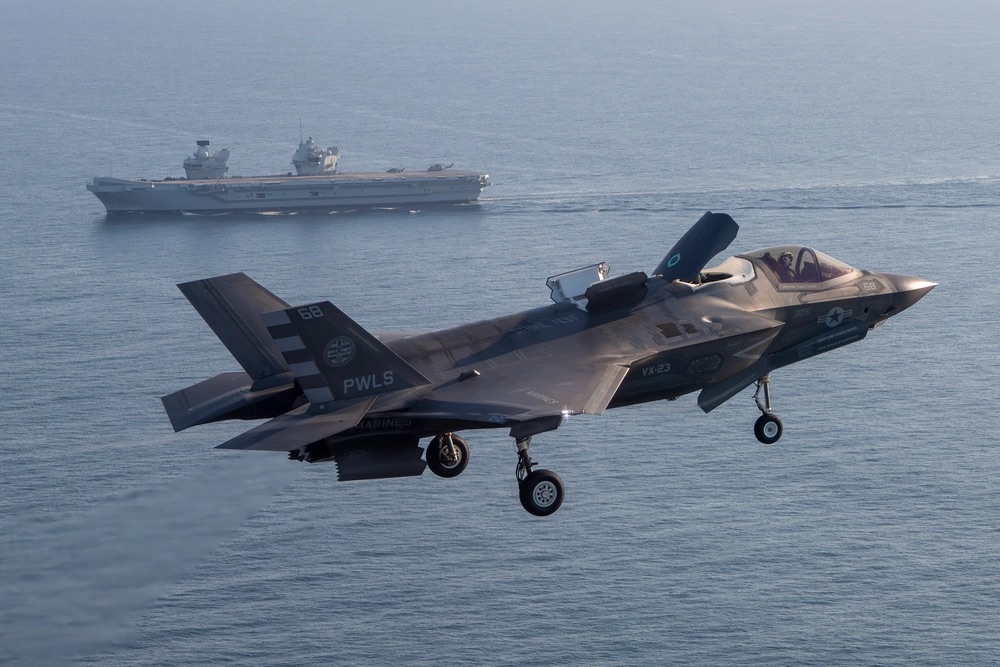
That’s why, if you see an F-35 with a panel open behind the cockpit, you instantly know you’re looking at the STOVL version.
F-35B: Preserving stealth with STOVL
Cutting a large opening into the top of a stealth fighter does seem a bit counterintuitive. After all, it looks so streamlined with every seam, hinge and panel generally designed for speed, performance and aesthetics.
The key is that the lift fan doors only open during take-off and landing, phases when stealth is far less critical. In forward flight, the doors close flush with the fuselage, preserving the aircraft’s low-observable shaping.
It’s a calculated trade-off: a little added weight and complexity in exchange for operational flexibility that no other Western stealth jet can match.
Featured image: DVIDS
Sign up for our newsletter and get our latest content in your inbox.


More from

September 27, 20263 min read

September 26, 20263 min read


September 25, 20264 min read


September 25, 20264 min read

September 24, 20262 min read


