Shield AI unveils X-BAT autonomous fighter jet with VTOL capability

4 min read

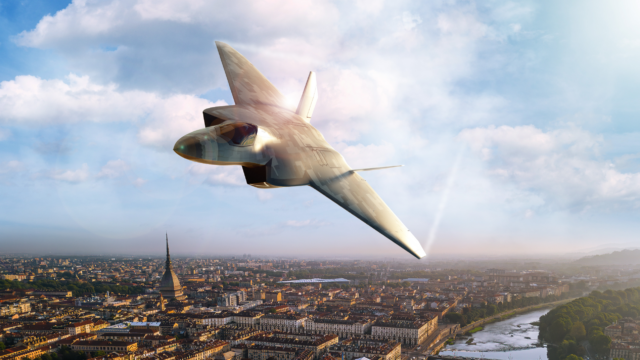
Shield AI has unveiled its ambitious new X-BAT concept for an autonomous vertical takeoff and landing fighter jet. It claims the aircraft offers the “greatest transformation in military aviation” since the first defence aircraft 115 years ago.
The X-BAT: An ‘autonomous fighter jet’
Shield AI is joining the rapidly growing chorus of contractors offering autonomous combat aircraft solutions for the United States Air Force with a twist.

Shield AI is billing its new X-BAT as a stealthy jet-powered ‘autonomous fighter’ jet. The company says it is completely “reimagining airpower – from training and logistics to operations and operating costs.” X-BAT builds on Shield AI’s existing combat-proven, but much less capable V-BAT drone.
In an interview with The War Zone, Shield AI’s Armor Harris, Senior Vice President, claimed the aircraft “basically brings the capability of something like an F-35,” adding that it can take off and land vertically at a tenth of the cost.
The aircraft is claimed to have some pretty impressive statistics, which could make it an attractive proposition for forces seeking collaborative combat aircraft. These include:
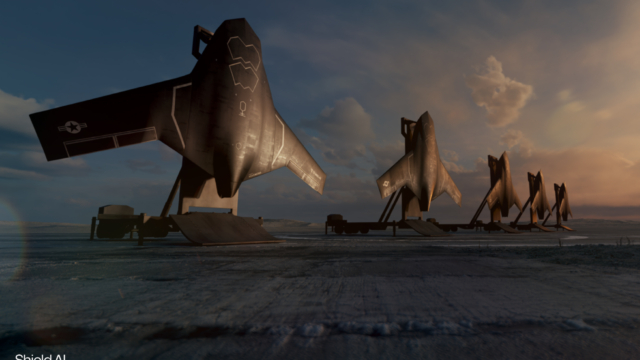
- Vertical takeoff: Can lift like a rocket from airfields, carrier decks or even from a truck
- 2,000 nmi range: Around 800 miles further than an F-35, making it possible to conduct long return trips, island hops and extended missions without tanker support
- Compact footprint: The company says up to three X-BATs fit in the space of one fighter jet or helicopter
- Affordable: Without naming a price, Shield AI says the X-BAT will be an ‘order of magnitude’ lower to acquire and operate than 5th-generation fighter jets
- Multirole: Like a good fighter jet, the X-BAT is designed for multirole operations, from ISR to strike to EW and intelligence
The X-BAT’s real kicker comes in the form of its complete autonomy. powered by Shield’s proprietary Hivemind AI technology. The platform has been successfully tested on multiple aircraft, including the F-16, and is designed to operate in denied, degraded, and communications-limited conditions.
“X-BAT is a revolution in airpower because it combines four things – VTOL, range, multirole capability, and autonomy,” said Harris. “VTOL plus range solves survivability on the ground and dependency on tankers. Multirole provides critical flexibility as the threat evolves, because no plan survives first contact with the enemy. X-BAT’s ability to autonomously operate standalone or collaboratively allows it to project power when other assets aren’t around and simplifies kill chains.”
The company says that the first X-BAT is under development and engine testing. The first VTOL flights are scheduled for 2026 with plans to achieve production by 2029.
Vertical takeoff could be a game-changer
In a future peer-on-peer war with China, forward US airfields are seen as vulnerable and may not be tenable. Increasingly, the Air Force is looking for runway-independent solutions, including smaller S/VTOL tactical transport options. Beta Technologies is another company to recently announce a runway-independent cargo solution to get supplies into contested environments.

Shield AI’s X-BAT caters to the requirement, being designed to take off and land vertically from a truck trailer-mounted rail system. This is a big deal. On the ground, all US fighter jets are sitting ducks, with wargames repeatedly showing that most US aircraft losses to China are on the ground.
To counter the US’s advantage in the air, China has focused on ways to destroy F-35s and other jets on the ground. If they do get airborne, China has developed systems like the J-20 to hunt down vulnerable enablers like tankers. Without tankers, fighter jets are incredibly limited in range.
Earth is our runway.
— Shield AI (@shieldaitech) October 21, 2025
Introducing X-BAT, the world’s first AI-piloted VTOL fighter jet. With vertical takeoff and landing, long range, and full autonomy, X-BAT delivers combat power anywhere, anytime. This is the future of airpower.
Watch the video: https://t.co/K4abUZa23z… pic.twitter.com/AnELEPOfLV
If realised as marketed, the X-BAT has potential for a major impact. The aim is to have the flexibility to launch and recover the aircraft from ships (from aircraft carriers to cargo ships), remote islands, and austere forward bases. It would eliminate much of the need for traditional infrastructure.
The X-BAT: Much more than a drone
The X-BAT is being designed with a 20-year lifespan; it is not intended as a disposable asset.
Shield AI claims it is the first weapon system that is ground-up designed around aerial autonomy. This is in contrast to the CCA’s that are designed to be tied to manned fighter jets.

This is no small drone. It has a wingspan of 39 feet, a range of over 2,000 nautical miles, a 50,000-foot ceiling, and a storage compartment of 40 by 14 by 6 feet.
Still, there are many hurdles to overcome for autonomous fighters to completely replace manned fighters. No AI model can match the decision-making capabilities of a human pilot in real-life, chaotic combat scenarios.
As the recent Israeli and US bombing of Iran highlighted, conventional fighter jets are also designed to haul heavy ordinance that smaller autonomous aircraft cannot match.
Featured Image: Shield AI